| Business leaders plotting ways to bring their employees safely back while awaiting Covid vaccines might turn to Mercury Systems for guidance. The supplier of electronic systems for the aerospace and defense industries used measures including air filtration and expanded sick leave to prevent workplace transmission of the coronavirus even as the pandemic surged in the community, according to a study published Monday. "This company never closed down, but employed these mitigation measures from the beginning and had great results in that very few illnesses from Covid-19 occurred across a large workforce," said study co-author Monica Gandhi, a professor of medicine at the University of California, San Francisco. 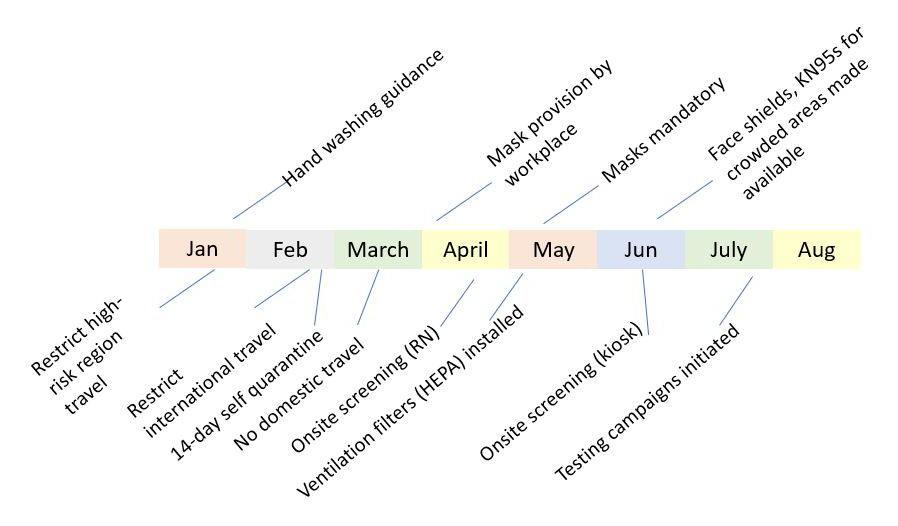 Timeline of Covid-19 mitigation actions taken by Mercury Systems. Source: Mercury Systems Mercury began restricting international and domestic travel in late February 2020. By mid-March, Mercury issued a mandatory work-from-home policy to more than half its employees. The directive excepted staff needed at factories in Arizona, California and New Hampshire. Sick-leave allowances and overtime pay were increased. Periods of isolation and quarantine for those with Covid-19 or exposed to cases were fully paid. Mercury upgraded facilities with one-way walking paths, no-touch hardware in restrooms and on doors, filtered air, and plexiglass shields between workspaces. It encouraged, distributed and eventually required masks. Of 586 employees, 44 had a positive test for SARS-CoV-2. Of 105 individuals with positive or inconclusive tests, 99% were asymptomatic at the time of testing. Positivity rates were consistent with community prevalence at the time, the researchers said. Routine testing wasn't necessary to prevent Covid-19 "as masking and distancing served as adequate non-pharmaceutical interventions to prevent illness," Gandhi said.—Jason Gale | 


Post a Comment