| Powell pushes back on inflation signs. Hedge funds dump Alibaba. Goldman CEO warns remote work is not the new normal. Here are some of the things people in markets are talking about today. Federal Reserve Chair Jerome Powell emphasized that the U.S. economy has a long way to go and signs of prices rising won't necessarily lead to persistently high inflation. "Our policy is accommodative because unemployment is high and the labor market is far from maximum employment," he told the House Financial Services Committee. Powell pointed to examples like car prices rising because of a chip shortage, and supply-chain constraints in the tech industry. Meanwhile, the $9 trillion rescue mission by central banks to improve the global economy is being tested as rising bond yields and inflation bets threaten their ability to keep borrowing costs down. Asian stocks looked set to rise after U.S. equities reversed losses on encouraging vaccine news and Powell's soothing comments on inflation. Futures pointed higher in Japan, Australia and Hong Kong. Energy and industrial stocks led gains in the S&P 500 Index, offsetting weakness in tech shares. Elsewhere, the 10-year Treasury yield surged as much as ten basis points to its highest level in a year before pulling back. The dollar weakened against its major peers, commodity currencies advanced and crude oil jumped to the highest in more than a year. Investors from hedge fund titans and Canadian and U.S. pension funds dumped 101 million of Alibaba's American depositary receipts in the fourth quarter, cutting the market value of their holdings by $89 billion. It was the biggest investment reduction among U.S. traded companies. Alibaba's shares, which are traded on the NYSE, have slumped about 18% since November, when regulators in Beijing halted the $35 billion IPO of Alibaba's affiliate Ant Group at the last minute. Government watchdogs have ordered Ant to overhaul its business and began an antitrust investigation of Alibaba. The company could face penalties of as much as 10% of its revenue if it's found to have violated rules. After sitting on the sidelines as the U.S. and Europe plowed headlong into vaccinating against Covid-19, Asia is finally starting to administer shots.
Hong Kong began its program Monday, with Beijing-based Sinovac's product. Japan, Australia and New Zealand are vaccinating priority groups with shots from Pfizer-BioNTech and AstraZeneca, while Malaysia kicked off its drive on Wednesday, South Korea is due to start Friday and Thailand a few days later. Meanwhile Qantas announced it aims to restart international travel in October, Johnson & Johnson's vaccine is safe and effective according to U.S. regulators, and Moderna is exploring how booster shots can beat virus variants. A flurry of buying that doubled GameStop shares Wednesday afternoon spread to a dozen other meme stocks at the center of last month's day trader-fueled boom and bust. GameStop jumped 104% for its biggest advance since Jan. 29, when Robinhood Markets restricted trading in it and 49 other stocks at the height of the frenzy. An equally weighted Bloomberg basket of those rose more than 5%, the most since late January. AMC Entertainment rallied 18% to push a three-day climb toward 59%. GameStop's boost was driven by CFO Jim Bell's ousting over a disagreement on strategy. What We've Been ReadingThis is what's caught our eye over the past 24 hours: And finally, here's what Cormac's interested in todayThe sudden jump in real yields and swings in bond markets are threatening to spill into equities as concern mounts about the implications of tighter financial conditions on global assets. A catch-all term incorporating a multitude of factors such as the cost of borrowing, access to liquidity and investor sentiment, monitoring financial conditions essentially boils down to judging whether we are in a risk-asset friendly easy money environment or not. A look at the little-changed gauges of financial conditions in both the U.S. and Europe from Bloomberg and Goldman Sachs — derived from a variety of factors from interest rates, foreign exchange, credit and equity markets — suggests we are still very much in easy money territory. 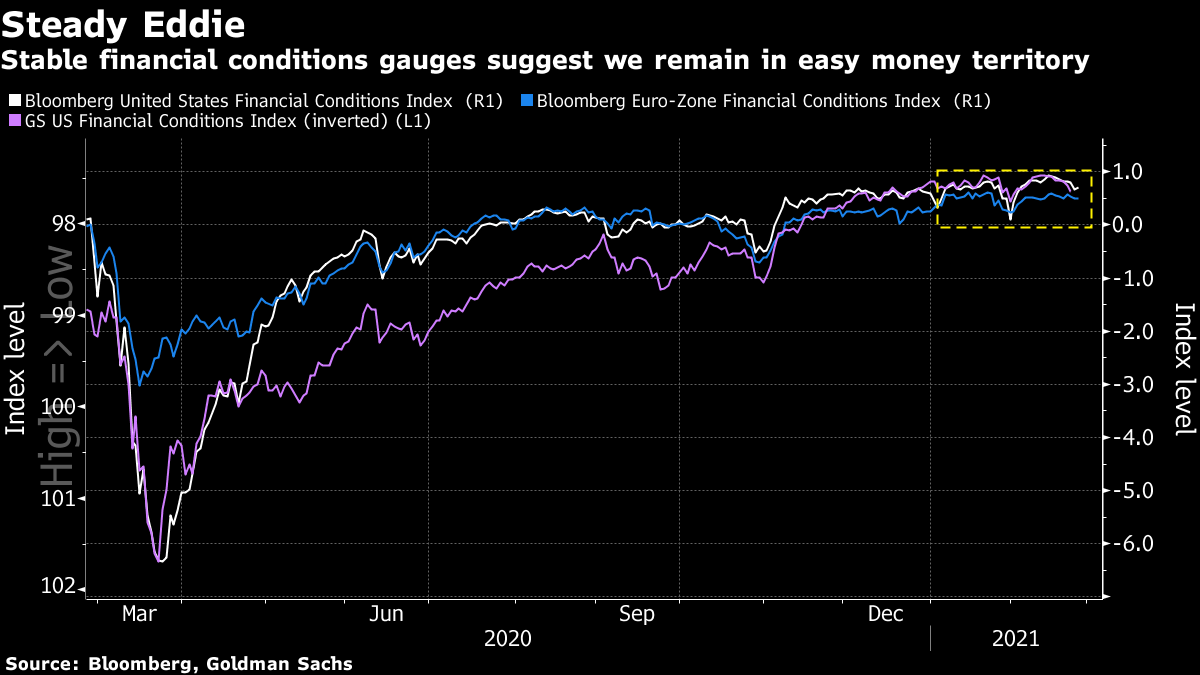 But even a modest tightening to a more neutral level would be enough to result in lower overall equity returns, according to UBS. That could come in the second quarter as inflation and growth enthusiasm peaks and would be marked by a bottoming in real rates and credit spreads, strategists including Bhanu Baweja wrote in a note this week. Tightening financial conditions would signal the end of the liquidity "tailwinds" that have been the biggest contributor to recent market gains, they said. Cormac Mullen is a Cross-Asset reporter and editor for Bloomberg News in Tokyo. | 


Post a Comment