| Welcome to the Brussels Edition, Bloomberg's daily briefing on what matters most in the heart of the European Union. EU leaders will likely agree today on continuing preparations for vaccination certificates, but not on their use. The bloc's tourism-dependent economies, which suffered the steepest contractions last year, are aghast at the lack of urgency by some of their peers and are determined to open their doors to people who have been inoculated. But others resist such moves, citing a lack of convincing evidence that those who get the jab won't still be contagious. In any case, leaders will unanimously declare today that lockdowns must continue and non-essential travel must remain restricted for the time being. Still, some will find themselves in the spotlight for going too far by essentially imposing blanket bans that disrupt the EU's single market. — Nikos Chrysoloras and John Ainger What's HappeningSupply Easing | Leaders will also likely be reassured by the Commission that vaccine supply issues will be resolved from next quarter, and pharma executives speaking to the EU Parliament this afternoon may say as much. But some countries are expected to protest the lack of predictability in deliveries and ask for steps to be taken to deal with potential production glitches in the future. Mutations Alarm | The main concern among leaders, as their draft communique suggests, is that mutations of the virus will require new vaccinations. The Commission is already making preparations for the quick approval, purchase and delivery of adapted shots, and governments will try to plot a strategy to avoid new lockdowns when these variants emerge. Slow Lane | Time is of the essence for the economy too. While the U.S. rushes toward a blockbuster stimulus package to accelerate its recovery, much of Europe is stuck in the slow lane. America is expected to reach pre-pandemic output levels in the second quarter, roughly a full year before the euro area. Swiss Opening | Switzerland is the latest to begin a phased reopening. Non-essential shops and museums will be accessible to citizens from next month — similar to here in Brussels — as will outdoor sporting facilities. Czech Republic's leader though is warning of "hellish days" ahead. Here's the latest on virus developments. New Heavyweight | With Angela Merkel set to step down after Germany's September vote and Emmanuel Macron gearing up for a tough election in France, Italy's Mario Draghi is stepping into the spotlight — participating today in his first EU summit as Italian prime minister. Read why senior officials believe he's uniquely positioned to drive change at home and in Brussels. In Case You Missed ItAstra's Efficacy | AstraZeneca's CEO will face MEPs later. Having barely moved on from the bitter public fight with the EU, a group of irate private-sector doctors in Italy is now appealing to the country's health ministry to avoid using the company's vaccine, believing it is less effective. Only the result of large-scale trials in the U.S. might clear things up — or make them even murkier. Extreme Weather | The EU is attempting to shore up its 14-trillion-euro economy against damage caused by climate change. Under an updated adaptation strategy that's part of the Green Deal, the Commission is calling for efforts such as better use of climate-risk data, smarter damage prevention and increased insurance coverage. Gig Economy | The Commission launched a consultation into the labor conditions of ride-hailing drivers, pizza couriers and others in the gig economy. It comes as countries mount a growing challenge to the likes of Uber, over the employment status of their drivers. Meanwhile, a Chinese ride-sharing giant is planning its entry into Europe. Monetary Problem | Bond markets are putting central banks under pressure to keep borrowing conditions easy in the face of a vaccine-driven economic recovery. ECB President Christine Lagarde said the institution is monitoring developments, but traders are testing its resolve. EU officials meanwhile are worried about zombies. Europe's Powerhouse | Germany's economy proved more resilient to the virus than expected at the end of 2020, though extended lockdowns and slow vaccine rollouts mean the start of 2021 still looks bleak. Merkel warned that Germany is in the midst of a third wave. Chart of the Day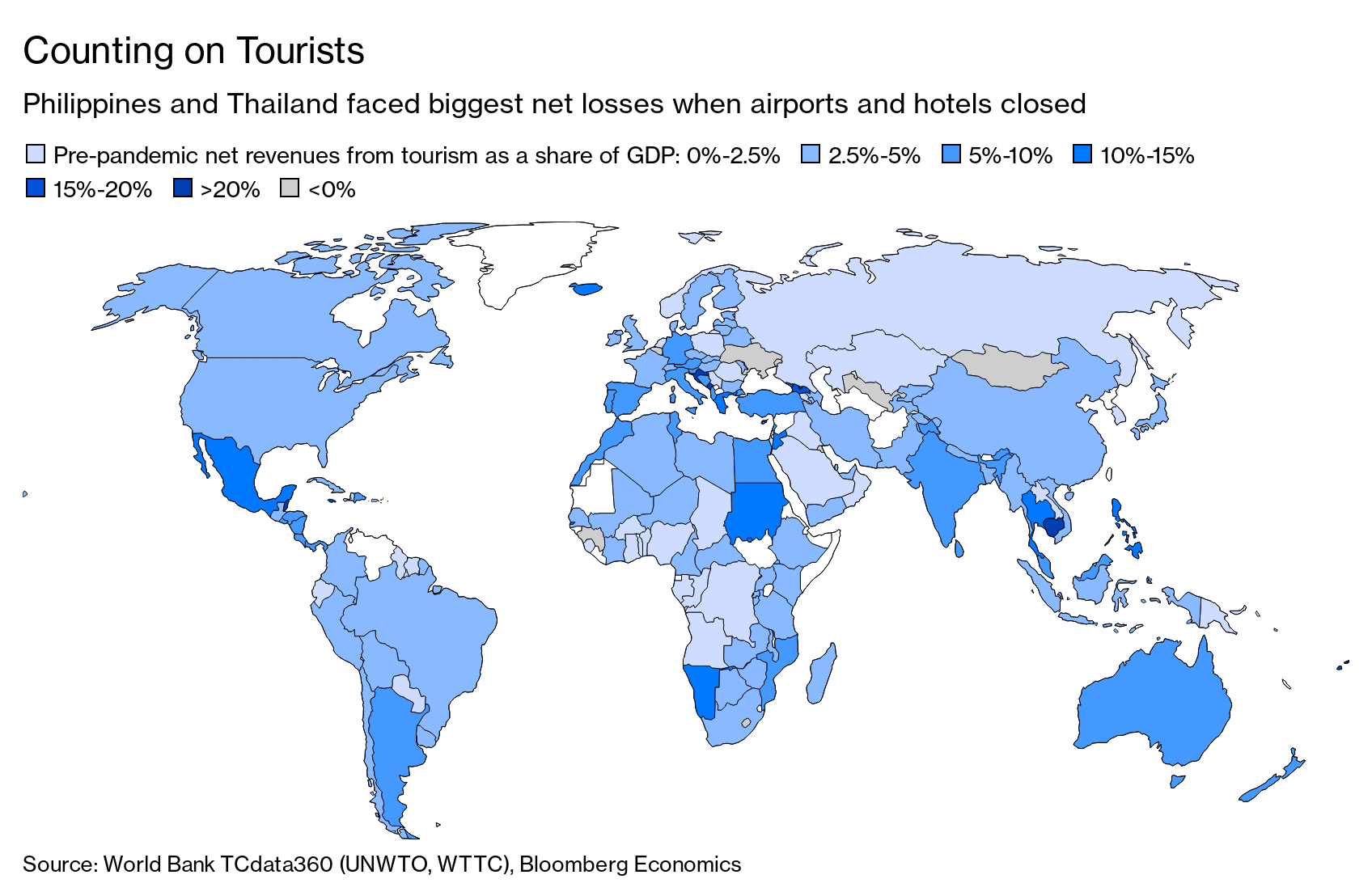 The Philippines, Thailand, Mexico, Spain and Italy faced the biggest net losses in the world when airports and hotels closed because of the coronavirus, according to calculations by Bloomberg Economics of the world's largest 40 economies. That means those countries can look forward to the biggest rebound when the Covid crisis finally ends. Still, it could take time before international travel fully recovers from the pandemic. Today's AgendaAll times CET. - 3 p.m. Special EU Summit via video conference, EU leaders to discuss Covid-19
- 3 p.m. Scott Rembrandt, deputy assistant secretary at the U.S Treasury, speaks at EPC event on combating illicit finance
- 4 p.m. EU Parliament hearing with CEOs of big pharmaceuticals on how to increase the capacity of Covid-19 vaccine production and improve delivery
- 4 p.m. Jon Cunliffe, deputy governor of the Bank of England, speaks at Bruegel event
- 5:30 p.m. Press conference following informal video conference of internal market and industry ministers
- EU antitrust chief Margrethe Vestager participates in and delivers a keynote speech via videoconference at the EU Industry Days
Like the Brussels Edition?Don't keep it to yourself. Colleagues and friends can sign up here. For even more: Subscribe to Bloomberg.com for unlimited access to trusted, data-driven journalism and gain expert analysis from exclusive subscriber-only newsletters. How are we doing? We want to hear what you think about this newsletter. Let our Brussels bureau chief know. | 


Yenişehir araç kiralama; Yenişehir bölgesinde dilediğiniz model ve marka araçları hızlıca bulabilme imkânına sahipsiniz. Adana araç kiralama
ReplyDeleteAncak her daim tarihi ve doğal güzelliklerin doyasına tadına varmak mümkün olmaz. Kıbrıs araç kiralama
ReplyDelete