Apple's $44 billion market in China is under threat. Tencent faces pressure from investors. And gold swings up again. Here are some of the things people in markets are talking about today. Apple's $44 billion China market is under threat after Donald Trump barred U.S. companies from doing business with WeChat, the super-app that has become integral to everyday life in the country. Scheduled to come into effect in roughly five weeks, the ban threatens to turn iPhones into expensive "electronic trash," said Hong Kong resident Kenny Ou. If Apple is forced to remove WeChat from its global app stores, iPhone annual shipments will decline 25% to 30%, TF International Securities analyst Kuo Ming-chi estimated in a research note. But demand isn't their only problem: Now, a key Apple supplier and a dozen other tech giants plans to split the supply chain between the Chinese market and the U.S., declaring that China's time as factory to the world is finished because of the trade war. Meanwhile, as U.S. and Chinese negotiators plan to discuss progress of their trade deal in the coming days, Beijing will be pushing to widen the agenda to include Washington's recent crackdown on businesses including TikTok and WeChat. Asian stocks looked set for gains Thursday after U.S. peers briefly surpassed their all-time closing high, led by surging technology shares. The dollar weakened and Treasury yields rose to five-week highs. Futures pointed higher in Japan, Hong Kong and Australia. The S&P 500 earlier climbed 1.4%, momentarily topping its February high, and capping the more than 50% rally since the market lows in March. The Nasdaq Composite outperformed as Apple, Microsoft and Tesla jumped. Treasury yields dropped from the session highs after the government's sale of $38 billion in 10-year notes attracted stronger-than-forecast demand. Gold steadied. Elsewhere, oil rose after data showed U.S. stockpiles fell over 4 million barrels last week and refiners boosted processing rates. In more blowback from the Trump ban on WeChat, Tencent tried to reassure investors that the order on its messaging service may apply only to its overseas operations, suggesting the impact on its overall business would be modest. During a conference call after earnings, executives repeatedly emphasized the distinction between WeChat, which is used outside China, and Weixin, a similar service within the country. Trump's executive order specifically mentioned banning the former. Tencent fielded question after question concerning the ban, which hammered the company's share price after it was announced last week. They came after Tencent boosted revenue at the fastest pace in two years and reported profit that beat the highest analyst estimate. Sales rose 29% to 114.9 billion yuan ($16.5 billion) in the three months ended June, while net income increased to 33.1 billion yuan. Investors in China's $9.5 trillion stock market are trying to pick winners from Xi's new economic mantra, "dual circulation". The idea behind the policy is to twin a build-up in domestic economic strength in face of intensifying external risks while maintaining China's deep engagement with the global supply chain. So what does that look like? "Policy makers likely envisage China's growth model in the future will be much less like Japan and Korea, but more like the U.S.," said Yi Xiong, chief China economist at Deutsche Bank in Hong Kong. "Preferences of domestic consumers will become more important than international ones in shaping companies' decisions." Defense, consumer and satellite stocks have all been outperforming lately. Gold rebounded Wednesday, extending a series of wild swings that saw the metal hit a record on Friday before plunging to below $1,900 an ounce. After surging about 30% this year, gold's rally came to a sudden halt Tuesday as U.S. bond yields rose, cutting into the negative real rates that had supported the metal. A measure of gold volatility over the past month jumped to the highest since April, as U.S. equities traded higher on Wednesday — with the S&P 500 edging toward a record — helping limit gains for bullion. Despite the erratic movements lately, gold is still one of the best-performing commodities of 2020. But the metal may take time to regain momentum with investors spooked by the rout, according to Commerzbank. What We've Been ReadingThis is what's caught our eye over the past 24 hours: And finally, here's what Tracy's interested in this morningIt was exactly one week ago that Goldman Sachs analysts warned that a successful Covid-19 vaccine could spark a sell-off in bonds and unwind the host of long duration trades that have crowded the market. Fast forward to today and the big news is the seesawing in gold prices as real yields rise and U.S. inflation expectations start to adjust upwards. The move seemed to start shortly after Russia's announcement that it had successfully developed a vaccine, and was reinforced by inflation data out of the U.S. including consumer prices coming in higher than expected on Wednesday. 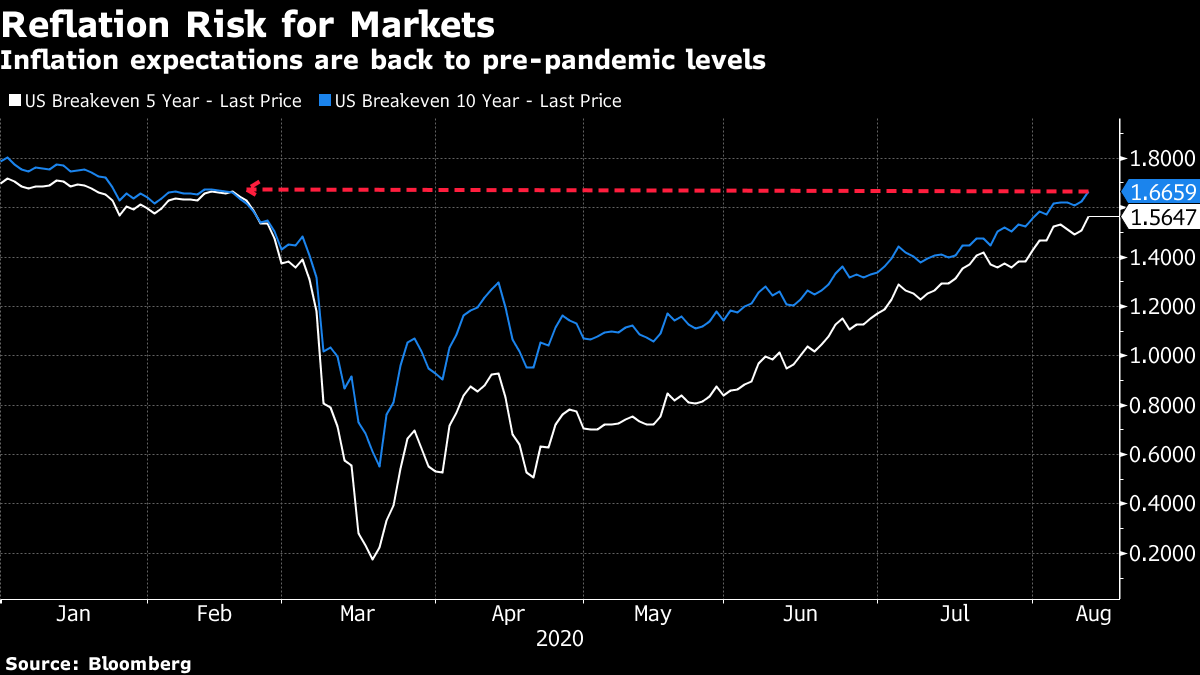 Of course, not all vaccines are created equal and one developed by Russia and tested on a relatively small sample size doesn't seem likely to be disseminated very widely or quickly. So it seems plausible that what we're seeing is just a preview of the reflation trade that could be sparked if a widely available vaccine were to be announced. Watch breakevens to see how quickly the market wants to get ahead of that development. You can follow Tracy Alloway on Twitter at @tracyalloway. | 


Post a Comment