| Donald Trump indicates that he doesn't want to further escalate tensions with Beijing. Deutsche Bank's new Asia CEO snubs Hong Kong. And the number of virus cases with unknown sources is steering government responses. Here are some of the things people in markets are talking about today. In contrast to his recent combative public tone, President Donald Trump has indicated to aides that he doesn't want to further escalate tensions with Beijing, and has ruled out additional sanctions on top officials for now, according to people familiar with the matter. Trump's private decision to refrain from further restrictions was made before signing the Hong Kong Autonomy Act on Tuesday. The new law calls for sanctions against "primary offenders" undermining Hong Kong's autonomy, but doesn't require the administration to act immediately. Trump's team had already created a list of Chinese officials, including Hong Kong Chief Executive Carrie Lam and Vice Premier Han Zheng, before Trump decided against the move, said two of the people. Still, the president can still decide to move forward with the penalties even if he doesn't do so now. Asian stocks were poised for a mixed start ahead of a slew of economic data in China that will provide clues on the path of economic recovery from the pandemic. U.S. equities earlier rose amid optimism about progress in developing a vaccine for the coronavirus. Futures were flat in Japan, while contracts edged up in Hong Kong and Australia. S&P 500 contracts edged higher after the index gained almost 1% on Wednesday, briefly drifting back into positive territory for the year. The dollar weakened and crude oil dipped, while Treasuries were little changed. The Federal Reserve said the economy showed signs of a nascent recovery at the beginning of July. Elsewhere, oil gained after a report pointed to a drop in U.S. crude stockpiles. Deutsche Bank's new Asia chief executive officer will be based in Singapore, having picked the city over Hong Kong at a volatile time for the Chinese territory. Alexander von zur Muehlen is relocating from Frankfurt when he takes over the job at the start of next month. His predecessor, Hong Kong-based Werner Steinmueller, is retiring at the end of July. Kamran Khan, the bank's new head of environmental, social and governance for the region, will also be based in Singapore, moving from the U.S. The decision comes as Hong Kong is embroiled in unprecedented political turbulence after more than a year of anti-government protests and now in the cross-hairs of a broader fight between U.S. and China. In an intense rivalry with Singapore, Hong Kong has long been a hub for Asian finance, with nearly all of the major global banks, including Goldman Sachs, JPMorgan and Citigroup, having their top regional executive in the city. As countries across Asia Pacific struggle with resurgences of the coronavirus, one data point is steering government responses: the share of cases with no clear indication of how infection occurred. These patients cannot be linked to other confirmed infections or existing outbreaks by virus responders, indicating hidden chains of transmission impossible to break. A growing proportion of such cases in a city's resurgence pushes governments, like those in Australia and Hong Kong, to take broad and blunt action, returning entire cities to lockdown-like conditions. "You can hardly contain the outbreak because you have no idea where they will come out next," said Yang Gonghuan, former deputy director general of China's Center for Disease Control and Prevention. "When there's more cases where the origins are unknown, it adds to the difficulty for containment." The Federal Reserve's efforts to keep debt markets flowing have things looking a little like 2009, with concerns about the U.S. economy abundant — but times still great on Wall Street trading floors. It's meant a $10 billion windfall for the biggest U.S. banks as their bond traders seized on big market swings to set new records, and their bankers arranged a slew of debt deals for companies desperate to raise cash. That helped keep JPMorgan and Citigroup profitable despite a surge in loan-loss provisions, and even delivered a surprise earnings increase at Goldman Sachs. The market bonanza has for now eased fears about the type of bank capital concerns that fueled the last crisis and prompted government bailouts. Still, it also raises questions of whether the Fed's efforts have disproportionately benefited financial firms rather than small businesses. What We've Been Reading This is what's caught our eye over the past 24 hours: And finally, here's what Tracy's interested in this morning For a brief moment, it felt like big banks might escape severe criticism in what's shaping up to be the worst economic crisis since the Great Depression. Banks were not the immediate cause of the economic hit. The financial system was relatively resilient in the face of an almighty market crash (though, as we're about to discuss, massive support measures from the Federal Reserve clearly helped). And then came the earnings. It's shaping up to be a bumper quarter for large banks, with Goldman Sachs on Wednesday reporting the most revenue from trading stocks and bonds in 11 and nine years, respectively. That was after JPMorgan and Citigroup reported their own blow-out quarters for trading profits earlier in the week. 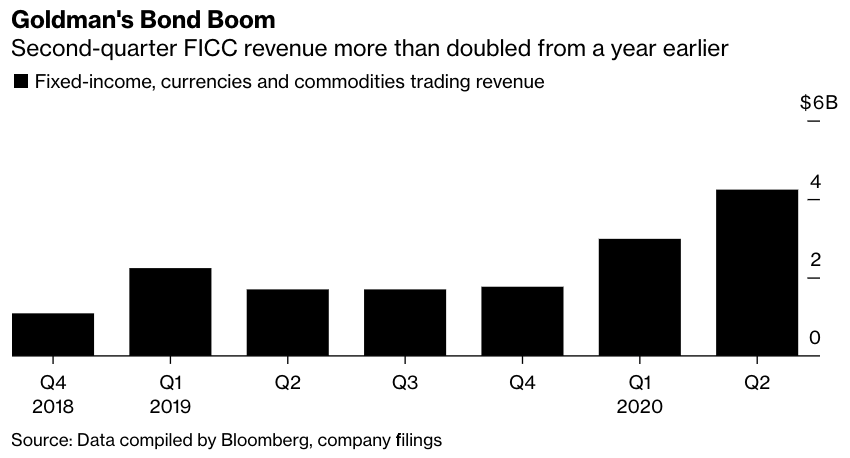 Those revenues stick out — and not necessarily in a good way — in a period that's expected to be dismal for corporate America. The CEO of consultancy Optimas called Goldman's results "almost indecent" and warned that type of outperformance is likely to spark a political backlash. The Fed's intervention benefited "investment banks primarily. This will lead to calls for the government to do more to help Main Street rather than Wall Street," he said. It's not hard to imagine that at a time when a large portion of the U.S. population is suffering economically, banks will, rightly or wrongly, make an easy political target. The best in-depth reporting from Asia and beyond. Sign up to get our weekly roundup in your inbox. | 


Post a Comment