| William Barr says Disney and Apple are pawns of China. Netflix subscribers plunge. And Moutai's record slump wipes 4.6%% off an index of the nation's largest companies. Here are some of the things people in markets are talking about today. Disney and Apple, among other major U.S. companies, have become pawns of China, enabling the government in Beijing to amass influence and wealth at the expense of the U.S. and Western democratic values. That's according to Attorney General William Barr, who warned Thursday: "American companies must understand the stakes." Citing Disney as an example, Barr said the entertainment giant gave in to demands from the Chinese government by letting officials manage its Shanghai theme park, only to see a Chinese-owned park open in another city featuring characters that look very much like trademarked Disney ones. As for Apple, Barr pointed to its recent removal of the news site Quartz from its Chinese app store, after the government complained about coverage of the Hong Kong democracy protests. Barr added that the Chinese government has launched hacking attacks to steal coronavirus vaccine research from U.S. companies and universities, while hoarding supplies needed to combat the pandemic. He made no mention of the joint assertion by the U.S., U.K. and Canadian governments Thursday that Russian state intelligence has done the same. Asian stocks were poised for a muted start to Friday trading after weakness in technology shares weighed on the Wall Street session. The dollar climbed. Futures in Japan were flat, while contracts in Hong Kong and Australia edged higher. Treasuries ticked up as American initial jobless claims posted their smallest weekly decline since March. Elsewhere, oil retreated from a four-month high after the OPEC+ alliance confirmed it would start tapering output cuts from next month. Ted Sarandos was only just named co-chief executive officer at Netflix and already he faces a difficult task: soothing investor anxiety about its slowing growth rate. The company tapped the longtime chief content officer to take the top job, alongside current CEO Reed Hastings, on a day when it delivered a disappointing subscriber forecast and sent its shares plunging as much as 15% in late trading. The world's largest paid streaming service expects to sign up 2.5 million new subscribers in the third quarter, compared with the more than 5 million expected on Wall Street. That's a steep comedown from Netflix's ferocious growth in the first half of the year. Kweichow Moutai fell the most in nearly two years after the influential People's Daily took aim at the high price of the liquor the company makes, saying the alcohol was often used in corruption cases. Moutai, China's biggest domestically listed company, tumbled 7.9% in its worst decline since October 2018, wiping out a record $25 billion of value. The plunge reverberated across China's almost $10 trillion stock market, with the SSE 50 Index of the nation's largest companies sinking 4.6%, its worst decline since early February. Other liquor makers also felt the sting, with Wuliangye Yibin, Jiangsu Yanghe Brewery Joint-Stock and Luzhou Laojiao all falling by the 10% daily limit. The comments were seen as the latest efforts by officials to cool sentiment in the nation's equities after retail investors took on the most amount of leverage in five years to speculate in shares. The six giant U.S. banks that just cut $35 billion from their profits to brace for a tsunami of souring loans also offered this confession: They don't really know how bad it's about to get. The data is confusing. Amid a slew of government programs temporarily propping up consumers and businesses, the percentage of loans falling into delinquency unexpectedly fell this year even as millions of Americans lost their jobs. People who arranged to defer payments on credit cards and mortgages dutifully sent checks anyway. It's an unprecedented situation, forcing bank leaders to make big assumptions about how the pandemic and the government's response will play out. To adjust its reserves, Citigroup imagined unemployment might improve modestly to about 10% by year-end. To show it can handle tougher times, JPMorgan ran projections with it surpassing 20%. But as bank leaders disclosed their massive provisions in second-quarter results this week, they're taking turns urging investors not to put too much stock in those numbers. "It's just very peculiar times," JPMorgan CEO Jamie Dimon noted. What We've Been Reading This is what's caught our eye over the past 24 hours: And finally, here's what Tracy's interested in this morning You know what's probably not a good thing? Highly-levered accounts that could end up having an outsized impact on the the world's biggest bond market. Back in March, when the U.S. Treasury market briefly seized up, attention focused on a little-known trade that saw hedge funds try to arbitrage the difference between the cash and futures markets for U.S. government debt. These Treasury basis trades typically involve investors buying the cheapest-to-deliver bonds and selling the relevant futures contract to pocket the difference. Many of those positions are funded through the repo market, which sees investors borrow cash secured against collateral. 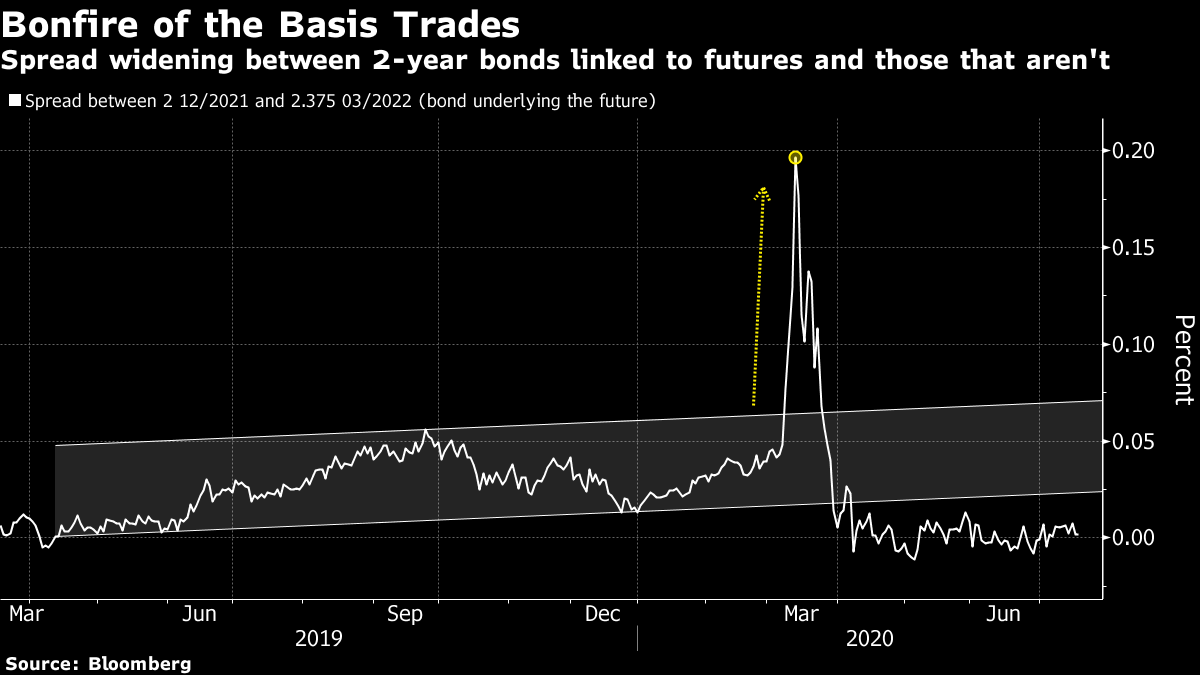 As markets reeled in March, investors rushed to derisk their portfolios and snap up U.S. Treasuries. But the stampede of safe-haven-seeking investors bought the more liquid futures contracts instead of cash, driving the difference between the two wider and causing massive pain for anyone who had borrowed money to wager that the spread would narrow. Those investors were said to have been hurt enough to exacerbate the sharp moves in the U.S. Treasury market as they stopped out their positions en masse, or so the thinking goes. A new paper from the Office of Financial Research (OFR) casts doubt on this theory, arguing that the cheapest-to-deliver Treasuries that were most likely to have been directly affected by basis trade losses actually became more valuable in the period. I'm not going to dive too deep into their argument; the whole paper is well worth a read. But I will point out what an odd state of affairs it is that there's this much intrigue in a market that effectively acts as the risk-free rate for the entire financial system. And even if basis traders didn't directly contribute to the seizing up of the Treasury market in March, the OFR paper still notes the risks that such positions might theoretically carry: "The transition of Treasury security ownership toward highly leveraged funds exposes the market to sell-offs because small changes in prices can trigger large losses." The best in-depth reporting from Asia and beyond. Sign up to get our weekly roundup in your inbox. | 


Post a Comment