| This is Bloomberg Opinion Today, a leverage ratio of Bloomberg Opinion's opinions. Sign up here. Today's Agenda  What's inside? Photographer: Bloomberg/Bloomberg We Never Learn: Banking Edition Hey, remember the financial crisis? Or what some of us now call "the Good Old Days?" When, sure, all the money was on fire, but you could at least hug your parents without fear of putting them in the hospital? One of the few upsides of the current nightmare relative to the previous one is that banking is no longer a runaway train dragging the economy over a cliff, but an apparent engine of stability. Not only are banks not failing, they're still making loans and protecting deposits and doing all the other stuff we want them to do. But behind that reassuring facade trouble may be brewing. Today's healthy banking sector is no accident, and owes much to the work of regulators after the previous crisis. They made banks more transparent about their capitalization and periodically tested them against theoretical economic stresses. But over time, stress tests have gotten less stressful, and risk levels have gotten less transparent, write former FDIC chief Sheila Bair and Thomas Hoenig. Some of this is meant to be temporary, to unburden banks during the latest crisis. But you can bet lobbyists will push to make the changes permanent. And that will raise the risk we'll have to relive those Good Old Days all over again. Of course, the other big lesson of both crises is that a blizzard of Fed cash hides a lot of ills, in banking and otherwise. Despite the worst economic downturn since the Great Depression, stocks are near all-time highs and credit markets are humming smoothly. Legendary hedge-fund manager and employee-recorder Ray Dalio recently argued it's gotten so ridiculous that markets are no longer free but mere playthings of central banks. Karl Smith and Robert Burgess respond that markets are still free, in fact; the Fed's cash is just the grease that's keeping them from locking up and collapsing. Further Trouble-With-Stimulus Reading: We knew oversight of small-business stimulus money was lax, and now we can see the consequences in embarrassing detail. — Tim O'Brien No, You Can't Stop Caring About Coronavirus One of the stock answers we use to reassure ourselves about the resurgence of coronavirus in the U.S. is that, well, at least the death count isn't soaring too. But this is a false comfort, warns Max Nisen. Deaths lag infections, typically by weeks, and often by months, as Covid-19 does not always kill quickly. An out-of-control pandemic means the good stuff we've done to prevent deaths lately — hiding vulnerable people away, treating patients more effectively — risks being swamped by sheer numbers. And death is not the only terrible outcome; some patients suffer long-term debilitating health effects. Letting the disease run wild is still a tremendous policy failure causing needless suffering. It also means we'll probably face a difficult choice this fall, when kids are due to return to school. It's clear by now that distance learning is generally terrible for most students, so some states are planning to carefully reopen physical schools. But many others are dragging their feet, writes Andrea Gabor. They need to follow the lead of states such as New Jersey and figure out how they can open schools safely, even if it's in a limited way. Are We Sure Trump Even Wants to Win? President Donald Trump has no plan for opening schools, aside from tweeting they "MUST OPEN IN THE FALL!!!" He also has no plan for the coronavirus generally, which is surprising in several ways, including that this would seem to boost his chances of winning re-election. Instead he's tweeting about Nascar and Confederate flags. This may stoke his White base into a fury, but it's not likely to win any converts, writes Jonathan Bernstein. In fact, Trump isn't behaving the way presidents ordinarily do when they want to keep the job, Jonathan notes. Most do anything it takes to win; Trump instead seems to be laying the groundwork for a public role after he loses. On the other hand, Trump may be turning the big Racism dial because it has worked for him and other candidates before, writes Francis Wilkinson. He argues the president is just waiting for someone to take his bait, triggering the racial violence that will help make his apocalyptic vision look more like reality. Telltale Charts As further evidence lockdowns don't hurt economies much more than simple fear of the coronavirus does, England's pubs and restaurants have been slow to reopen and even slower to fill, notes Andrea Felsted. 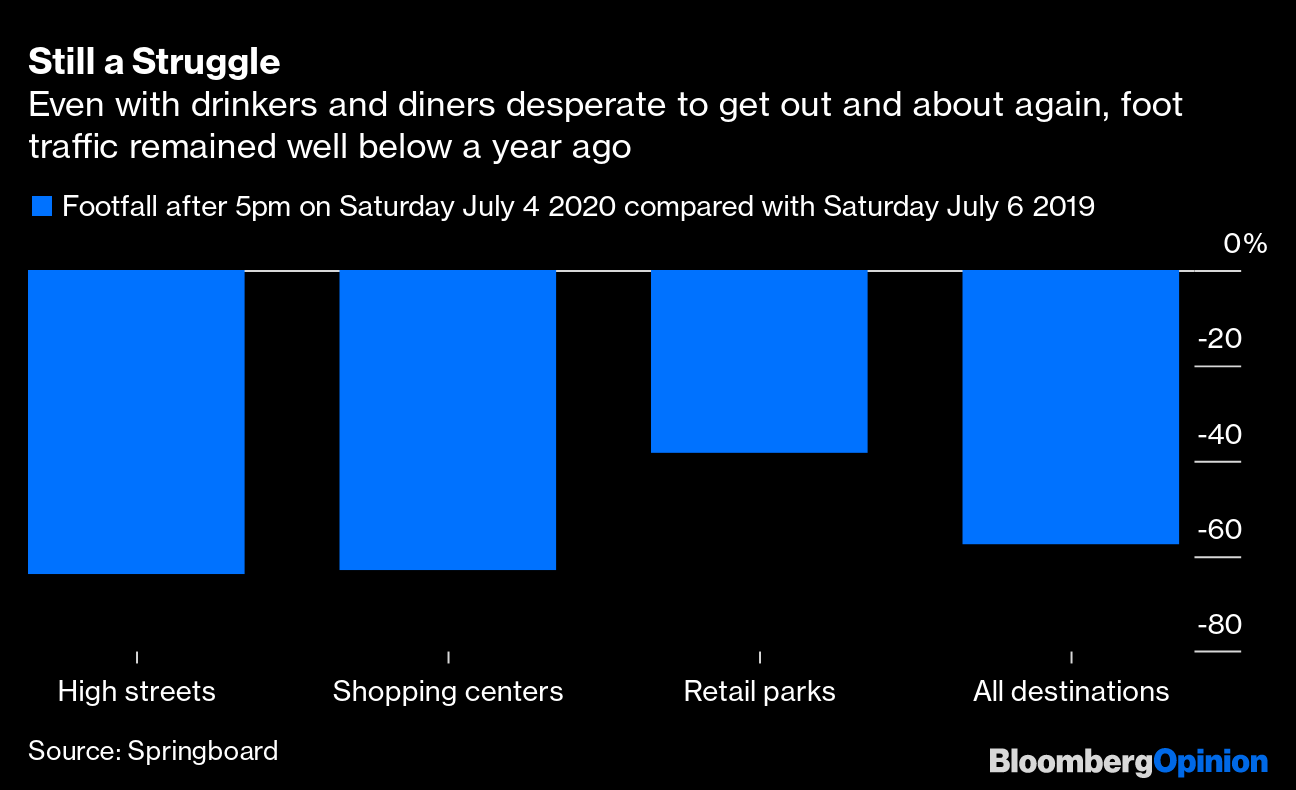 Further Reading Maybe Google poses legitimate antitrust concerns, but those don't seem to motivate Bill Barr's interest in it; politics do. — Bloomberg's editorial board Extra unemployment benefits haven't discouraged people from returning to work, helping the case for universal basic income. — Noah Smith Universities forget diversity when it comes to hiring financial firms. — Jim Reynolds Italy's dysfunctional government and poor fiscal management make it hard for Europe to launch a unified rescue effort. — Ferdinando Giugliano The pandemic is devastating Kerala's migrant workers and the remittance economy on which the Indian state depends. — Bobby Ghosh It's part of a global crisis for migrant workers that could affect billions. — Bobby Ghosh ICYMI The White House wants a new stimulus bill by August. Millions of Americans have moved because of coronavirus. Ghislaine Maxwell is now in Turkish-prison-like conditions. Kominers's Conundrums Hint If you're still trying to sort out our four subtle sequences, here are a few hints: - For the first, perhaps think about what's different between each element of the sequence and the next.
- For the second, maybe you need to think about more than two elements at a time.
- Would the third look more familiar if it started with 74 instead of 73?
- And as to the fourth — perhaps try reading that one aloud.
Kickers Who's hungry for some 3D-printed steak? (h/t Mike Smedley) How two scientists built a $250 million business using yeast to clean wastewater. Accelerating gifted students doesn't harm them psychologically, a 35-year study has shown. Invite Rick to RickRoll your Zoom calls. Note: Please send 3D-printed steak and complaints to Mark Gongloff at mgongloff1@bloomberg.net. | 


Post a Comment