China's economy is growing again, another week with more than 1 million jobless claims, and it's decision day at the ECB. ReboundThe Chinese economy grew 3.2% in the three months to June from a year earlier, beating the median forecast for a 2.4% expansion. There were some worrying signs behind the headline number, with consumer spending coming in weaker than expected. The news comes as President Xi Jinping sought to reassure global CEOs about doing business in China amid the U.S. push to isolate the world's second-largest economy. ClaimsConsensus sees weekly jobless claims dropping to 1.25 million when the data is published at 8:30 a.m. Eastern Time. Continuing claims are expected to drop to 17.5 million. With the virus surging again in some states just as government support for businesses is running out, there are fears of a new wave of layoffs. Adding to the pressure on the unemployed is the imminent end to the $600 a week in extra federal benefits, with lawmakers in Washington at a standstill in talks for more stimulus. Nothing newThe European Central Bank is expected to keep interest rates on hold and maintain its emergency bond purchase program at 1.35 trillion euros ($1.5 trillion) when it announces its latest monetary policy decision at 7:45 a.m. With the outlook for the region remaining uncertain as politicians remain divided over a fiscal stimulus package, President Christine Lagarde is likely to face questions over further policy measures in the press conference begining at 8:30 a.m. In commercial bank news, Morgan Stanley and Bank of America Corp. report earnings, with expectations rising after generally better than forecast results from their peers this week. Markets dropThe worse than expected performance of the Chinese consumer and some reassessment of vaccine progress is putting pressure on sentiment. Overnight the MSCI Asia Pacific Index dropped 1.5% while Japan's Topix index closed 0.7% lower. In Europe the Stoxx 600 Index had slipped 0.7% by 5:50 a.m. with disappointing earnings adding to selling pressure ahead of the ECB decision. S&P 500 futures pointed to a lower open, the 10-year Treasury yield was at 0.623% and gold slipped. Coming up...U.S. retail sales for June are expected to show 5% growth in the month from May when the data is published at the same time as jobless claims. Also at 8:30 a.m., the Philadelphia Fed business outlook for July is released. U.S. May business inventories and the July NAHB housing market index are at 10:00 a.m. TIC flow data is at 4:00 p.m. New York Fed President John Williams, Atlanta Fed President Raphael Bostic and Chicago Fed President Charles Evans all speak today. As well as the Wall Street banks, Johnson & Johnson, Abbott Laboratories and Netflix Inc. report earnings. What we've been readingThis is what's caught our eye over the last 24 hours. And finally, here's what Joe's interested in this morningA common thing you hear is that because the Fed has bought a lot of Treasuries that it must be "artificially" suppressing interest rates, with the implication that in the absence of such purchases, the yields on long-term government debt would be way higher. Of course, it seems like the opposite could be true. If the Fed were less involved in the market, risky assets might do worse, and people would buy even more Treasuries as a flight to safety. Either way, there's good reason to think that right now, they've basically been behaving as a straightforward economic proxy. 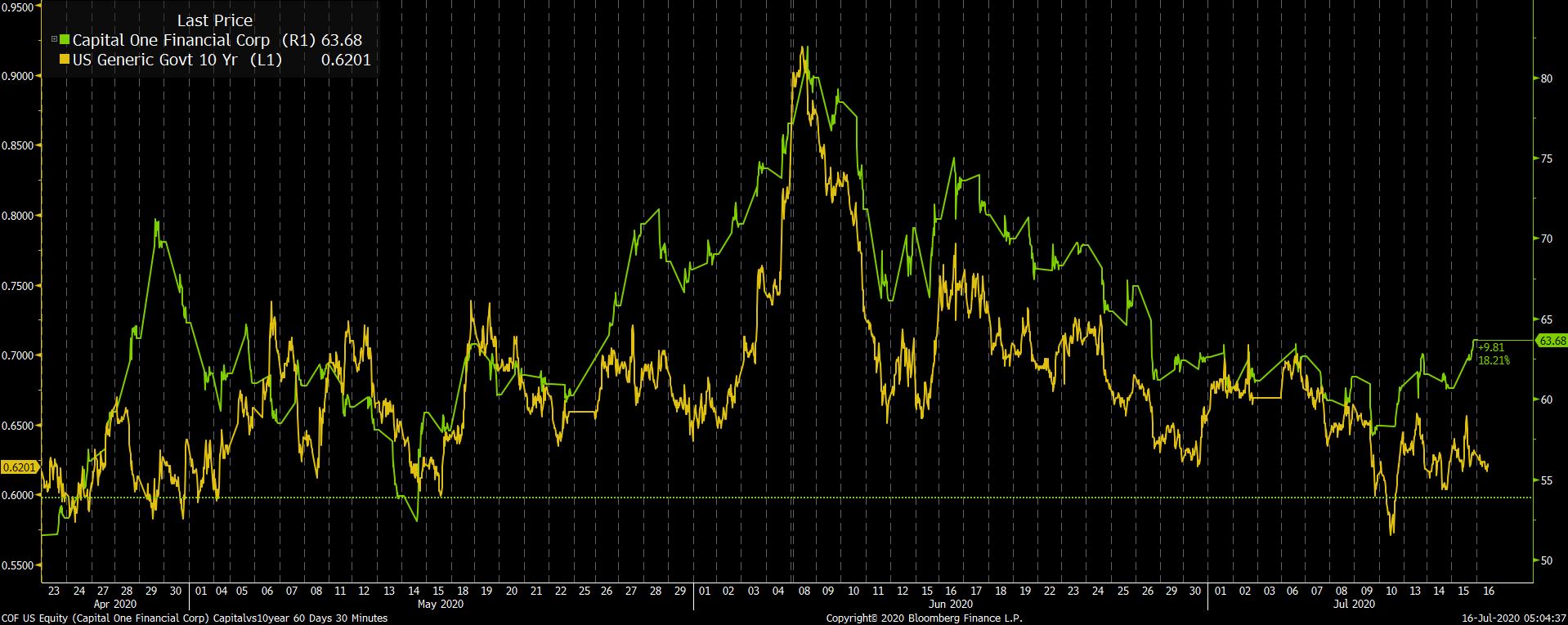
The green line in the attached chart is Capital One, a credit card company that's obviously going to be highly exposed to household finances. The gold line is 10-year yields. For the past 60 days, they've moved together hand in hand, peaking within moments of each other. When people were most optimistic about the prospect of a v-shaped recovery (and by implication better household finances) rates were near their recent peak. As the v-shaped recovery dreams have been shattered by rising virus cases and a slowing services sector rebound in several states, both the lines reversed in course. It's just two lines, but the bottom line is you don't have to overthink the Fed's role in this or think that there's something weird going on. People sold Treasuries when they were more optimistic about recovery and bought them when they grew more anxious.
Joe Weisenthal is an editor at Bloomberg. Like Bloomberg's Five Things? Subscribe for unlimited access to trusted, data-based journalism in 120 countries around the world and gain expert analysis from exclusive daily newsletters, The Bloomberg Open and The Bloomberg Close. | 


Post a Comment