| Want the lowdown on what's moving European markets in your inbox every morning? Sign up here. Good morning. Brazil's president tests positive for Covid-19, the U.K. readies a mini-budget and the U.S. eyes Hong Kong's currency peg. Here's what's moving markets. 'Little Flu' Brazilian President Jair Bolsonaro revealed he has tested positive for Covid-19. This follows his dismissal of the virus as "just a little flu" and refusal to wear a mask in public, while at the same time Brazil has had the world's second-highest number of cases and deaths. Bolsonaro is defending his approach and taking hydroxychloroquine, the anti-malaria medicine that U.S. President Donald Trump has also continued to tout despite health authorities having issued a warning against its use. Elsewhere, New Zealand suffered a breach of its quarantine rules, positive tests jumped again in Florida, and Sweden is seeing infection rates decline as citizens adhere to social distancing measures. Mini-Budget U.K. Prime Minister Boris Johnson told German Chancellor Angela Merkel he is ready to leave the European Union without a trade deal in place if no compromise can be reached, increasing the risk of another economic shock for the country. How the government intends to protect the country from a brutal, Covid-driven recession will take center stage on Wednesday as U.K. Chancellor of the Exchequer Rishi Sunak delivers a mini-Budget to lawmakers. With more than 12 million jobs currently being maintained via the government's support package, it is a substantial task. Sunak is set to keep his focus on jobs, with a 2 billion-pound program to be unveiled to pay the wages of young workers. Hong Kong Peg Some senior aides to President Trump want to undermine the Hong Kong dollar's peg to the U.S. dollar as an option to punish China for moves to chip away at Hong Kong's political freedoms. The move marks another politically-driven test for Hong Kong's markets but traders and economists said it seems like a "fairly whacky idea" that would be difficult to implement and risks hurting U.S. interests as much as it would harm China. Hong Kong's markets were largely untroubled by the report but HSBC Holdings Plc did slump amid suggestions the U.S. is seeking ways to punish Hong Kong's banks. The tech industry is also part of the battle, with a potential exodus from Hong Kong on the cards and Trump saying he's considering banning social network TikTok in the U.S. Wired Copper prices on the London Metal Exchange erased their losses since the beginning of the year. After China's coronavirus outbreak slammed demand and sent the commodity into a nosedive, outbreaks across major copper-producing countries are now buoying copper prices by choking the supply side. The market looks set to tighten further, a BMO analyst said, as a virus surge in Chile adds to disruptions in Mexico, Peru and Zambia. Coming Up… European stocks are trending lower on Wednesday with global stocks mixed. Trading updates from TGS Nopec Geophysical ASA, OMV AG and Victrex Plc will give us a glimpse of how Europe's oil and chemicals sectors held up in the second quarter. The European Union is set to unveil its strategy to boost the use of hydrogen fuel, after the commodity featured heavily in the bloc's mammoth Green Deal stimulus package. What We've Been Reading This is what's caught our eye over the past 24 hours. And finally, here's what Cormac Mullen is interested in this morning Investors betting the recent surge in Chinese shares could help give the global equity rally a leg up shouldn't pin all their hopes on the Middle Kingdom. China's stocks have less than half the "influence" of their U.S. peers over equities from the rest of the world, according to an analysis of 20-day correlations from data compiled by Bloomberg. Over the last 10 years, the correlation between the Shanghai Composite Index and the MSCI World Index of developed shares was just 0.21 versus a reading of 0.54 for the S&P 500 Index and an MSCI global gauge excluding U.S. equities. A maximum possible correlation of 1.0 would signify stocks that move in lockstep. Investors have been drawn to an almost unprecedented rally in China, with the Shanghai Composite up about 12% this month. The gauge jumped 5.7% on Monday in its biggest gain since 2015, amid efforts by regulators to boost the attractiveness of stocks and hopes for an economic recovery. Impressive gains, especially if you have China exposure, but not necessarily the kind that can spark a rally in other stock markets. 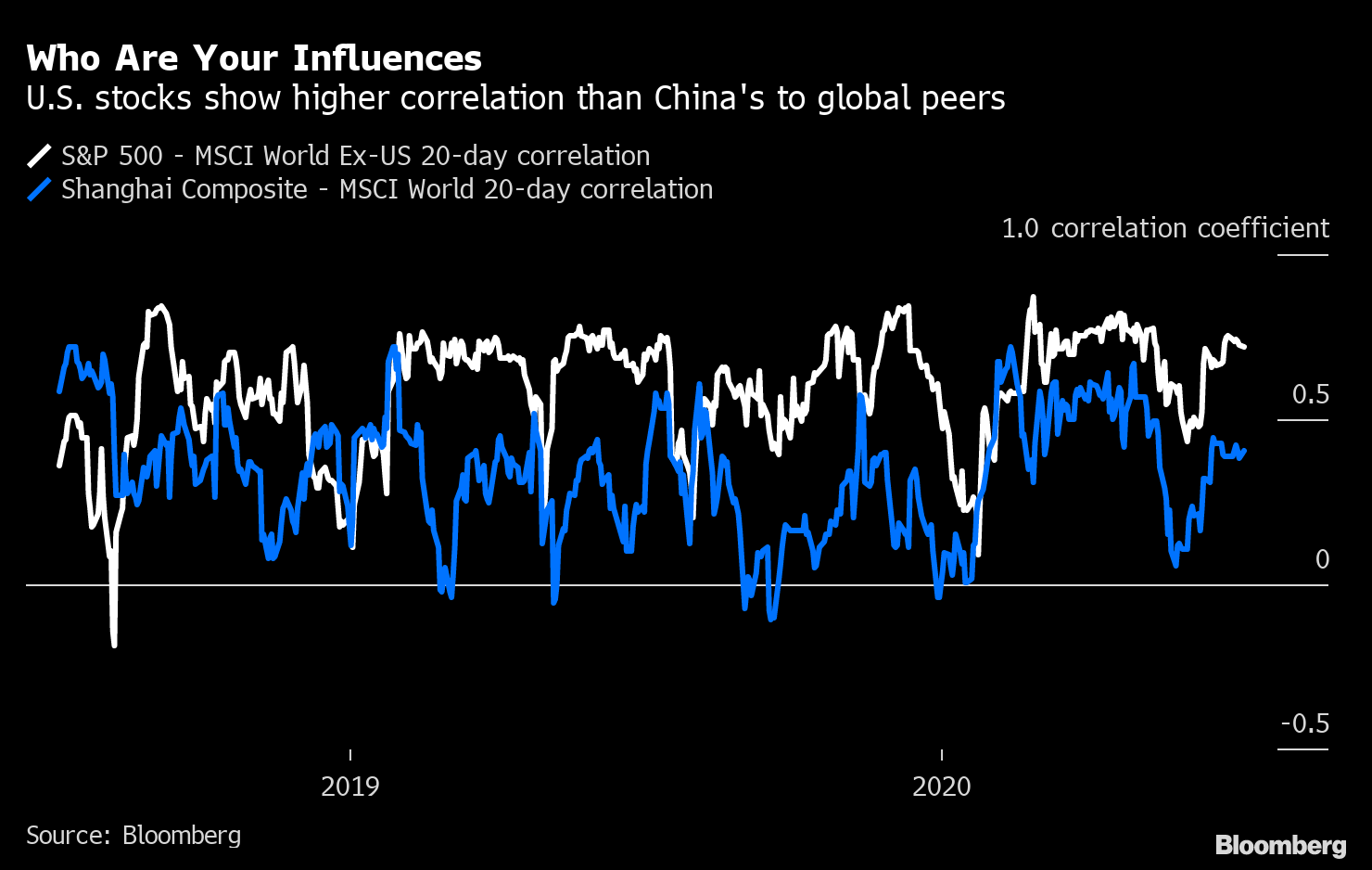 Cormac Mullen is a cross-asset reporter and editor for Bloomberg News in Tokyo. Like Bloomberg's Five Things? Subscribe for unlimited access to trusted, data-based journalism in 120 countries around the world and gain expert analysis from exclusive daily newsletters, The Bloomberg Open and The Bloomberg Close. | 


Post a Comment