| Want the lowdown on what's moving European markets in your inbox every morning? Sign up here. Good morning. China's economy returned to growth, a Twitter hack targeted politicians and business leaders, and it's ECB day. Here's what's moving markets. Looking Up The Chinese economy returned to growth in the second quarter, marking a significant milestone in the global struggle to recover from the Covid-19 pandemic. Even so, the economy is still 1.6% smaller than at the end of the first half in 2019 and retail sales shrank more than expected. Asian stocks slipped along with European and U.S. equity futures, as virus hotspots in the U.S. remained a focus. California's surge in infections continued, with the largest U.S. state reporting near-record increases in cases and deaths, while Los Angeles had record hospitalizations. And adding to concerns, data showed that the virus also appears to be spreading in Asia in unknown ways. Cryptic Tweets Twitter accounts of some of the most prominent U.S. political and business leaders, from Barack Obama and Joe Biden to Jeff Bezos and Warren Buffett, were hacked in an apparent effort to promote a Bitcoin scam. The attacks were stunning in scope and almost certainly coordinated. Others whose accounts were caught up included Bill Gates, Elon Musk, Kanye West, Uber Technologies Inc., Apple Inc. and Michael Bloomberg, the founder and majority owner of Bloomberg News parent Bloomberg LP. The accounts sent out tweets promising to double the money of anyone sending funds via Bitcoin within 30 minutes. As the hack unfolded, verified Twitter accounts suddenly lost the ability to post new tweets. Within hours, Twitter said access has been restored for most accounts. ECB Day While the ECB is expected to hold interest rates and asset purchases steady this afternoon, there is an off-chance it could tweak rules on cash deposits to help lenders cope with the pain of negative interest rates. Investors are also looking for clarity on whether the central bank plans to spend all of its 1.35 trillion euro emergency asset-purchase program, or exit early if Europe's recovery outpaces expectations. Executive board member Isabel Schnabel and governing council member Klaas Knot have suggested that the ECB may not exhaust the full amount. Most economists surveyed by Bloomberg expect the purchase program to grow by another 500 billion euros this year. Data Drama A day after Apple Inc.'s victory against an EU tax order, fellow tech behemoth Facebook Inc. is bracing for a landmark EU top court ruling on trans-Atlantic data transfers. The case was brought by an Austrian privacy activist who has challenged Facebook's handling of EU citizens' data ever since Edward Snowden's spying revelations in 2013. A ruling against the existing mechanism could upend the handling of cross-border data by Facebook and thousands of other companies, who would need to scramble for a replacement or suspend the transfers. In 2015, when the same court ruled in the same activist's favor and threw out a previous data transfer framework, the disruption enraged affected companies. This time, the EU has done its homework to prevent a repeat of the turmoil, the bloc's Justice Commissioner told Bloomberg. Coming Up… Online retailer Zalando SE and lab equipment maker Sartorius AG -- both stock market outperformers throughout the virus crisis -- were the latest European companies to boost 2020 forecasts overnight. Luxury group Richemont's first-quarter sales fell by nearly half, a worse decline than analysts had expected. Still to come, industrial group Atlas Copco AB and credit tracker Experian Plc are among other companies set to release quarterly updates, and we'll get a glimpse into Britain's employment recovery. Highlights in the afternoon include the ECB's monetary policy decisions and U.S. initial jobless claims. What We've Been Reading This is what's caught our eye over the past 24 hours. And finally, here's what Cormac Mullen is interested in this morning The slump in the dollar is threatening to bring to an imminent end its near-decade-long uptrend against major peers. Deutsche Bank's Trade-Weighted Dollar Index -- a gauge of the currency against the U.S.'s most important trading partners -- has fallen to test the trendline in place since 2011, a break of which would be an important signal for dollar bears. The index has dropped more than 1% so far this month amid weakening demand for havens, an ongoing rally in risk assets and a shift in sentiment toward currencies like the euro and yuan. Dollar strength has been a feature of much of the last 10 years. The trade-weighted basket climbed over 40% from the 2011 low to its recent peak in March, at the height of coronavirus fears. Yet a growing chorus of commentators is calling for the currency to decline, as the global economy attempts to recover from the impact of the pandemic. A breach of the uptrend would confirm this bearish bias and could give a fresh boost to assets which benefit from dollar weakness -- the euro and emerging market securities to name just two. A rebound from here could lead to a renewed bout of risk-off sentiment for global markets. 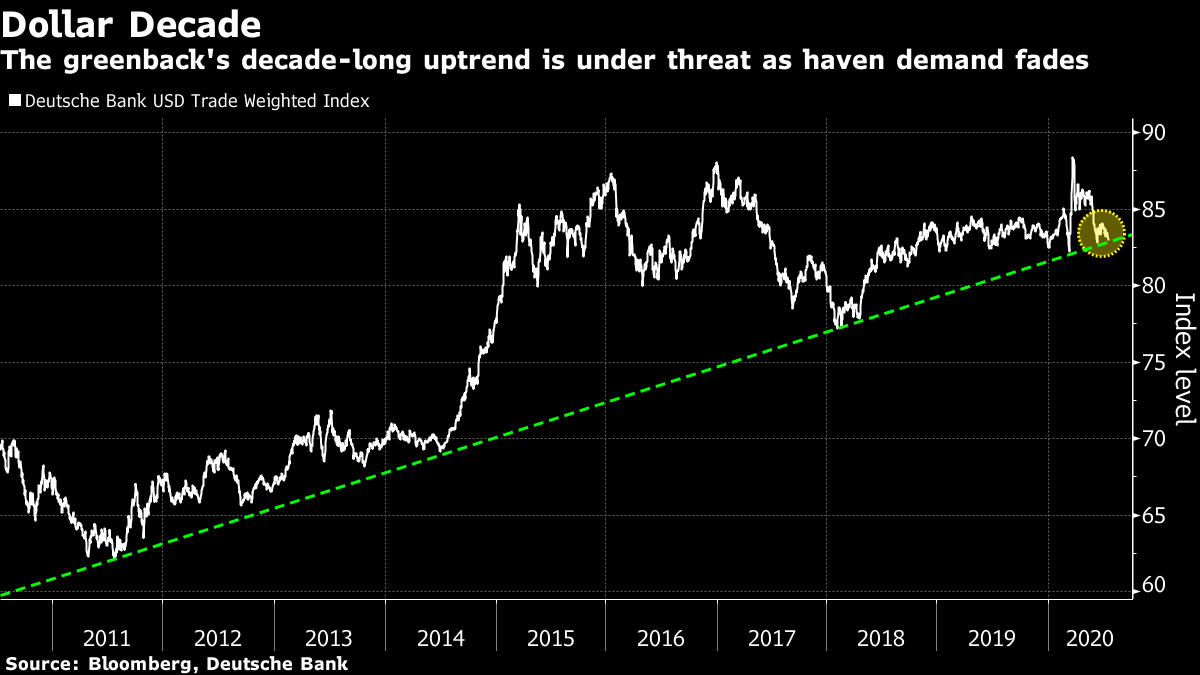 Cormac Mullen is a cross-asset reporter and editor for Bloomberg News in Tokyo. Like Bloomberg's Five Things? Subscribe for unlimited access to trusted, data-based journalism in 120 countries around the world and gain expert analysis from exclusive daily newsletters, The Bloomberg Open and The Bloomberg Close. | 


Post a Comment