| Lockdowns may have staved off about half a billion coronavirus infections. The S&P 500's historic rally wipes out all 2020 losses. And money managers fear that Hong Kong may not be able to keep investment dollars flowing in. Here are some of the things people in markets are talking about today. Lockdowns and other public-health measures may have prevented about half a billion coronavirus infections in six countries, including China and the U.S. The virus has now caused some 7 million reported cases of Covid-19, with more than 400,000 fatalities. Published Monday in the journal Nature, the first peer-reviewed analysis of the impact of health policies suggests that the toll would have been vastly worse without lockdowns, social distancing, travel restrictions and other interventions. Many coronavirus infections are relatively mild, and most of the roughly 500 million averted cases would have gone undetected, according to the study. "Seemingly small delays in policy deployment likely produced dramatically different health outcomes" in different countries, said Solomon Hsiang, lead author on the paper from the University of California, Berkeley. Here's a breakdown of estimated cases prevented by country. The S&P 500 closed at a 15-week high — wiping out its 2020 losses —with Asia stocks set to extend the global rally. Equity futures pointed to modest gains in Japan, Australia and Hong Kong, while only one goal remains for the main American equity benchmark: its record high from before the pandemic landed. The dollar posted its longest slide in almost a decade, while Treasuries advanced. Oil sank after Saudi Arabia said it wouldn't continue its additional, deeper output curbs after June. The yen pushed higher. Elsewhere, South Korean assets will be in focus after North Korea said it's determined to shut down all contact with its southern neighbor, according to state-news agency KCNA. Short sellers across Asia are being drawn to the health care sector, betting the region's best-performing industry this year is poised for a retreat. The daily average amount of short interest among 324 biotechnology and pharmaceutical stocks across Asia's major equity benchmarks has more than doubled so far this year from 2019, according to data compiled by Bloomberg. Australian firms account for almost half of the top 10 most shorted ones as they reset operations and seek to win regulatory approval for products in some of the world's most lucrative markets. Rich valuations, regular deadlines and approval hurdles result in increased volatility, making the sector a "breeding ground for short sellers," said Eleanor Creagh, market strategist at Saxo Capital Markets in Sydney. The Hong Kong exchange's push to attract big Chinese technology listings comes with one big risk, say money managers: The city's ability to keep the investing dollars flowing in as it's roiled by political tensions. Hong Kong Exchanges & Clearing has been pulling out all the stops to attract China's brightest stars as questions mount about their U.S. listings. Approvals have been sped up, with JD.com and NetEase greenlit in a matter of weeks. The bourse is also pushing to cut the settlement time for listings to boost liquidity, an issue that has dogged multi-billion-dollar deals in the past, causing dislocations to interest rates and the currency. Some investors now fear a flood in issuance will be hard to absorb and be left with little support, especially at a time when the international investor base the city needs is becoming increasingly worried about U.S. retaliation after Beijing proposed a controversial new security law for Hong Kong. Australia's farmers are on a mission to find fresh buyers for their barley, and are targeting bigger exports this year even after the country's top customer, China, slapped tariffs of about 80% on the grain. Markets in Japan, Vietnam, Indonesia, India and Saudi Arabia are among those being scoured for new clients or eyed for increased shipments of the cereal, which is mostly used in brewing and livestock feed. Australia is pursuing a domestic appeals process against China's tariffs and will then consider whether to take the case to the World Trade Organization, according to Agriculture Minister David Littleproud. The tariff on barley — along with a Chinese ban on some meat exports — comes at a time when Australia's primary producers are already reeling from a steep drop in demand. What We've Been Reading This is what's caught our eye over the past 24 hours: And finally, here's what Tracy's interested in this morning It seems the push to revive China's street-vendor economy has devolved into a case of "Li said, Xi said," as one Twitter user put it. Two weeks after Premier Li Keqiang made his high-profile pitch to encourage people to take up street stalls and other traditional forms of commerce, authorities in Beijing seem to be backtracking on the plan. Just as swiftly as we saw tutorials for creating food carts rolled out in state media, we're now seeing op-eds and commentary criticizing or downplaying the whole idea. Why the pushback at a time when China's unemployment rate is believed to have surged? Per Bloomberg's report, street vending is "a form of commerce at odds with President Xi Jinping's vision of China as a developed, high-tech superpower." (The irony, of course, is that street vending arguably encourages the kind of entrepreneurial spirit that's ostensibly valued in tech. Tencent's QQ.com recently published a list of famous businessmen who got their start in the informal economy as if to highlight this point). What's remarkable about this whole episode — other than an apparent high-profile disagreement within the Communist Party —is the stock market action. Companies that make food trucks and other retail equipment saw their shares surge over the past week but those gains are now rapidly unravelling. 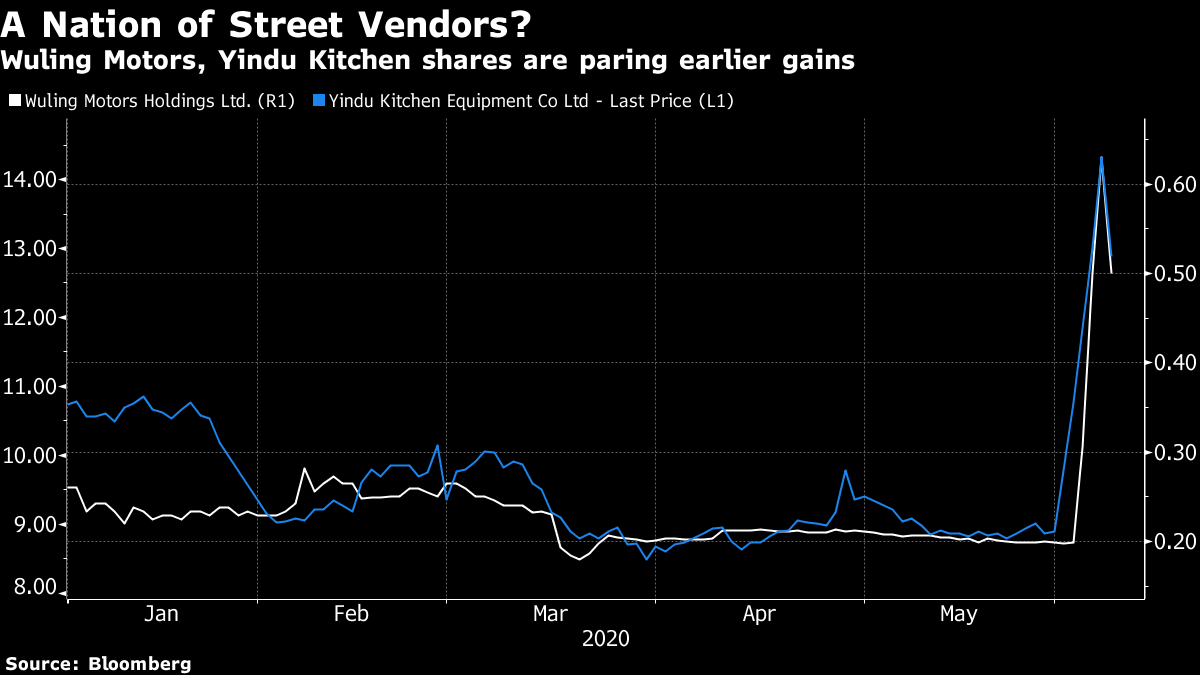 You can follow Bloomberg's Tracy Alloway at @tracyalloway. The best in-depth reporting from Asia and beyond. Sign up here to get our weekly roundup in your inbox. | 


Post a Comment