This is Bloomberg Opinion Today, an unemployment claim of Bloomberg Opinion's opinions. Sign up here. Today's Agenda Dark times. Photographer: JOHANNES EISELE/AFP/Getty Images This Is What Economic Collapse Looks LikeSome things are intensely awful no matter how much you prepare for them, such as jumping into icy water or listening to Nickelback. Today's jobs report was like that. Unemployment soared to 14.7% in April, the highest rate since the Great Depression. A record 20.5 million people lost their jobs, making all the employment growth of a decade-long expansion go *poof* in a month. We'd seen this coming; weekly unemployment claims have shown 33.5 million people losing jobs in seven weeks. Wall Street expected worse, in fact, and is already looking ahead to some imaginary recovery (or new Fed rescue operation, as Mohamed-El-Erian writes), so stocks naturally soared, which should at least keep makers of pitchforks and guillotines employed. But the numbers are still unspeakably awful and will keep getting worse; the report's survey period was in mid-April and didn't catch nearly all the misery. Most of the job losses are temporary for now, but that can't last much longer. What's clear is that the trillions of dollars Congress and President Donald Trump and the Fed have poured into the economy so far won't nearly be enough, Bloomberg's editorial board writes. Many of these programs expire in early summer, when we'll likely still be suffering depression-level economic pain. Weirdly, neither Congress nor the president seems all that energized about loading another round into the Stimulus Cannon, notes Jonathan Bernstein. Trump's approach to the economic disaster, and the coronavirus pandemic that started it, lately seems based on the assumption that ignoring a problem will make it magically go away. This is highly relatable, but no way to run a country. Trump's answer for now is rushing to reopen states from pandemic shutdowns that clearly aren't ready. This does have the benefit of saving some states a few bucks on unemployment payments, notes Noah Smith. Some have threatened workers they'll lose benefits if they don't return to dangerous jobs, in fact. But this won't help the economy and could even make things much worse by stretching out the pandemic, the lockdowns and the job losses. That's the last thing we want; at least ice baths and Nickelback songs are over relatively quickly. Bonus Job-Pain Chart: Only warehouses, where all the stuff we're buying now is stored, hired substantially in April, notes Justin Fox. Other essential industries were slashing jobs: 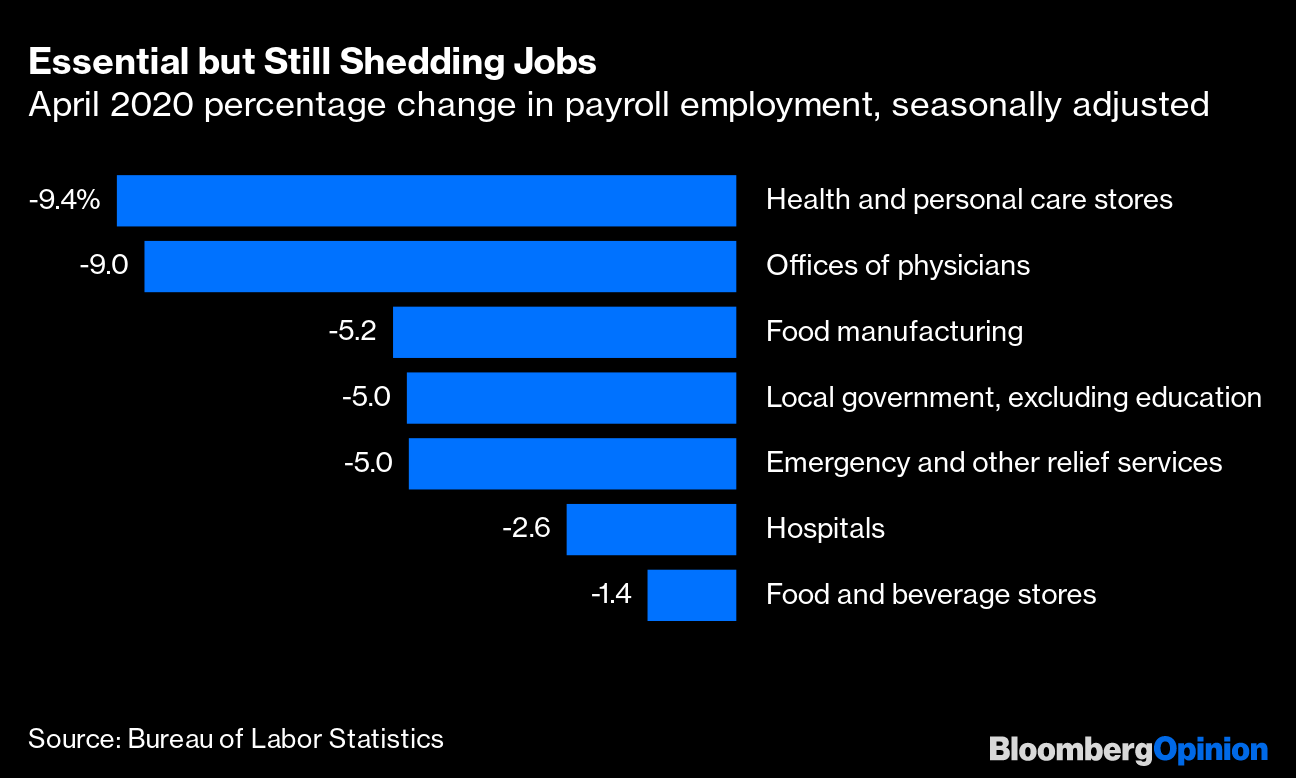 Women Bear the BruntOne of the freakiest features of April's jobs report was that average hourly wage growth jumped. This isn't what you'd expect in a nascent depression! But it was unfortunately just a sign of how much the layoffs were concentrated in low-wage jobs. Like the pandemic itself, the economic pain is targeting America's most vulnerable populations, particularly women, write Elaine He and Nicole Torres, with a series of infuriating charts. More women are considered essential workers than men, but they're also losing jobs at a faster rate: 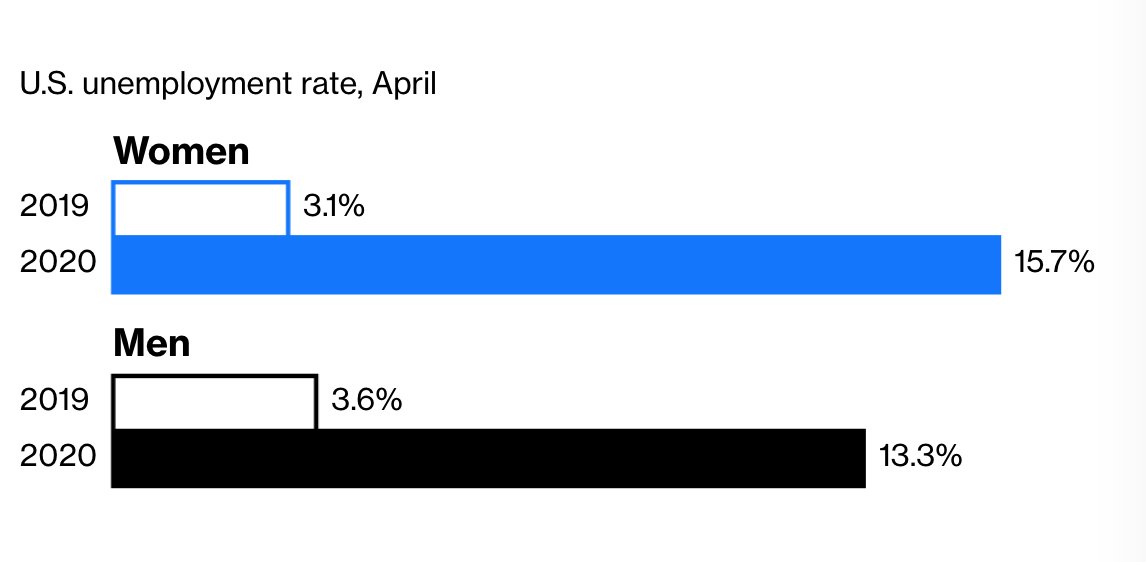 At the same time, they're also more likely to be single parents of out-of-school kids, and they do more of the housework than their housebound husbands. Read the whole thing. Testing, Testing, TestingNone of this economic misery will abate until the country gets its Covid-19 outbreak under control, and a key to doing that will be adequate testing. As you may have heard, we still don't have it. Last month, Michael Lewis wrote about how the Chan Zuckerberg Biohub in San Francisco built a coronavirus-testing juggernaut, only to see it stall due to a shortage of basic materials such as swabs to jab up patients' noses. The lab has since scrounged up the needed equipment, with no help from the federal government. It recently tested hundreds of samples from one San Francisco neighborhood, and the results are already adding to our understanding of the disease. That the lab was able to test at all owes to a handful of people finagling swabs from China. Somehow America, the richest country in the world, has been unable to make such simple things as swabs and protective gear in sufficient numbers. This is because we long ago stopped building communities of manufacturing know-how, writes Dan Wang. Silicon Valley is the last example of such a place in this country. America must build many more of these if it hopes to be able to build stuff again. Meanwhile, the U.S. government is using a secret FEMA algorithm to tell states when they should reopen, writes Cathy O'Neil. This meets all of Cathy's tests of whether an algorithm is dangerous: It's important, secret and destructive. It's certainly not an example of American problem-solving know-how. Telltale ChartsThis one chart from Tara Lachapelle says everything about the entertainment industry these days: Netflix Inc. is bulletproof, while everybody else is hurting from a lack of sports, advertising and content production. 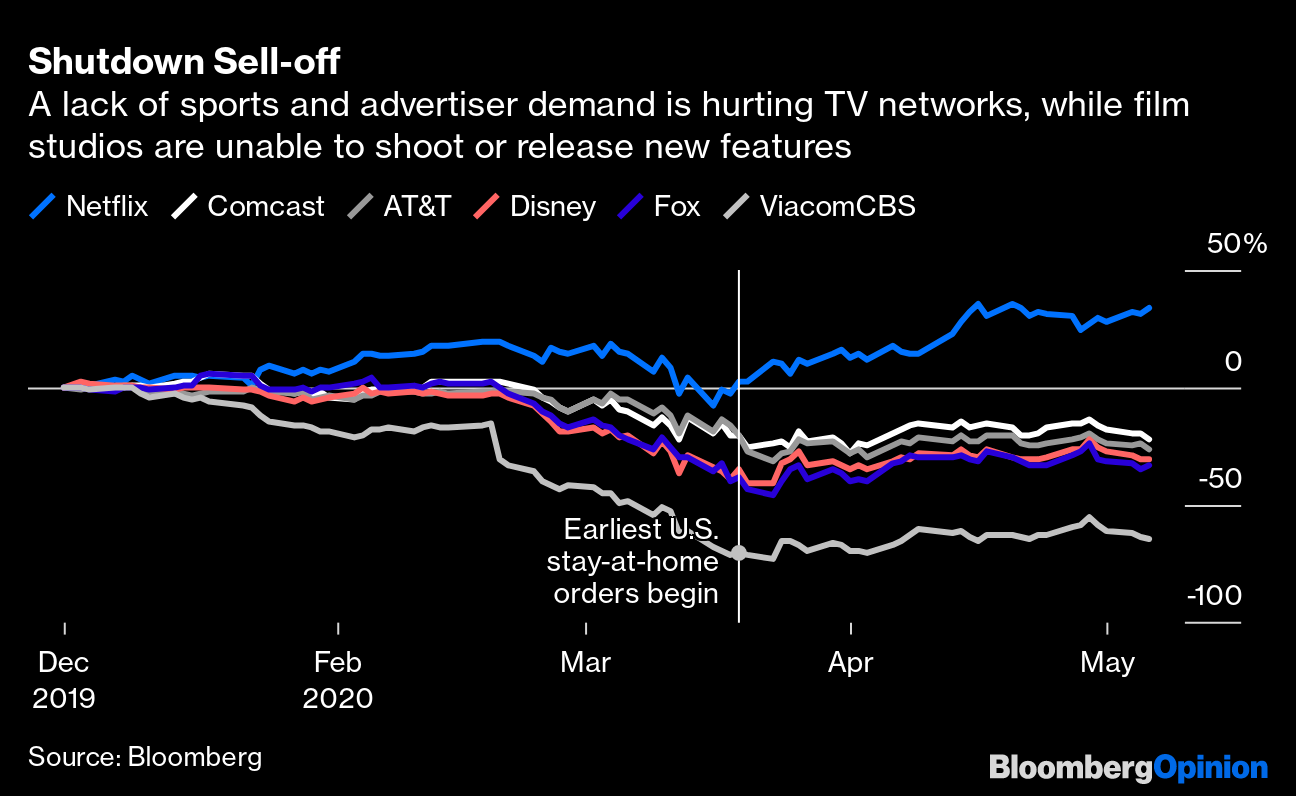 You might want to sit down for this, but risk managers haven't been doing so great at managing risk, writes Ben Schott. 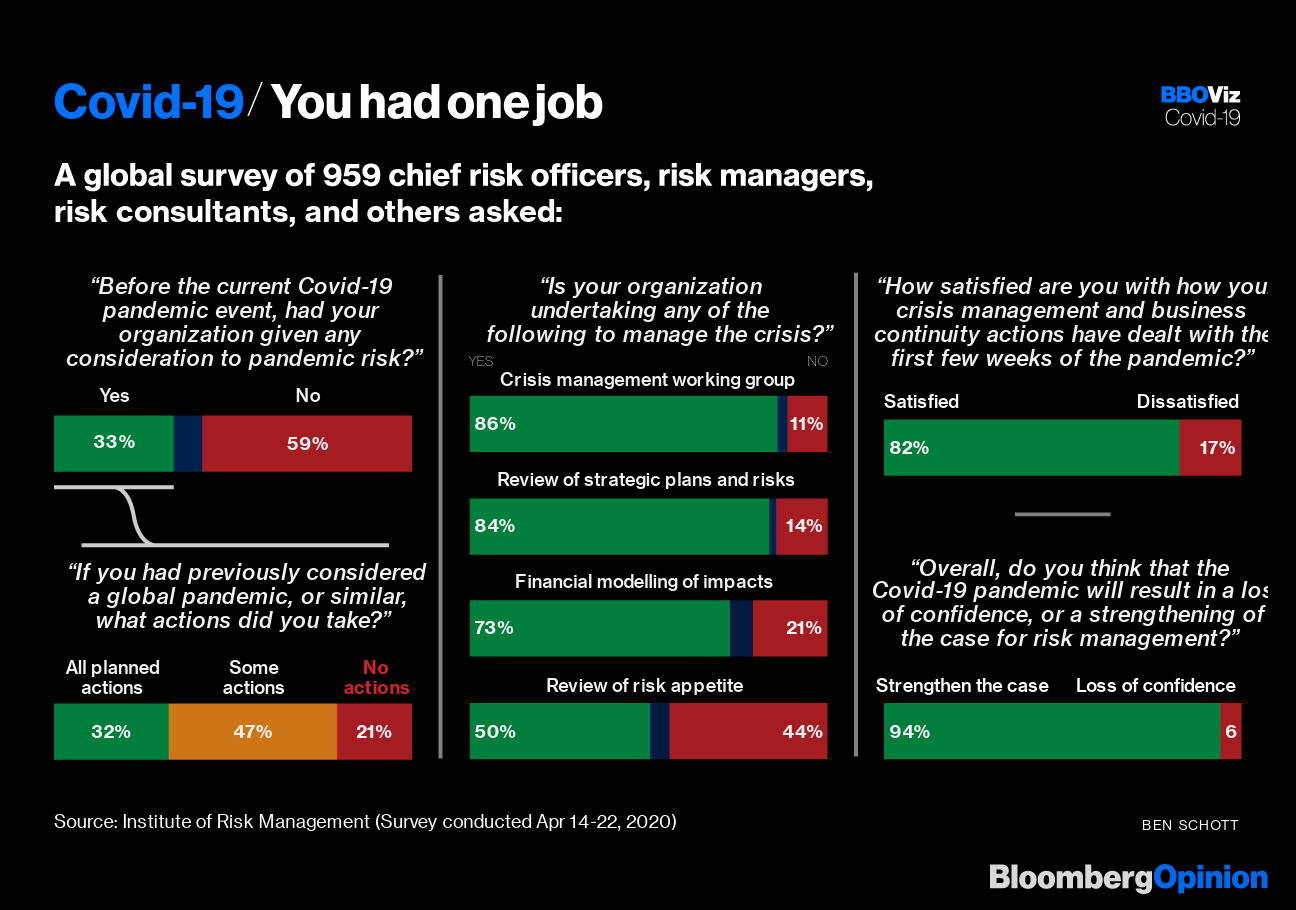 Further ReadingEven in an unusually bad time, General Electric Co.'s numbers stand out as being particularly bad. — Brooke Sutherland Shutdowns have been a boon to Amazon.com Inc., but Shopify Inc. and other rivals are gaining ground. — Tae Kim Justice is finally served for Michael Flynn. — Eli Lake Iraq is still a basket case, and its unlucky new prime minister's best hope is for new elections. — Bobby Ghosh Russia has been increasingly provoking the U.S. and its allies. A flotilla sent to northern waters is meant to push back. — James Stavridis Argentina has handled the pandemic well, and it also has a chance to put off a debt reckoning. — Mac Margolis ICYMIMike Pence's press secretary tested positive for Covid-19. She's married to Stephen Miller. Internet giants are telling staff to plan to work from home all year. Oil's crash busted Interactive Brokers' computers, wallets. KickersDeepfake music is now so good it might be illegal. (h/t Scott Kominers) Scientists develop a plasma thruster that could fly planes. Roomba inventor says don't fear the robot. How "Mad Men" became the perfect pandemic binge-watch. Note: Please send deepfakes and complaints to Mark Gongloff at mgongloff1@bloomberg.net. Sign up here and follow us on Twitter and Facebook. | 


Post a Comment