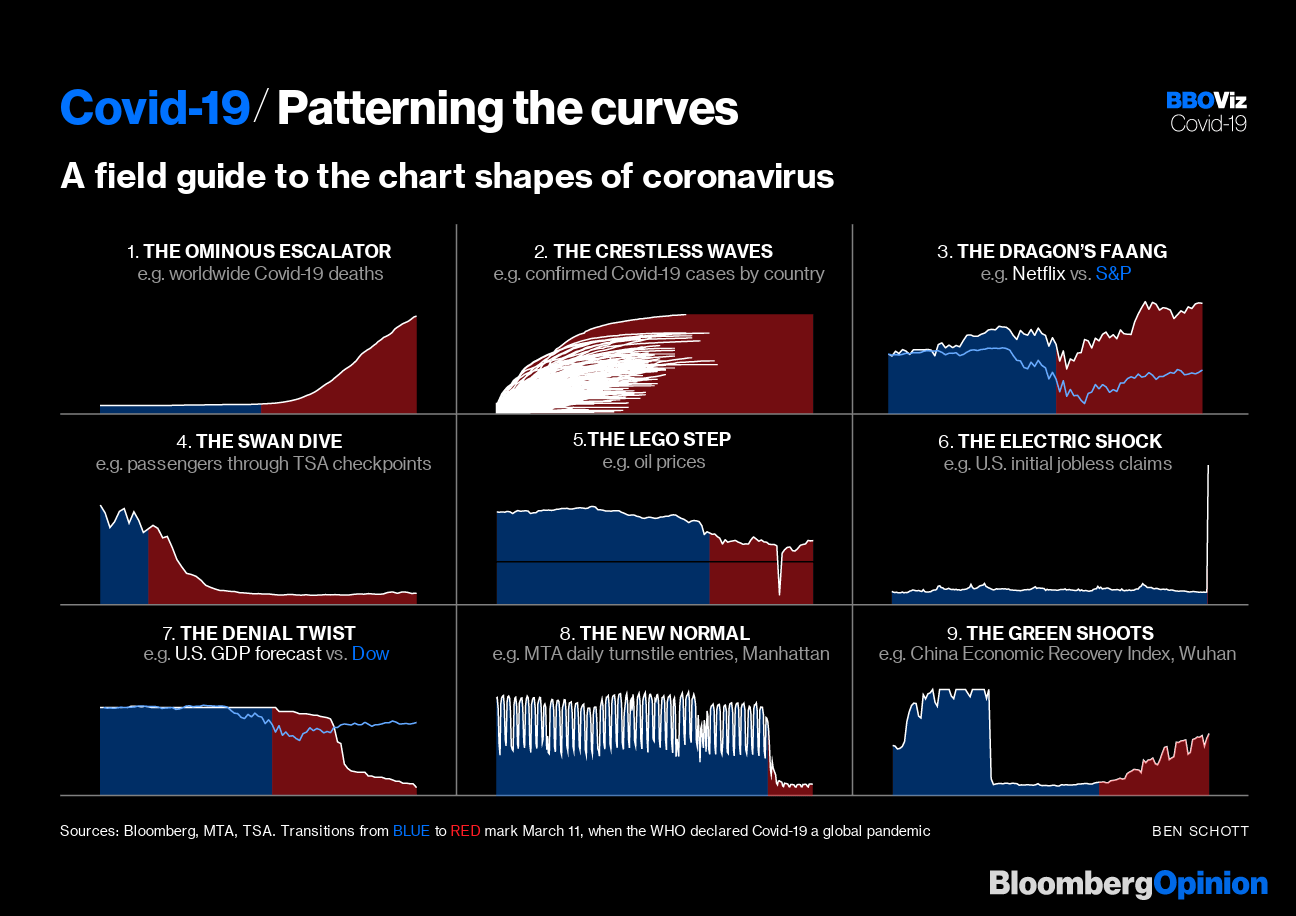
| This is Bloomberg Opinion Today, a worker-safety plan of Bloomberg Opinion's opinions. Sign up here. Today's Agenda 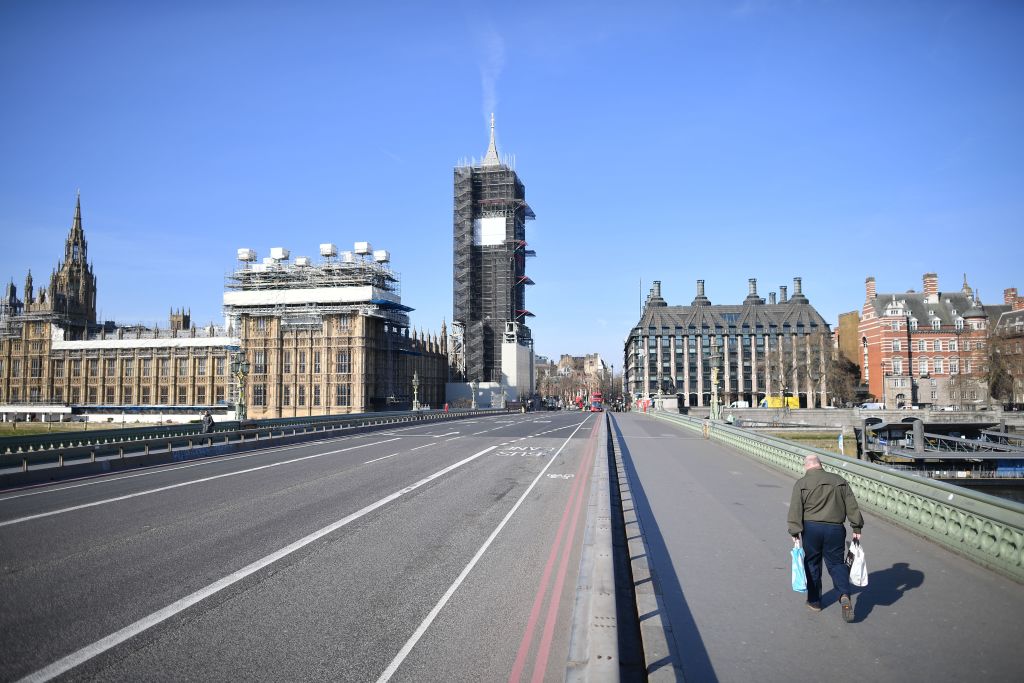 What counts as adventure these days. Photographer: JUSTIN TALLIS/AFP/Getty Images The Long Road Back to Normal Back in early March, when Taft was still president and "Peg o' My Heart" topped the charts, Clara Ferreira Marques wrote a smart column comparing the economic hit of Covid-19 to a credit crisis, but with people: Stop the flow of people, and you stop the economy. Boy, was she ever right, we've learned in the eternal weeks since, with economic activity collapsing and U.S. unemployment spiking to Great Depression levels. Understandably, everybody wishes this had never happened and that we could just get the people flowing again. But most people will not willingly resume their normal flow until they feel safe. Nowhere is this clearer than in Georgia, where Governor Brian Kemp has been frantically mashing the big red REOPEN ECONOMY button on his desk for weeks, to little avail, writes Conor Sen. Despite being allowed to open, businesses aren't rushing to do so. On the plus side, this means the coronavirus is less likely to have a huge second wave. But it also means the economy won't bounce right back as Kemp and President Donald Trump might hope. Businesses might not feel safe reopening until they're protected not only from the virus but also from the risk they'll be held accountable if there's an outbreak among workers. The government could solve both problems at once, Bloomberg LP founder and majority owner Michael Bloomberg writes, by spelling out guidelines businesses must follow to protect workers, while also shielding those businesses from lawsuits if they follow the rules. Those plexiglass shields won't pay for themselves, so taxpayers should help businesses cover the costs. What we can't do is let yearning for normalcy make us do dumb things. Reopening too quickly is one. Pretending the death toll isn't real is another. Relying on miracles is a third. We've already seen this in people poisoning themselves with hydroxychloroquine and cleaners, after a certain someone suggested they might be cures. We've also seen a flood of shoddy and sometimes fraudulent antibody tests hitting the market, fulfilling a demand for those golden immunity tickets that may or may not ever exist. This is a market ripe for abuse and in dire need of better oversight, writes Lionel Laurent. It will certainly not get people moving again. Further Reopening Reading: Trump's Other Issues Didn't Disappear It may seem hard to believe, but many controversies from Ye Olden Times are still quietly raging while we're all fighting for our lives, internet connections and Clorox wipes. Tomorrow, for example, the U.S. Supreme Court will hear arguments (hopefully not interrupted by toilet flushing this time) about whether President Donald Trump's tax returns can be made public. The president has spent every second of his term neck-deep in financial conflict, right up until this weekend, when he tweeted an advertisement for one of the golf courses bearing his name. Tim O'Brien, one of the few people alive who has actually seen Trump's finances, argues the public has every right to know what's in them, to see just how conflicted Trump really is. In another courtroom, a judge has a chance to review Attorney General William Barr's blatantly partisan decision to drop charges against former Trump national security adviser Michael Flynn, long after Flynn pleaded guilty to those charges. Given the unusual circumstances and the threat of an increasingly politicized Justice Department, that judge should take a hard, skeptical look at Barr's action, writes Noah Feldman. Further Political Reading: Oil's Flattened Curve The lack of people flowing has put a real damper on energy use, at one point driving oil prices into negative territory. With bits of the global economy moving again here and there, oil demand is creeping back a bit, just as supply is finally starting to shut down, notes Julian Lee. The risk here is that, as with the flattening pandemic curve, people read too much into modest success. In this case, that would mean blowing it all by rushing to pump too much oil. Any drilling is still too much drilling right now, writes Liam Denning. People are driving more than at the worst of the shutdown, possibly giving oil producers hope a new car boom will save them. But David Fickling suggests people will still be far more likely to work from home or even wear masks on public transport than deal with traffic jams. Further Energy Reading: School Daze The pandemic has been an epochal event for education, with millions of students, from kindergarten to college, suddenly doing all their learning at home. Many students and educators are struggling; others are discovering they prefer it. Bloomberg Opinion writers took some deep dives on the topic: Telltale Charts Toys and games are the best stock performers in the quarantine era, notes Matthew Winkler. 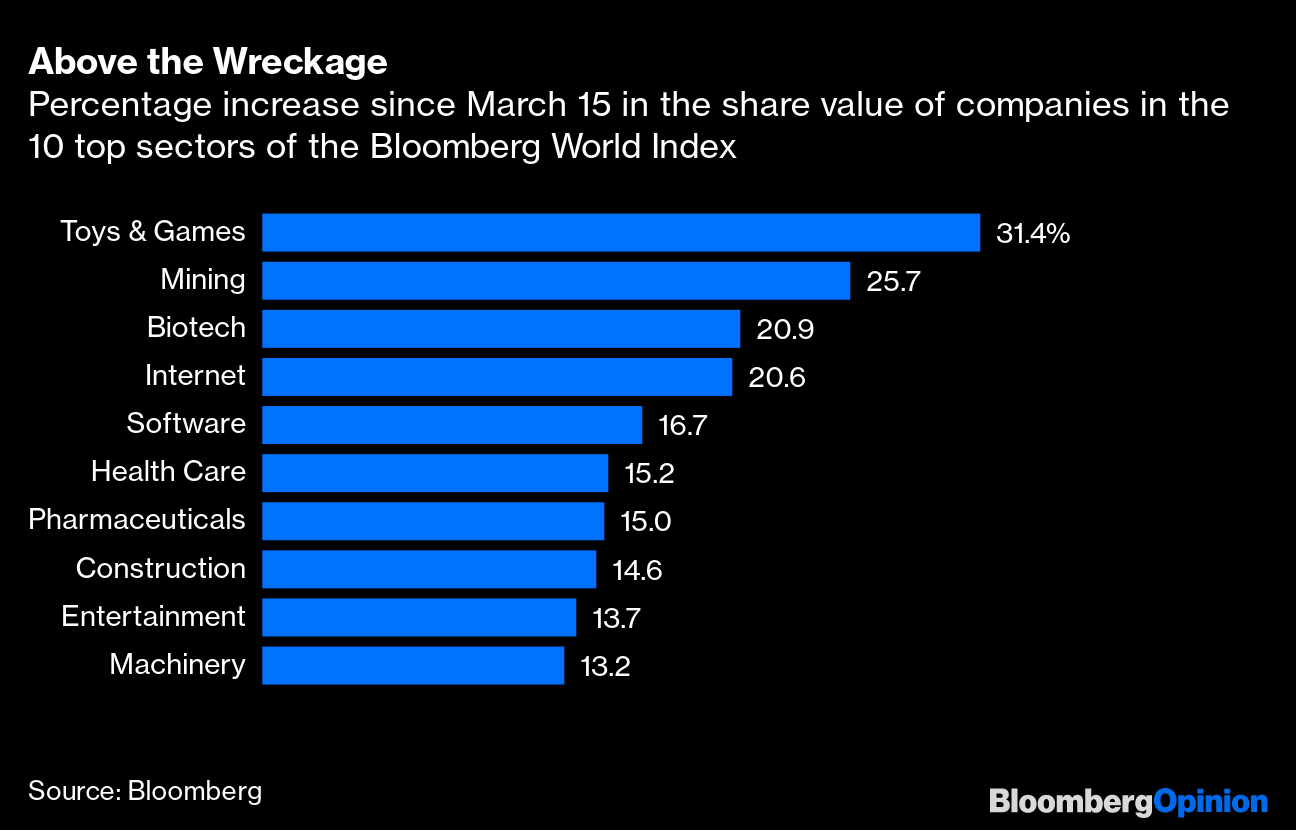 Here are the nine charts that define the world now, according to Ben Schott. Further Reading Germany's high-court ruling against the ECB creates a constitutional crisis for the EU. — Andreas Kluth Amazon.com Inc. would be better off buying a movie studio than movie theaters. — Tara Lachapelle Once again the doomsayers are wrong about inflation. — Barry Ritholtz Doomsayers may not be totally wrong about muni bonds this time. — Brian Chappatta Iraq's new prime minister is a sign of Iran's waning influence. — Eli Lake A blood test may detect hard-to-find cancers early enough to treat them. — Faye Flam ICYMI A Spanish flu lesson: Don't end restrictions too soon. New York City had 24,172 excess deaths between March 11 and May 2. Why chicken is plentiful and beef is not. Kickers What really happens when kids are marooned on an island for months. How Youngstown, Ohio, bet it all on a self-chilling beverage can. One kind of space-time is unstable. Jerry Stiller's best moments on "Seinfeld." Note: Please send self-chilling cans and complaints to Mark Gongloff at mgongloff1@bloomberg.net. Sign up here and follow us on Twitter and Facebook. | 



Post a Comment