| Chinese researchers are looking into the rate of coronavirus reactivation. May is the time to buy, according to a money manager whose stock fund has climbed 52% in 2020. And Tesla suspends production in its Shanghai factory. Here are some of the things people in markets are talking about today. Among recovered Chinese Covid-19 patients, about 5% to 15% may have tested positive again, a study found. The rate of reactivation in China varied from place to place, with some regions showing less than 1% of such cases, according to Wang Guiqiang, director of the department of infection at the Peking University First Hospital. Wang disclosed the figures during a press conference held by China's National Health Commission on Thursday. Wang said most of the patients who have tested positive again have yet to show any symptoms, and finding the reason for the reactivation will take more work. The findings go some way to confirming a growing fear of re-infection in recovered patients in China, where the virus first emerged last December. Elsewhere, Moderna surged the most in more than two weeks after the company said its experimental vaccine would be in late-stage studies by early summer, and Japan approved Gilead's remdesivir to treat the novel coronavirus. In the U.S., cases rose 2.4%, matching the one-week average. Here's how Bloomberg is tracking the pandemic. And for countries looking to Taiwan's stellar containment efforts as a model to follow, this is how the island got a head start on smashing the virus. Asian equities were poised for a mixed start Friday ahead of a key U.S. employment report that's set to highlight the unprecedented depth of job losses from the coronavirus shutdown. Treasury yields and the dollar fell. Futures edged higher in Japan, fell in Hong Kong and were little changed in Australia. Earlier, the S&P 500 Index rose, with speculation mounting among equity investors that the worst of the economic hit has passed as more of the U.S. opens. Filings for unemployment continued at historically high levels, but fell from the prior week. The tech-heavy Nasdaq Composite turned positive for the year, wiping out losses that reached as much as 24% at the depths of the pandemic-fueled sell-off. Two-year Treasury yields plunged to a record low and 10-year rates fell toward 0.6%. Elsewhere, oil fell in a day of wild price swings as investors weighed supply-and-demand fundamentals against Saudi Arabia's global price hike. A Chinese money manager whose stock fund has climbed 52% in 2020 says May is no time to shy away from equities. Wang Rongxin, general manager of Beijing-based Rosin Asset Management, thinks a buying window is at hand. Key annual meetings of the country's top legislature are set to start in two weeks, and he says possible policies to emerge should fuel China's economic recovery following pandemic-related lockdowns. The Zhonggang Yinrun Private Equity Investment Fund, which launched in August, has benefited so far this year from bets in 5G, electric vehicles and pharmaceuticals paying off. It has averaged about a 75% allocation in stocks, but he said the fund could top 90% this month. Here's what Wang is interested in. Tesla suspended production at its plant on the outskirts of Shanghai, according to people familiar with the matter, bringing to a halt all of the company's vehicle manufacturing globally. The electric-car maker informed factory workers who were supposed to return to work Wednesday, after China's five-day Labor Day break, that their holiday would be extended and they will return as soon as May 9, sources said. The reason for the abrupt halt wasn't immediately clear. Chinese technology news site 36kr reported it was because of component shortages. While Tesla's only car factory outside the U.S. is expecting delays in receiving parts for its Model 3, it's also facing problems with a crucial piece of manufacturing equipment that's being fixed, according to the people. In these times of crisis, India's top companies are leaning on Japanese lenders for funding. From Mukesh Ambani's Reliance Industries to Tata Capital, the nation's biggest firms have raised a record 181 billion yen ($1.7 billion) from yen-denominated loans this year, helping them to tide over a crunch in the dollar market. With benchmark sovereign yields in Japan falling back below zero on increased stimulus from the central bank, the country's banks are hungry for higher-yielding assets. India's biggest companies are turning to them for relatively cheap money, as the coronavirus pandemic roils the economy. Access to overseas loans for refinancing is critical for Indian firms, whose offshore debt bill for this year comes to an unprecedented total of about $31 billion. What We've Been Reading This is what's caught our eye over the past 24 hours: And finally, here's what Tracy's interested in this morning They're he-ere! Negative rates have arrived in the U.S., with traders pricing Fed funds futures contracts at negative interest rates for what may be the first time ever. The only question now is whether that pricing indicates that traders actually believe the Federal Reserve will embark on a negative rates policy by early 2021, or whether the move reflects some sort of technical trading blip. The timing might give us some clues. The dip below zero happened soon after the U.S. Treasury announced a whopper refunding schedule, including many, many T-bills. You could make an easy argument, as the analysts over at JPMorgan do, that this was a classic case of a whole bunch of investors repositioning at once. Lending some credence to that theory is the fact that Fed Chairman Jerome Powell has repeatedly poured cold water on the idea of going negative — as recently as last week. The only Fed speaker to opine on the topic on Thursday was Richmond Fed President Tom Barkin, who also blasted the idea, saying "I haven't seen anything personally that makes me think [negative rates] worth a try here." 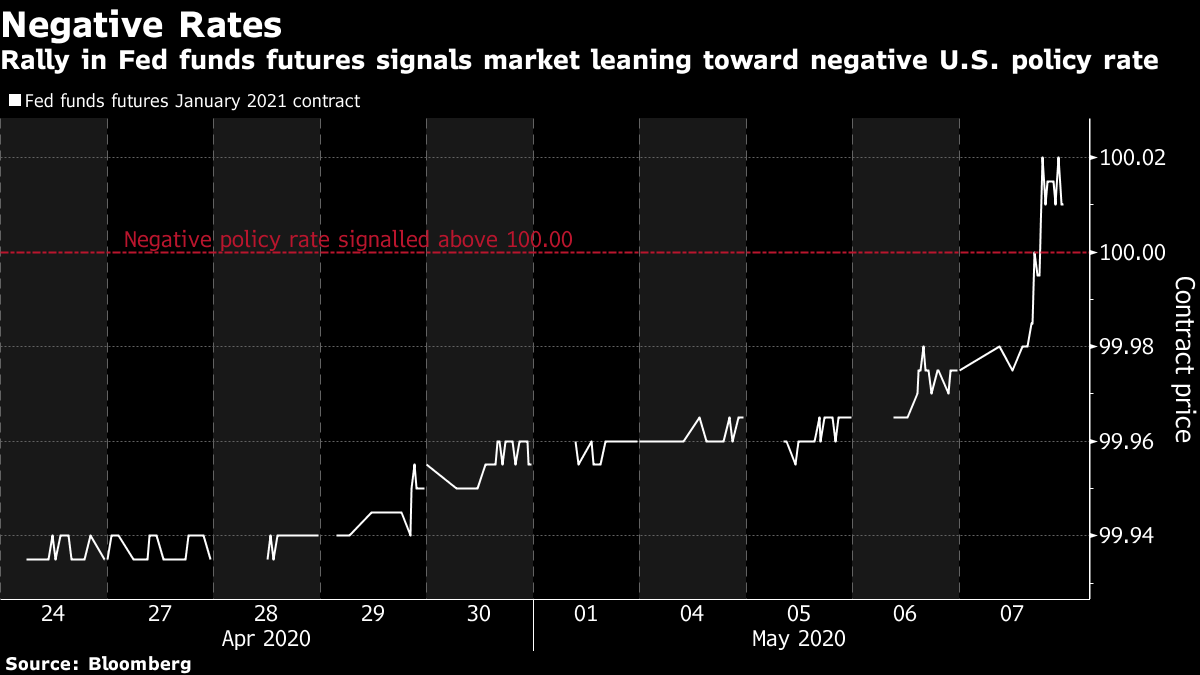 On the other hand, the move towards negative happened after the latest initial jobless claims showed 3.17 million Americans filing for unemployment benefits, the seventh straight week that the figure has come in above 3 million. That could suggest that the market sees the need for the Fed to embark on more extreme action to engineer an economic recovery. Or perhaps investors viewed the jobless number as more evidence that they need to hedge against the risk of deflation arriving in the U.S. through the Fed funds futures market. I could go on and on. For every argument here, there's a counter-argument. Take your pick, choose your side, and place your bets on what U.S. monetary policy will look like next year. You can follow Bloomberg's Tracy Alloway at @tracyalloway. | 


Post a Comment