This is Bloomberg Opinion Today, a reopening plan of Bloomberg Opinion's opinions. Sign up here. Today's Agenda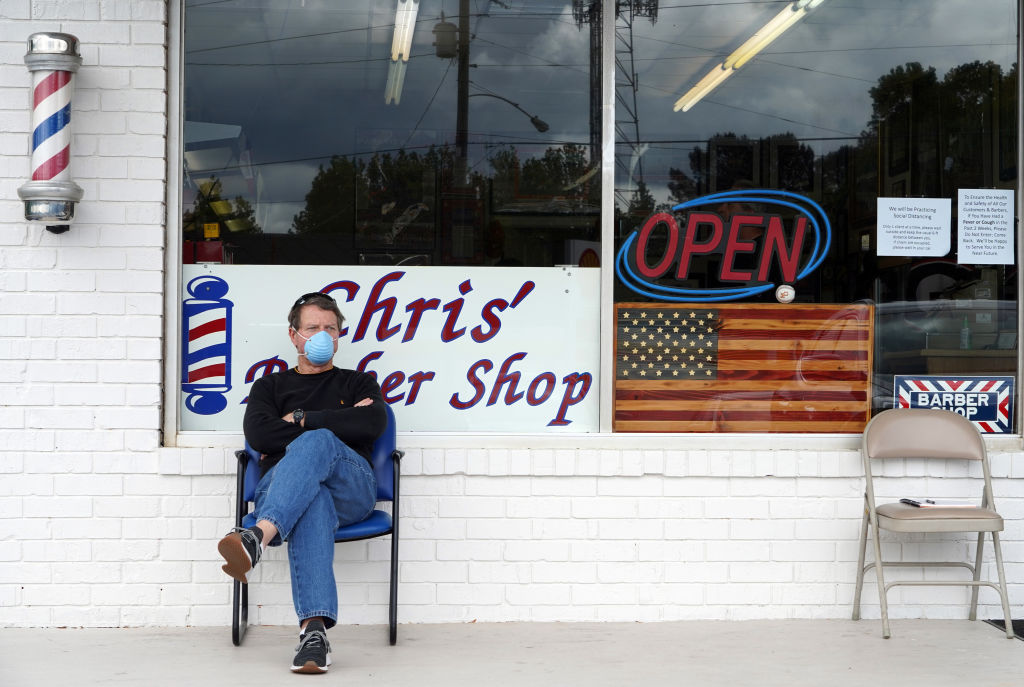 Worth the risk? Photographer: TAMI CHAPPELL/AFP/Getty Images Are You Sure You Want to Reopen That State?How worried should you be about your state reopening for business while a pandemic still rages? If you live in Colorado, Indiana, Iowa, Kansas or Nebraska, then the answer might be "very." If you're anywhere else, then the answer may be only slightly less than "very." Those five states have the worst combination of rising Covid-19 cases and low testing capabilities among those ending pandemic shutdowns, writes Max Nisen. And at least nine other states are on iffy ground at best. 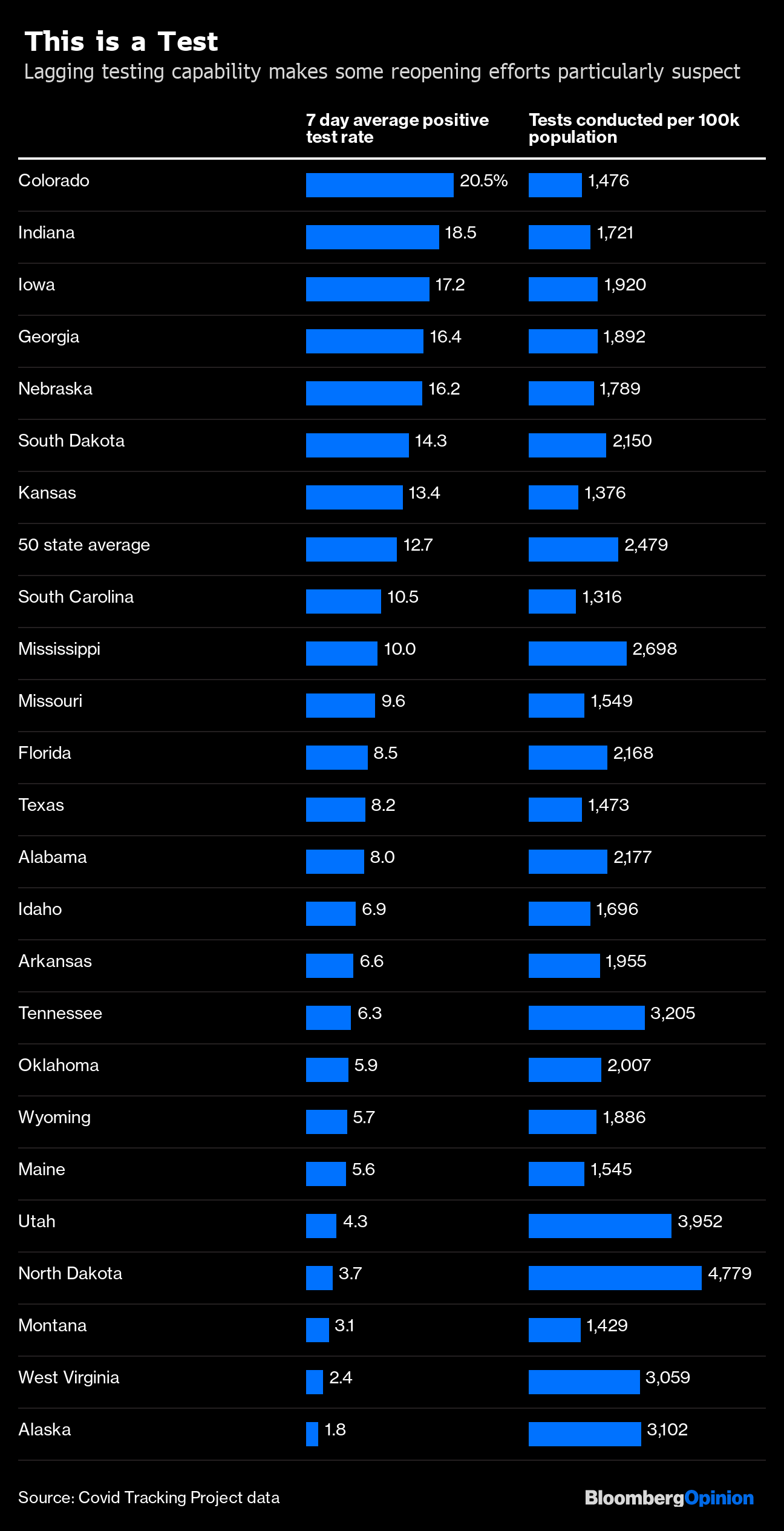 Toward the bottom of that chart — which includes all states that have reopened to some degree as of Monday — you'll see some are doing a relatively decent job of testing people. This gives them a better-than-average chance of avoiding a terrible resurgence of the virus. Not included in the chart is Minnesota, which is still edging toward a limited reopening. Fortunately, the Gopher State, working with the Mayo Clinic, seems to have testing figured out, writes Adam Minter; it may hit 5,000 tests a day this week, with a long-term goal of 20,000. Other states should get on Zoom with those nice Minnesotans to learn how it's done. More and better testing would help the whole country reopen more safely, in fact. But President Donald Trump still has no national testing plan, notes Bloomberg's editorial board. Letting states fend for themselves, as Trump seems wont to do, won't cut it. It takes national coordination to get equipment where it needs to go and to keep states and local governments from fighting over it. Testing has ramped up slightly since the early days, but it's still not nearly enough. Some estimate the country should test 20 million people a day; so far it's tested 8 million in total. Tyler Cowen, giving America a first-semester report card for its response, awards a D+ for testing. The rest of the grades are similarly awful, though the final project — finding an effective treatment or vaccine — is still incomplete. But what's been lost in the meantime is irrecoverable. Markets Won't Let a Little Depression Keep Them DownOne of the big things lost is a functioning economy. The Labor Department reported more than 3 million people filed for jobless benefits last week, taking the pandemic's seven-week total to 33.5 million. The stock market blissfully rallied, though, apparently on the idea things aren't getting worse. This focus on second derivatives just keeps dangerously widening the gap between Wall Street and Main Street, writes Mohamed El-Erian. One of the dangers is that a rising stock market may cool the sense of urgency to help workers who are still in desperate straits. As it stands, we've got unemployment benefits that could be going to underemployed workers right now, but we're not using them, points out Michael R. Strain. We're seeing some political aversion to offering much more stimulus, on the idea the government has piled up too much debt already. And this disaster came at a time when the whole economy was already up to its eyeballs in debt, writes Noah Smith. But the Fed can help take care of that by letting inflation run hot, which magically makes debt loads lighter, as it did in the 1940s. Now you just have to get the economy to play along. Further Economic Reading: Dang It Feels Good to Be a GamerBeing a gamer these days is sort of like being the guy in that famous "Twilight Zone" episode where the bookworm finds an intact library after the end of the world. Except this time he brings an extra pair of (spoiler alert) glasses. Because there is suddenly time enough at last for all the gaming you can stand, and arguably the best platforms and games in history to match, writes Tae Kim. This has been a particular boon to Nintendo, which released "Animal Crossing: New Horizons," just as millions went into quarantine looking for adorable escapist entertainment. Nintendo's aging Switch device suddenly has new relevance, writes Tim Culpan, giving Nintendo the opportunity to turn it into a must-have like Netflix. Telltale ChartsWe've got to stop saying Covid-19 is deadly only for the very old. It actually starts raising the risk of death at relatively young ages, according to some number-crunching by Justin Fox. 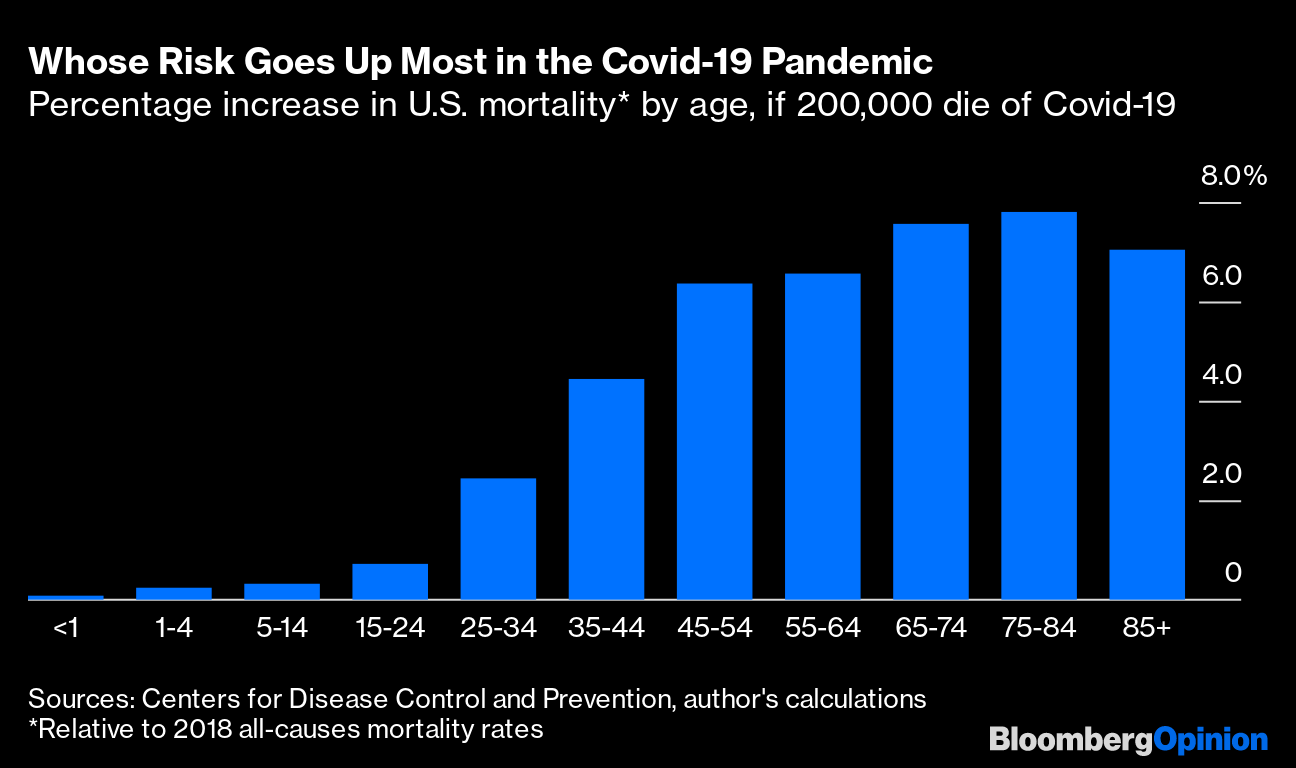 The Treasury Department's decision to issue more long-dated debt is, like Cheap Trick, big in Japan, writes Brian Chappatta. 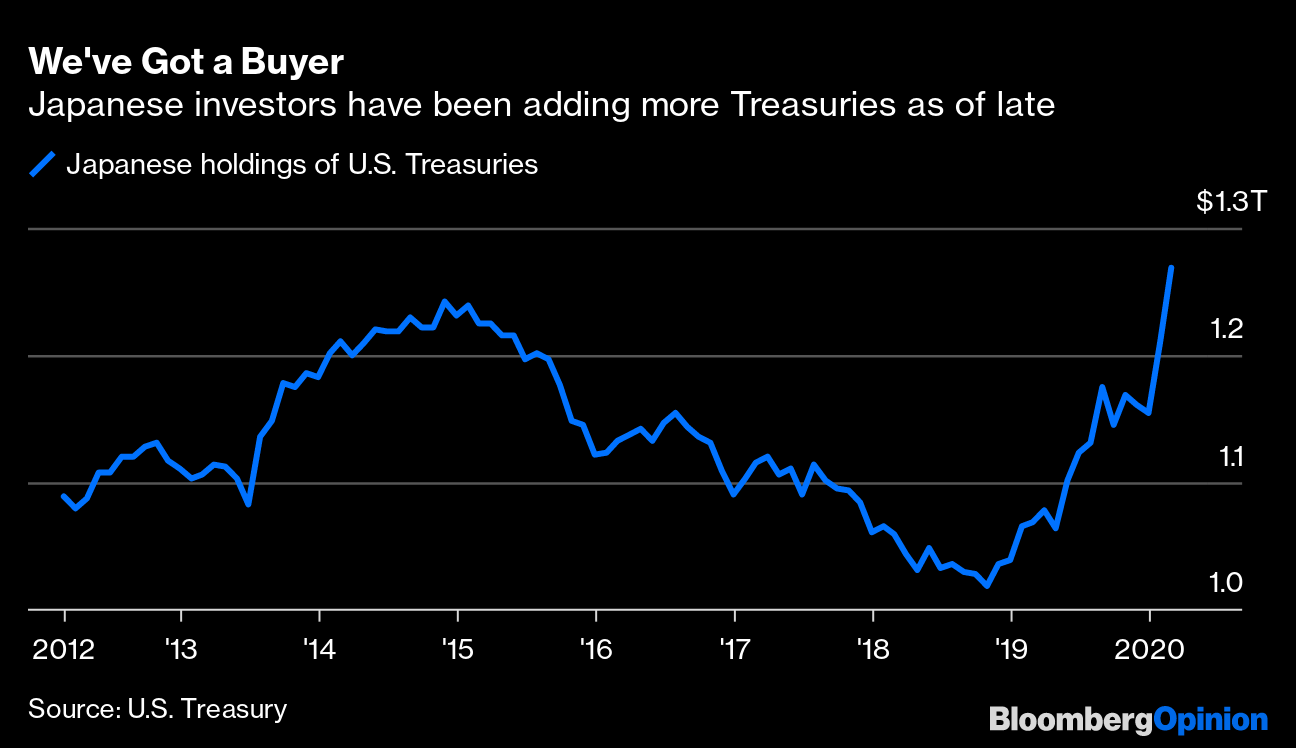 Further ReadingNeiman Marcus is the latest retailer to be hobbled by debt and slowing traffic and then felled by coronavirus. — Andrea Felsted We're seeing the fruits of the GOP's choice to shun policy making in favor of just saying loud stuff to rile up the base. — Jonathan Bernstein China had a chance to make inroads with Europe during this pandemic but overplayed its hand. — Andreas Kluth Erdogan's intervention in Libya is a rare policy victory. He should savor it while it lasts. — Bobby Ghosh Read this before doing your taxes this year. — Alexis Leondis The subway was the lifeblood of New York City and gave it character. It won't be the same again for a long, long time. — Cathy O'Neil ICYMIThe Justice Department is letting Michael Flynn off the hook. How U.S. meat plants became a virus breeding ground. Axl Rose and Steve Mnuchin exchanged words. KickersEvery Mario game, ranked. Poorly designed house for sale. (h/t Scott Kominers for the first two kickers) A new moon race has begun. Carl Sagan's rules for critical thinking. Note: Please send Mario games and complaints to Mark Gongloff at mgongloff1@bloomberg.net. Sign up here and follow us on Twitter and Facebook. | 


Post a Comment