| Want the lowdown on what's moving European markets in your inbox every morning? Sign up here. Good morning. The U.K. has new lockdown guidance, the U.S. is pushing ahead with reopening and there's a long road ahead for the economic recovery. Here's what's moving markets. Stay Alert The U.K.'s lockdown rules morphed into new guidelines, with the major change being urging people who can't work from home to go to work if possible, in an attempt to get the economy moving again. It's likely to face resistance from labor unions and Labour politicians. GDP data from the U.K. and Germany is due this week, providing an initial glimpse into the damage, just as the European Union risks an institutional showdown. Italian Prime Minister Giuseppe Conte said the country's lockdown may ease earlier than planned, while Spain reported the lowest number of deaths since March as its restrictions are also softened. Economic Disaster Like the U.K., the U.S. will urge people to get back to work, using South Korea and Austria as examples, but will do so as the White House deals with in-house infections. Presumptive Democratic nominee Joe Biden took aim at the country's "economic disaster," exemplified by brutal job numbers, which he says has been made worse by the policies pursued by President Donald Trump. The White House is pushing ahead with reopening plans, even saying that another rise in virus cases won't require another shutdown. The Supreme Court will this week hear Trump's case to stop Democrats and a New York prosecutor from seeing his tax returns, a major constitutional case that could provide another election flashpoint. Long Road Ahead Attention is starting to turn to recovery but the road ahead is looking more like a long slog than a quick snapback for Europe's economy. Global central banks seem poised to do more, from more interventions by the Swiss National Bank to pledges from China's central bank. The Federal Reserve thinks there is worse to come and faces the monumental challenge of how to ease the plight of tens of millions who have already lost their jobs, plus potentially many, many more as the situation worsens in May. The key ingredient for things to get back to normal? Confidence. Asset Outlook How central banks intend to proceed will put further attention on Fed Chairman Jerome Powell when he speaks on Wednesday, in particular in a bond market counting on ongoing support from governments and monetary authorities. Looking at the stock market isn't likely to give any clues on when the virus crisis is over, while pound traders are starting to look complacent with the ever-present risk of Brexit in the background. Ultimately, for all assets everywhere, the real risk to watch is whether virus cases and deaths start rising again. Coming Up… European and U.S. stock futures are following Asian equities higher, buoyed by a number of countries reporting the fewest virus deaths since March. Oil is falling after two weeks of gains as traders once more weigh up the glut of crude in the world against nascent signs of recovery. It's a relatively light day for economic data, with Italian industrial production on tap, while the earnings day is topped by German detergent and glue maker Henkel AG and British Gas owner Centrica Plc. What We've Been Reading This is what's caught our eye over the past 24 hours. And finally, here's what Cormac Mullen is interested in this morning If U.S. stocks are running too hot and their European counterparts too cold, then Asian shares are like a Goldilocks bowl of porridge for equity bulls, combining attractive valuations and defensive qualities. The arguments against U.S. shares have been well documented — too expensive, too dependent on the performance of tech megacaps and divorced from fundamentals. Their European peers are weighed down by concerns over the impact of sovereign debt levels, disagreements on joint fiscal support programs and now fresh question marks over European Central Bank stimulus. Over in Asia, while investors face broadly the same economic headwinds — first and foremost stocks are cheap. Blended measures of trailing and forecast earnings for the equal-weighted versions of the S&P 500, MSCI Europe and MSCI Asia Pacific Indexes show U.S. and European stocks trade on a similar multiple of around 17, while Asian shares trade on just 14 times. The metric — based on one proposed by The Leuthold Group's Jim Paulsen — benefits from anchoring valuations to earnings power in two contrasting economic periods: pre- and post-crisis, and equalizes influences across all underlying companies. Outside valuations, the economic backdrop for companies in Asia is arguably better — with April PMIs and economic surprise gauges as evidence of this. And on the coronavirus front, Asia is further along the timeline of flattened virus curves and re-opened economies. With no-one sure what comes next for equities, it seems Asian stocks offer a more attractive mix of valuation, defensiveness and growth characteristics than those in the U.S. or Europe. 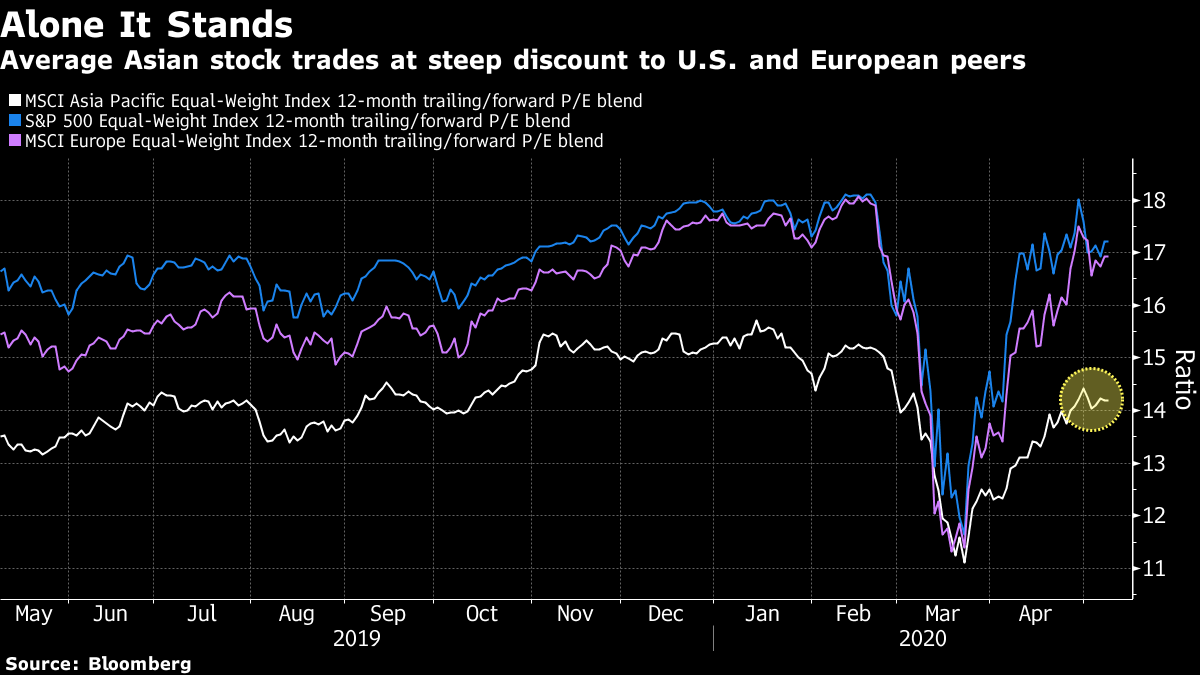 Cormac Mullen is a cross-asset reporter and editor for Bloomberg News in Tokyo. Like Bloomberg's Five Things? Subscribe for unlimited access to trusted, data-based journalism in 120 countries around the world and gain expert analysis from exclusive daily newsletters, The Bloomberg Open and The Bloomberg Close. Before it's here, it's on the Bloomberg Terminal. Find out more about how the Terminal delivers information and analysis that financial professionals can't find anywhere else. Learn more. | 


Post a Comment