| Virus cases in the U.S. surpassed 1 million while Singapore scales up medical facilities. Meanwhile all three of the city-state's banks are expected to see profit declines for the first time since 2016. And Australian businesses are worrying after Canberra drew China's ire by calling for a probe into the origins of the coronavirus pandemic. Here are some of the things people in markets are talking about today. Cases in the U.S. surpassed 1 million, according to data compiled by Johns Hopkins University. New York City reported a decline in the number of people admitted to hospitals for the new coronavirus, while the state's governor, Andrew Cuomo, laid out criteria necessary for some upstate regions to reopen. Singapore is scaling up medical facilities as the number of virus cases inches closer to 15,000, making it Asia's most-infected nation after China and India. France plans to begin reopening shops on May 11, while Spain is preparing for a "new normal" as Europe's most hard-hit nation removes restrictions over the next eight weeks.The number of new infections in Germany fell below 1,000 for the first time in more than five weeks. Meanwhile, China's top scientists said the virus won't be eradicated, joining a growing consensus that the pathogen will probably return in waves. Here's how they're attempting to prevent a second wave of infections. Stocks in Asia were poised for a mixed start on Wednesday after a volatile U.S. session that saw equities slip and Treasuries climb amid a slide in consumer confidence and as more companies withdrew earnings guidance. The dollar weakened. Futures in Hong Kong dipped, while those in Australia rose, while Japan is shut for a holiday. The Nasdaq Composite snapped a two-day winning streak, pulled down by Facebook, Amazon.com and Netflix as data showed U.S. consumer confidence dropped in April to the lowest since 2014. Treasuries rose. Meantime, U.S. oil markets were roiled again as investors bail on near-term contracts for fear of negative prices. All three of Singapore's banks are expected to see profit declines for the first time since 2016 as they set aside cash for a potential spike in bad loans stemming from the coronavirus-fueled economic slump. Net income at each lender probably slid between 21% and 28% in the three months ended March 31 from a year earlier, according to the average estimates of six analysts surveyed by Bloomberg. DBS Group Holdings Ltd., the nation's largest bank, may post the steepest profit drop when it kicks off earnings season on Thursday, while Oversea-Chinese Banking Corp. is forecast to report the smallest contraction. The pain for Singapore's lenders is set to persist as the city-state braces for a sharp economic contraction this year thanks to the pandemic that's crippling manufacturing, tourism and other services. Banks are also contending with falling interest rates and slowing loan growth, and the crash in oil prices may trigger defaults among local firms that cater to the energy sector. OCBC and United Overseas Bank Ltd. will report next week. Tension is heightening between Australia and China after Canberra called for an independent probe into the origins of the coronavirus pandemic, worrying businesses in the world's most China-dependent developed economy. Even as Australia prepares for its first recession in almost three decades, Foreign Minister Marise Payne said an independent tribunal with powers similar to United Nations weapons inspectors should be allowed to enter Wuhan, where the outbreak first emerged late last year. She also called for an independent review into how China and the World Health Organization handled the initial stages of the pandemic. Australia has also called for the end of wildlife sales in so-called wet markets, one of which was one of the first places in Wuhan where the virus was detected. The move don't come without the risk of blowback: China remains Australia's largest export destination, with sales of iron ore, coal and food at the heart of their A$213 billion ($137 billion) trading relationship. As dividends are slashed around the world, the $42 billion in promised payouts by China's biggest banks have a powerful defender - the Communist Party. Industrial & Commercial Bank of China Ltd. and its three biggest peers are returning more than 30% of their 2019 earnings to shareholders, implying an average dividend yield of more than 6%. That's nearly double what's offered by their competitors in the U.S. But with the banks facing trillions of yuan of potential credit losses from the coronavirus fallout, there's debate on whether China's mega lenders should maintain payouts to keep investors, especially their government owners, happy at the cost of their own deteriorating capital strength. The approach is very different overseas. Banks in the U.K. and Denmark scrapped dividends to meet demands from regulators, while payouts were hit in Switzerland and Australia as watchdogs encouraged lenders to preserve capital. What We've Been Reading This is what's caught our eye over the past 24 hours. And finally, here's what Tracy's interested in this morning There's an old chart from Goldman Sachs, published back in 2009, that I still think about. It shows the average cost of capital for airlines versus their average return on capital. For the entire duration of the chart — from 1993 to 2009 — there's a big gap between the two lines that's simply labeled "loss of investor capital." The chart implies that even in the good times airlines don't necessarily make money for investors. Now, Covid-19 seems almost certain to make the business of flying even more uneconomic than it historically has been. 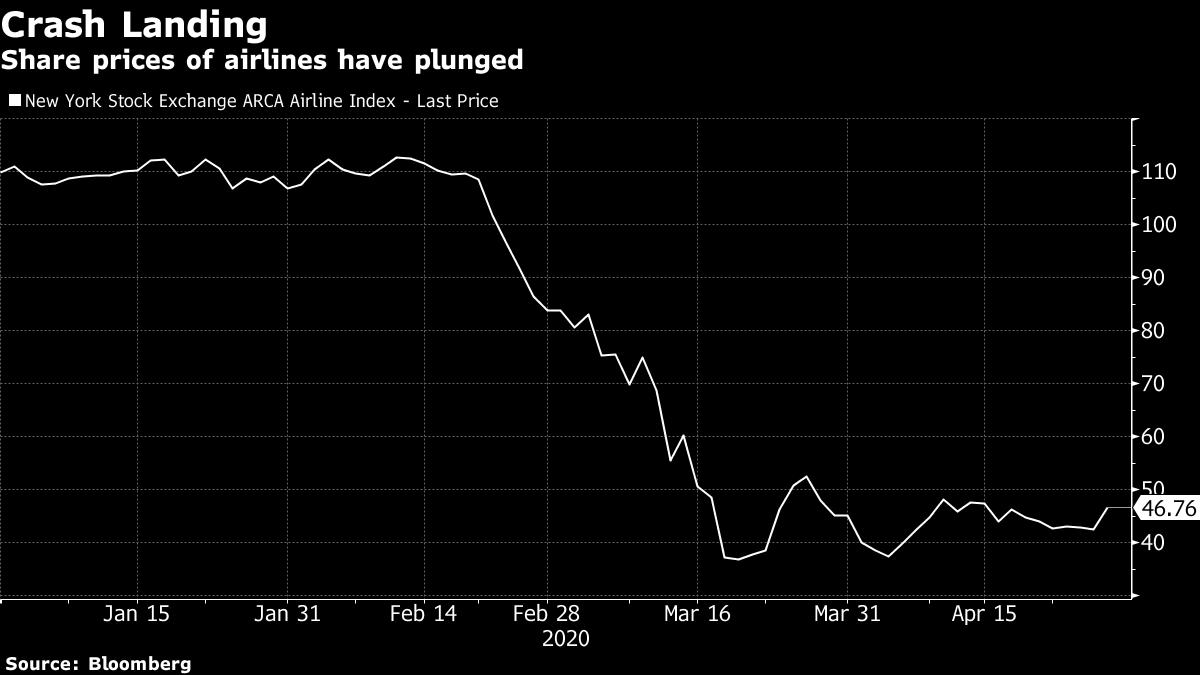 Government support is helping to provide a lifeline for individual carriers in the short-term, allowing them to issue some stock and bonds to raise new money (Southwest announced on Tuesday that it would sell shares and $1 billion worth of convertible debt). But it's pretty clear that they wouldn't be able to do so without an implicit government guarantee. In that sense, the coronavirus might (finally) force a re-evaluation of the viability of the entire airline industry. You can follow Bloomberg's Tracy Alloway at @tracyalloway. For the latest virus news, sign up for our daily podcast and newsletter. | 


Post a Comment