| Welcome to your morning markets update, delivered every weekday before the European open. Good morning. Skepticism grows about Donald Trump's oil breakthrough, more data will emerge on how bad a hit the economy is taking and confirmed virus cases topped 1 million. Here's what's moving markets. Crude Volatility Not that oil markets were in need of headlines to cause extra volatility, but Thursday delivered a huge move after U.S. President Donald Trump tweeted that Saudi Arabia and Russia, currently engaged in a price war, will cut output. Crude soared but that rise is abating because the devil will be in the details. Questions are already being raised on whether such a move would be legal and if it would be enough to address the glut of oil; a supply cut also won't help with the huge demand drop. The oil industry seems skeptical too. Right now, oil spikes and slumps are the biggest cause of volatility in stocks too, so getting more information will be essential for other asset classes too. The Economy Uniformly shocking economic statistics are likely to be the rule rather than the exception for weeks as the impact of the pandemic ripples around the world. The eye-popping U.S. jobless claims on Thursday quite rightly caused significant concern, with some states having seen 10% of workers lose their jobs in three weeks and the middle class also feeling the pain. The monthly payroll figures later today will provide more insight and will be at the front of all market-watching minds, but there can be no question that the global economy is nursing some significant bruises from a virus outbreak some have estimated will ultimately cost $4.1 trillion. 1 Million The world passed 1 million confirmed coronavirus infections on Thursday. For Europe, while the curve is flattening in Italy, the number of deaths in Spain shows that lockdown measures are unlikely to end any time soon. The U.K. has continued to see an increase in deaths but the focus there is on the government response and the ongoing pressure on the government to expand testing at a much quicker rate. In addition, the 'B'-word has reared its head, with canceled meetings raising suggestions that a European Union exit may be delayed. France is preparing more stimulus, Austria is providing a case study in the limits of the state paying wages and the European Central Bank's strategy review is going to have to wait. Asset Corner As we reach the end of another hectic week, here are a few other areas where the virus disruption is causing havoc for you to keep in mind. Food prices have dropped the most since 2015, in part due to biofuel prices having dropped in sympathy with crude and dragging on commodities like sugar, corn and vegetable oils. The case for a rescue of the U.S. municipal bond market is growing, with prices dropping, market access limited and investors pulling out. High-yield bonds funds are seeing record inflows, half of all jobs in Africa could be imperiled and this is what the guardians of the foreign-exchange galaxy are doing to try to heal the market. Coming Up… The crude oil-driven rally faded in Asia and stock futures in Europe and the U.S. are pointing to another down day for markets. U.S. payrolls will take the vast majority of the attention on the data front, but we'll also have purchasing managers indexes for the services sector in the euro area and the U.K., both likely to point to yet further slowdowns. And then, whether or not you're able to leave your house, and you're probably not, it is the weekend. What We've Been Reading This is what's caught our eye over the past 24 hours. And finally, here's what Cormac Mullen is interested in this morning Strategists and analysts may be talking about positioning for the post-crisis recovery, but rates traders aren't buying it, at least according to the Fed funds futures market. It shows U.S. investors aren't expecting a hint of a rate hike all the way through until at at least the end of next year. With some economists now projecting U.S. GDP heading for its worst drop in quarterly records back to 1947, it's easy to understand their pessimism. And with the epicenter of the coronavirus outbreak now firmly in the U.S. and many areas of the country still not in lockdown, the awful human toll is only likely to mount. Meanwhile, Treasury yields have resumed their downward march with 10-year ones heading back toward the 0.5% level. Essentially, bond and rates traders are back at odds with their more optimistic equity counterparts — remember the S&P 500 is still up about 15% from its late-March low. The next couple of weeks could be hard for an equity bull, and stocks could soon follow their fixed-income counterparts in pricing in a further away recovery. 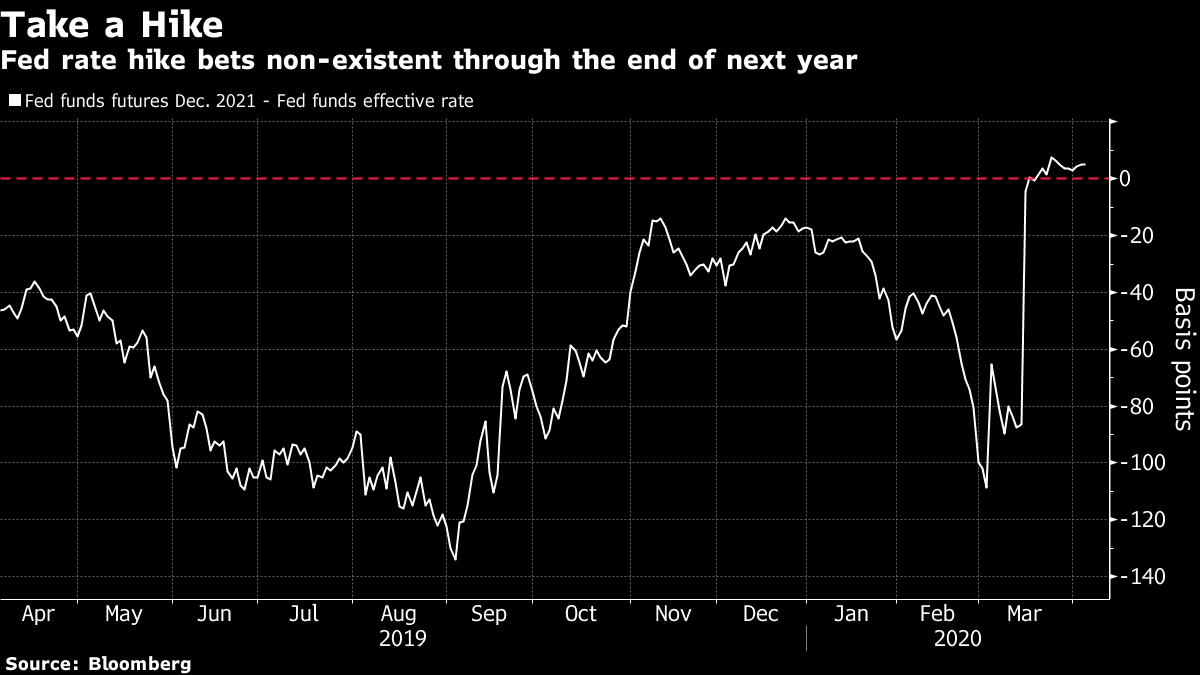 Cormac Mullen is a cross-asset reporter and editor for Bloomberg News in Tokyo. Like Bloomberg's Five Things? Subscribe for unlimited access to trusted, data-based journalism in 120 countries around the world and gain expert analysis from exclusive daily newsletters, The Bloomberg Open and The Bloomberg Close. | 


Post a Comment