| This is Bloomberg Opinion Today, a flying collateralized debt obligation of Bloomberg Opinion's opinions. Sign up here. Today's Agenda  Traveling is more fun than ever. Photographer: Bloomberg/Bloomberg We Have Met the Derivatives, and They Are Us Ever since the financial crisis we've reassured ourselves that such a thing can't happen again for a long time, that with tame banks and derivatives, there's no more market voodoo out there strong enough to hex the economy. But maybe the seeds of the next meltdown were staring us in the face all along, whenever we looked in the mirror. Just as shutting down the flow of credit triggered a deep recession in 2007-09, shutting down the flow of people could be disastrous this year, warns Clara Ferreira Marques. We've already seen how strict quarantines and production stoppages in China hurt its manufacturing worse than in 2008. The rest of the world could feel the same pain if the coronavirus isn't brought to heel soon. The effects could in some ways be worse than the financial crisis, Clara warns, because there are fewer quick fixes, and some of this demand will be gone forever. For example, say you decide not to fly your family from New York (22 confirmed coronavirus cases as of this writing) to Florida (four cases) for Spring Break. Your kids won't get another long break from school until the summer, by which time you might be thinking about canceling that vacation, too. This is the grim calculus facing airlines, which were already seeing demand fall before the virus really got going, writes Brooke Sutherland. An extended decline will crush their already fragile profit margins. And it will have ripple effects for airplane-makers, still trying to catch their breath from the trade war and Boeing Co. 737 Max grounding. If airplanes are basically sealed, flying collateralized debt obligations of people, then so are movie theaters. People were already choosing to stay home with their Netflixes and Primes and what-not, notes Tara Lachapelle. Add coronavirus worry to the mix, and you've got plenty of reasons not to cram yourself into a theater with coughing strangers just to experience "Fantasy Island" on the big screen. Just like that, you've got another industry on the rocks. And this, folks, is why stocks keep falling. Why Can't We Be More Like China? On the hopeful side, things may be looking up in China somewhat, and that's partly because Beijing figured out how to keep greasing the financial skids of production to ease the pain for manufacturers, writes Tim Culpan. The U.S. has not been nearly as creative. Congress has passed an $8.3 billion package of coronavirus relief, but the economy needs fiscal stimulus, too, writes Michael R. Strain. Unfortunately, Trump is resisting such calls, relying instead on his time-tested strategy of yelling at the Fed. The European Central Bank, meanwhile, also seems content to ride this thing out for a while, but then it has less in its toolkit than the Fed or U.S. government, write Marcus Ashworth and Elisa Martinuzzi. Euro-zone interest rates are already negative, and it's too risky to extend much more easy credit to already shaky banks. Further Virus Response Reading: This could overload Brazil's already strained public health system. — Mac Margolis Special Relationship to Be Tested for Specialness One of the big promises Boris Johnson has made about Brexit is that the U.K. will finally be free to fully embrace its BFF, the U.S. As with many Brexit promises, this may have been a smidgen exaggerated. Johnson's government this week put out a paper on its goals for a glorious trade deal with the U.S., and they are underwhelming in the extreme, writes Therese Raphael — I mean, unless a 0.16% boost to GDP gets your motor running. Even the political gains from closer trade, the real goal of such talks, will be elusive, Therese warns. Even before trade talks get going in earnest, Trump's National Security Council is considering putting some distance between itself and the U.K. by withdrawing defense assets from British soil, Eli Lake reports. This may just be a threat to push Johnson to reverse his decision to let Huawei into Britain's 5G network. But it's also a real point of contention, spoiling the beginning of this beautiful new phase in the Special Relationship. Telltale Charts: Coronavirus Numbers Edition With news and markets being all coronavirus, all the time, it's easy to lose perspective. Is this the prologue to the apocalypse or just a particularly nasty cold? Fortunately we have numbers to help settle these questions, and Justin Fox has crunched them into charts for us. For one thing, coronavirus is far deadlier than the flu, but not nearly as deadly as SARS: 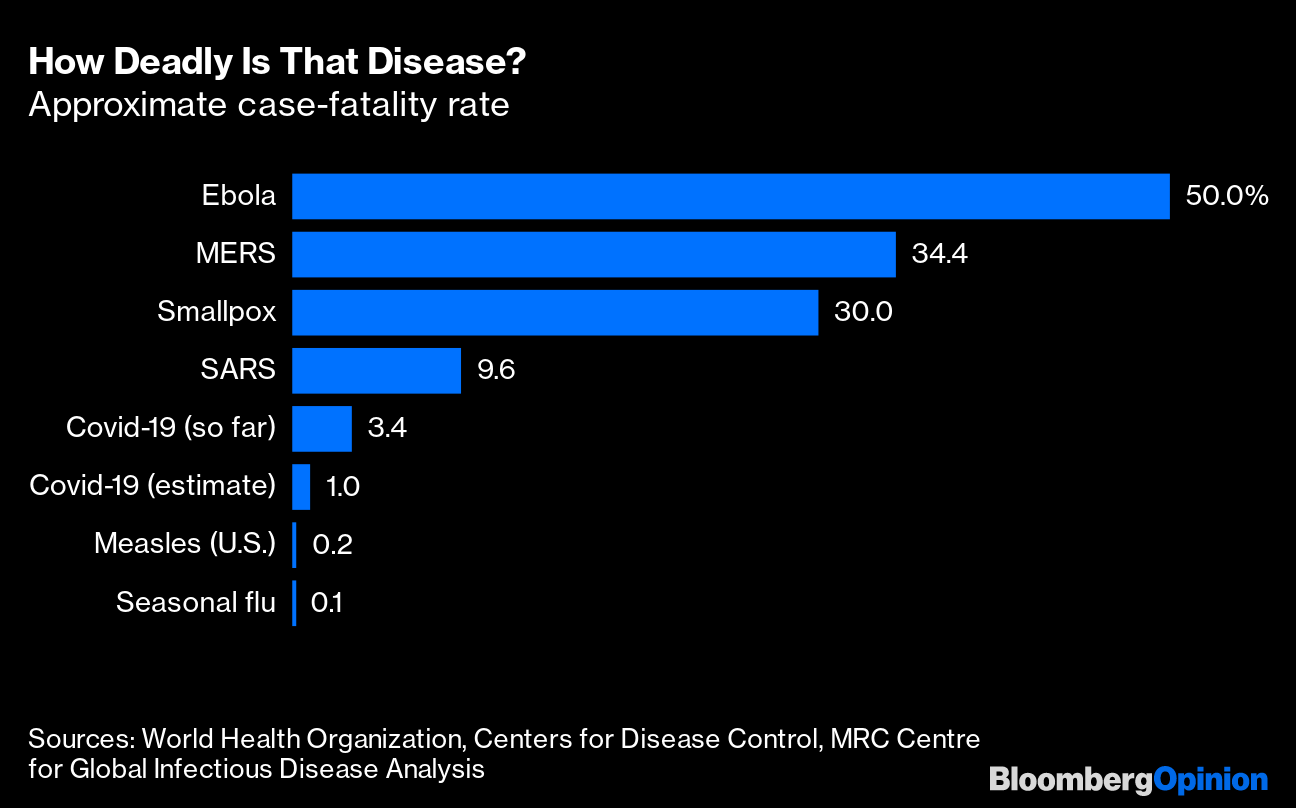 And it is also much more contagious than the flu, but not nearly as contagious as measles (though all of these numbers might change with time): 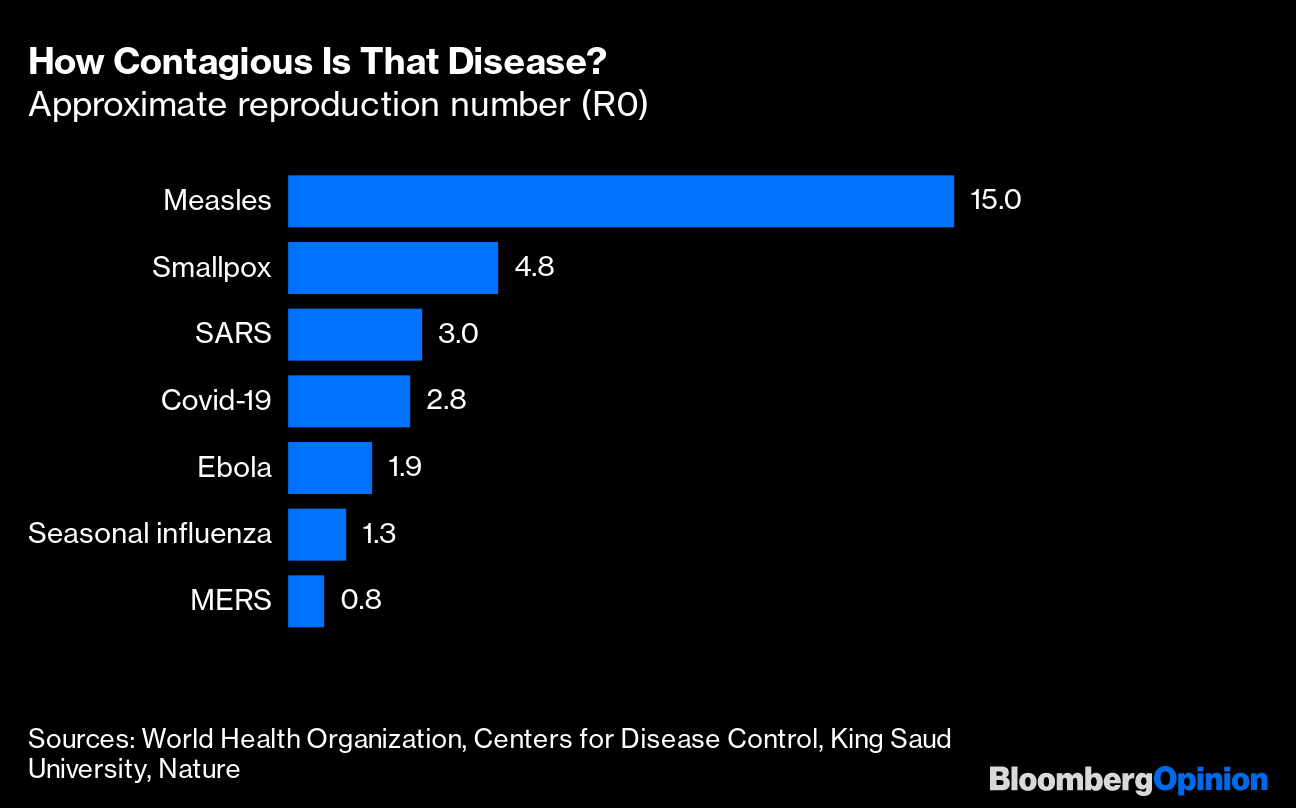 Further Reading Don't kid yourself: Elizabeth Warren lost partly because she is a woman. — Francis Wilkinson Chevron Corp. and Exxon Mobil Corp. both claim oil demand will rise forever, but only Exxon is staking its future on that misguided faith. — Liam Denning As if the Fed didn't have enough problems, the repo market is acting up again. — Brian Chappatta How Brown managed to trounce all the other Ivy League endowments last year. — John Authers Chuck Schumer's attack on conservative Supreme Court justices was out of line. — Noah Feldman ICYMI What doctors in Wuhan say about the coronavirus. Mortgage rates are tumbling. Farmers fight John Deere over who gets to fix an $800,000 tractor. Kickers Artist makes travel posters for parks based on 1-star reviews. (h/t Scott Kominers) The brain has a nightly rinse cycle. The body has a remarkable ability to adapt to extreme cold. A man lived in a bunker under a public park for two years. Note: Please send 1-star reviews and complaints to Mark Gongloff at mgongloff1@bloomberg.net. Sign up here and follow us on Twitter and Facebook. | 


Post a Comment