| The message from China's leaders has been clear: recovery from the coronavirus must begin without delay. Factories that were idled for weeks by the outbreak are racing to jump-start production. Local governments are rolling back restrictions on travel. Airlines are adding flights even if no one wants to fly. China's policymakers certainly have more economic levers at their disposal than many of their western counterparts. The state's dominance of industries such as banking, energy and transportation amplifies Beijing's influence beyond even what lower taxes and cheaper borrowing costs can effect. That top-down approach also has its pitfalls though. Pressure from above to restart production could lead lower officials to rush people back to work without the proper precautions, for example. That could endanger an encouraging recent trend that seems to show authorities are getting the spread of infections under control. 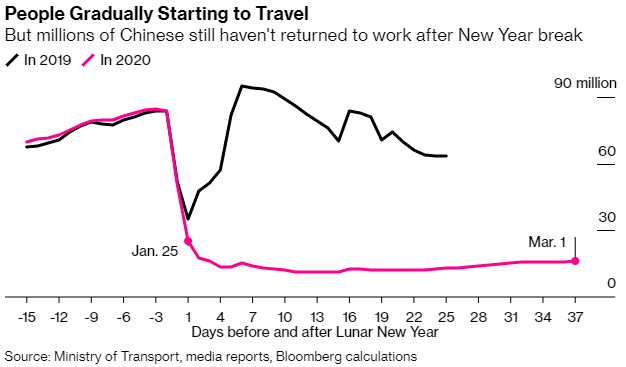 Meanwhile, there's evidence that the push to fire up growth is also leading to doctored data. In coastal Zhejiang province, local officials have given businesses electricity usage targets to reach so that the data can be used to show production is ramping up. To hit their quotas, some plants have resorted to running machinery even as factory floors sit empty. And then there's the danger that buoying the economy today could plant the seed for a future crisis. China has pushed its commercial banks, the biggest of which are state-owned, to give reprieves to smaller businesses unable to service their loans because of the outbreak. S&P estimates that could result in China's "questionable" loans peaking at 11.5% of GDP in the aftermath of the virus. But with that said, Beijing also can't sit on the sidelines as the virus pummels the economy. Policymakers have to act, in spite of the risks. It is the unenviable position of being damned if you do and damned if you don't. Great Power Rivalry If you thought a deadly virus spreading quickly across the globe might at least temporarily mollify tensions between the U.S. and China, you'd be wrong. Recent signs the rivalry is heating up include a bid by the U.S. to secure more rare earth minerals and a fight over who leads an obscure United Nations agency in Geneva. More concerning though is a brewing battle over media. The U.S. this week slashed by 40% the number of staff four Chinese state-owned news outlets can have in America. That was in part a response to China's decision last month to expel three Wall Street Journal reporters. A Chinese spokeswoman then responded to Washington's move with a strongly-worded tweet, suggesting Beijing would retaliate. It's not hard to imagine things escalating from here, even if it's to no one's benefit. Smog Signals There's no shortage of data showing the tremendous impact the coronavirus has had on China's economy. Everything from gauges of manufacturing to cars sales to demand for diamonds has plunged. But perhaps nothing has been more starkly illustrative than pollution, or to be clear, the sudden lack thereof. Satellites operated by NASA and the European Space Agency have detected a significant drop in pollutants above vast swaths of the country. Though more recently, emissions levels have begun to climb as industrial activity picks up, which is both good and bad news. 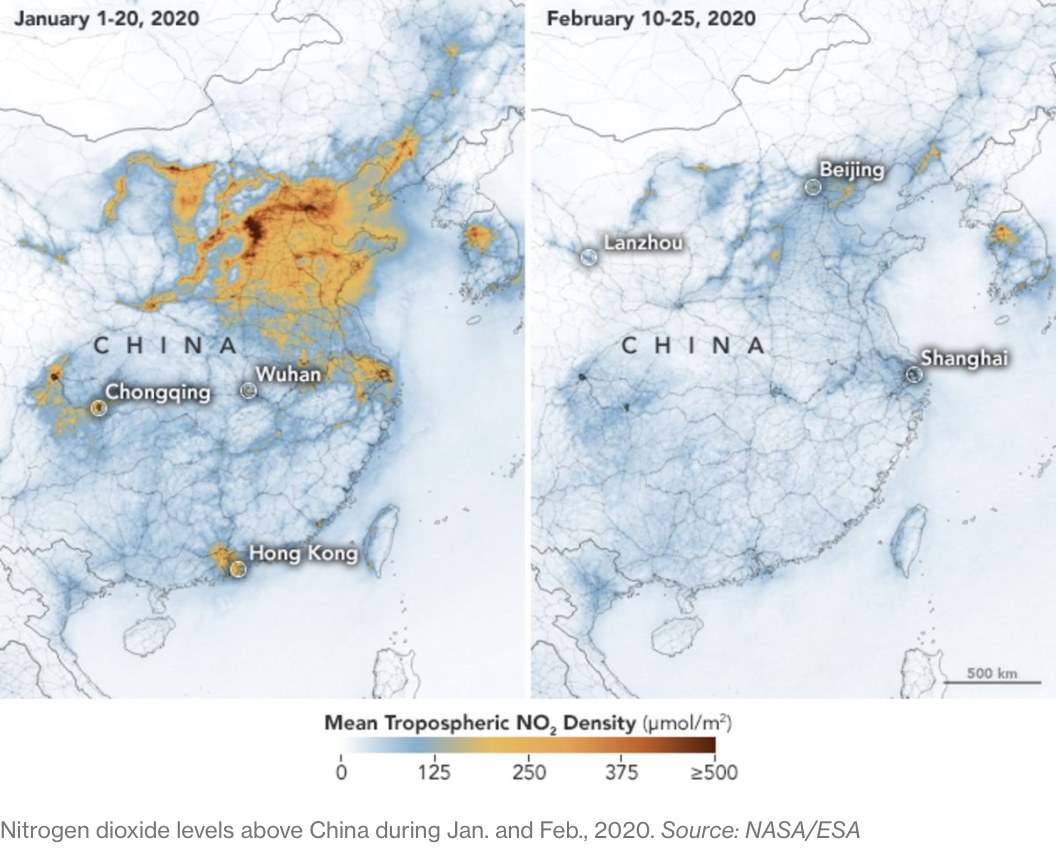 Swine Fever China's top research body on animal diseases has created a vaccine for African swine fever that in laboratory testing appears to be safe and effective. This could be a significant development if it results in the rollout of a viable vaccine. The disease, which is deadly for pigs but doesn't infect humans, has devastated the country's supply of pork, the staple meat for much of the population. But there's also reason not to jump the gun. African swine fever is not a new disease. It's been spreading for decades from Africa to Europe to Asia, causing havoc along the way. All attempts to create a vaccine have to date failed. It's possible that China, which consumes more of the meat than any other country, has made a breakthrough. Though it's also possible that more work is needed. Relative Strength One part of China's economy that's come roaring back is its financial markets. An index of the largest companies listed in Shanghai and Shenzhen has gained more than 30% since the last trading day before the Lunar New Year holiday. Those gains have been fueled by a slew of stimulus measures announced by Beijing to counter the outbreak and expectations that more will follow. Morgan Stanley named equity markets in China, Singapore and Australia the best places for stock investors to weather the coronavirus. China's currency, meanwhile, has also rebounded. It's recouped all its losses sustained since the outbreak took hold thanks in part to the Federal Reserve's emergency rate cut, which sparked a weaker dollar. 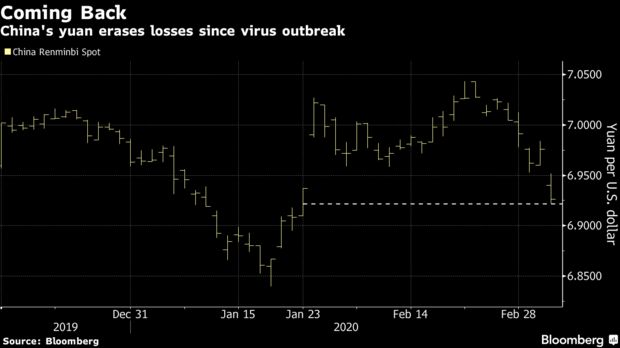 What We're Reading And finally, a few other things that got our attention: | 


Post a Comment