| Good afternoon from Los Angeles, wherever you may be. For the next several weeks (and likely months), we are going to be reporting on the fallout from one of the worst public health crises of my lifetime. I will continue to provide an outlet for news about the entertainment and media industries in this newsletter. To make sure I am best serving all you readers, I want to encourage you to reach out with stories about how your life is changing, how those around you are suffering or finding new creative outlets, as well as what you are watching, reading and talking about. If you are lonely and just want to talk… I am around. Don't hesitate to reach out. I am also introducing a new feature within this newsletter. I am going to answer questions from readers. You can see the first few below. Without further ado, here's the rundown. – Lucas Shaw We are all TV addicts now Time spent watching TV, streaming video and gaming is skyrocketing. Just pick your data: Streaming video usage spiked more than 20% globally last weekend. Gaming is up 75%, according to Verizon. 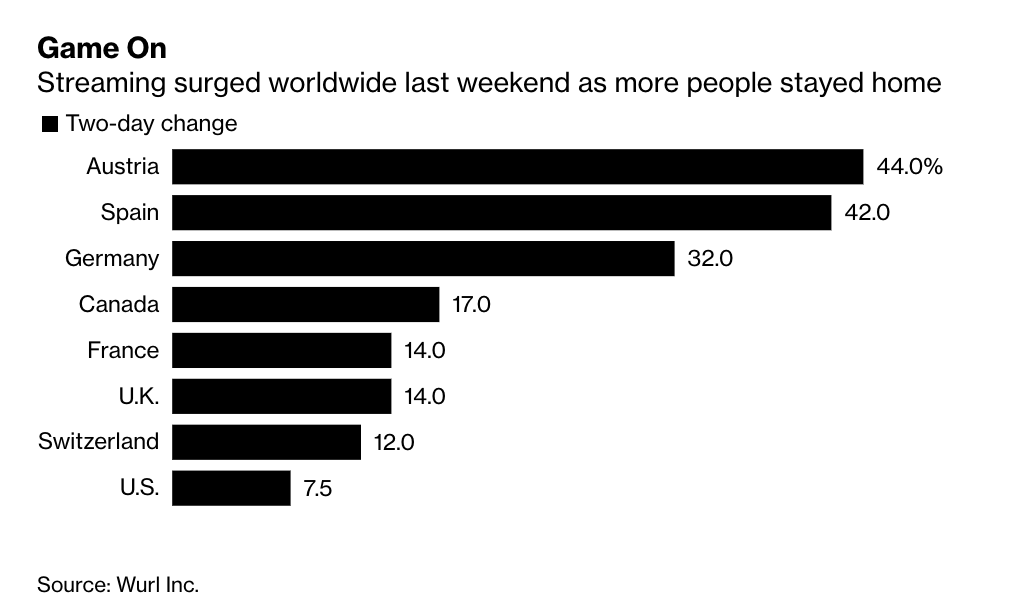 The demand for TV is so great that governments are nervous it could break the internet (not literally). Netflix, Amazon and YouTube have had to cut back on streaming quality at the behest of European regulators, while France has asked Disney to hold off on the rollout of Disney+ to prevent added pressure. U.S. providers say they have enough to go around. It's not hard to understand why. We can't go outside! (Or shouldn't at the very least.) But the growing demand for programming at home – and the limited business options outside the home -- are forcing media companies to tear up their strategies. Universal Pictures will offer movies such as "Invisible Man" and "Trolls: World Tour" for rental at home before they leave theaters, while Disney is releasing "Frozen 2" and "Onward" for rental and streaming months ahead of schedule. This is either a huge deal or a nothing burger, if you followed along on Twitter. The truth is somewhere in between. Hollywood studios have long wanted to collapse the theatrical window, aka the lag between when a movie is in theaters and when it is made available at home. They spend millions of dollars marketing a movie for its theatrical run, and then must wait months for it to be available at home, forcing them to spend yet more money marketing the title. Theaters have resisted efforts to shorten this window, and have prevailed in part because Disney has resisted. Theater owners are none too pleased with Universal. John Fithian, the head of the National Association of Theater Owners, said his members will "never forget." Why get mad at Universal and not Disney? Universal took movies still in theaters, and made them available at home. Disney has only expedited the at-home release of movies that have left theaters. (I would note that Paramount sold one of its movies to Netflix, which will have the same net result: it'll be available at home.) The movie business isn't changing forever, despite hyperbolic headlines this week. These studios aren't releasing their biggest projects at home because they don't think they would make as much money. Movies like "F9," "Mulan" and "Wonder Woman 1984" are expected to gross upwards of $500 million at the box office, and millions more in DVD sales, video-on-demand and rentals. How much studios can make on $20 or $40 rentals for big new movies is a great unknown. It's still best to stash the project and release it when theaters are open again. But the experiment makes sense for a movie like "Invisible Man," which has already made most of its money from theaters and can now get a little boost from people stuck at home. Readers ask: Will we see more surprise releases?  Source: Disney Source: Disney With the uncertainty roiling society right now, I want to be as responsive as possible. So I am going to answer a few questions people posted on Twitter, and I hope some of you will send along questions (in whatever manner you like) for next week. You can ask them anonymously. "How much content remains in Netflix's strategic reserve?" -- Casey Newton Netflix is in a better position than most because of its release startegy, and tonnage. Netflix releases all its episodes at once, so it needs full seasons to be finished before they are released. The service plans to release multiple projects a week for the next couple months, including new seasons of "Money Heist," "After Life" and Hasan Minhaj's "Patriot Act." But this is a blessing and a curse. In the short term, it will be putting more product into the world than any of its rivals. In the long term, it will struggle to keep up that pace. TV networks and streaming services aren't just sitting on huge piles of unaired new programs. Most networks tell me they can survive a couple months without production, but after a couple months, things get hairy. Most shows due for release in the summer or fall are unfinished. Heck, FX had to delay the release of a new season of "Fargo," due out in April, because the last two episodes weren't done. "We don't see any disruption in our output over the next few months," Netflix Chief Content Officer Ted Sarandos told Brian Stelter this morning. You know, maybe later in the year, if this progresses long, you'll start feeling some of that as the physical production is not operating." Or, as one senior executive told me, "There will be holes in the schedule." Will Disney add more recent releases early on Disney plus, like that one with lightsabers? -- Matt Townsend Disney doesn't have much left in the cupboard. "Toy Story 4," "Avengers: Endgame" and "Aladdin" are all on the streaming service already. Disney could move up the release of "Rise of Skywalker" for streaming, but it might need to save that bullet for a couple weeks from now to sustain interest in Disney+. Unlike almost all of its rivals, Disney+ doesn't have a big new show on the schedule for any time in the next 6 weeks. Its programming highlights for April are nature documentaries and a cooking show. Disney won't release upcoming movies like "Mulan" or "Black Widow" at home for the reasons discussed above. It can't move up the release of TV shows in development like "The Falcon and the Winter Soldier" because they aren't done. Any ideas on what sort of content tends to be demanded during a crisis like this one? And in its aftermath? -- Victor Alonso-Berbel Caveat: It's a little early to answer this, and data is spotty. But…. My understanding is comedies and other "feel-good" programming are doing very well. I am especially interested in what's happening in music as well. So if you have any data, give me a shout! It's also a great time to be working in obscure sports, or sitting on archival footage. Networks that rely on live sports are a little desperate, which is why ESPN 2 is airing marble racing on Sunday. What are the knock on effects for creativity? Will studios batten down the hatches and only green light things that squeeze out the novel ideas? -- Kamal Yeechor Studios are still buying, for now. Record labels are still buying, for now. My sense is these companies are going to be more judicious about what they approve because they don't know how long they will be out of production. They don't want to create a huge backlog. But this is going to be a great time for user-generated programming. Thousands of creative people are stuck at home with few outlets, so they are going to fool around with YouTube, Twitch, TikTok, Snapchat, Instagram and apps we don't think about. DJ D-Nice hosted a live Instagram session yesterday that attracted more than 100,000 people, including Mark Zuckerberg and Oprah Winfrey. While big companies might be conservative, I'd argue this is a great time for Netflix or Amazon to fund the creation of movies made at home, or experiment with new formats. Set up a fellowship! Hollywood asks for government help  Photographer: Sadiq Asyraf/AP PHOTO Photographer: Sadiq Asyraf/AP PHOTO Adam Schiff, a Democratic congressman from Southern California, signed a letter calling for the government to support entertainment workers. Movie-theater owners have also asked for help, as has the music business. The federal government is considering a trillion-dollar bailout for the economy, but is still weighing which industries will receive financial support in the months ahead. Studios have halted productions around the world in response to the coronavirus, putting actors, writers, truck drivers, sound engineers and gaffers out of work. How likely is a federal bailout of the entertainment business? Variety says it is unlikely. The support will have to come from the companies, wealthy shareholders and charity. To that end, Netflix has created a $100 million fund to support Hollywood laborers put out of work by the coronavirus. Don't expect live events until summer, at the earliest  Photographer: Cameron Spencer/Getty Images AsiaPac Photographer: Cameron Spencer/Getty Images AsiaPac The Cannes Film Festival is now postponed, as is almost every major film release until the summer. One big summer movie, a sequel to "Minions," was postponed because the animation studio is closed for the time being. Concert promoters and organizers are starting to cancel events into April, May and beyond. Some 50,000 concerts have been canceled or postponed, according to Bandsintown. That might be a conservative figure. While many shows will be rescheduled, many bars, festivals and concert promoters will not be able to survive. There is no major sporting event on the calendar until the 2020 Summer Olympics, which are scheduled to begin July 24. Olympic athletes are starting to question whether the events will happen, and even organizers are starting to mull a delay. While large media companies will be able to withstand a couple months without new products, the workers can't. The International Alliance of Theatrical Stage Employees, a labor union representing craftspeople in the entertainment industry, estimates 120,000 of its 150,000 members have lost work already. 5 stories you may have missed 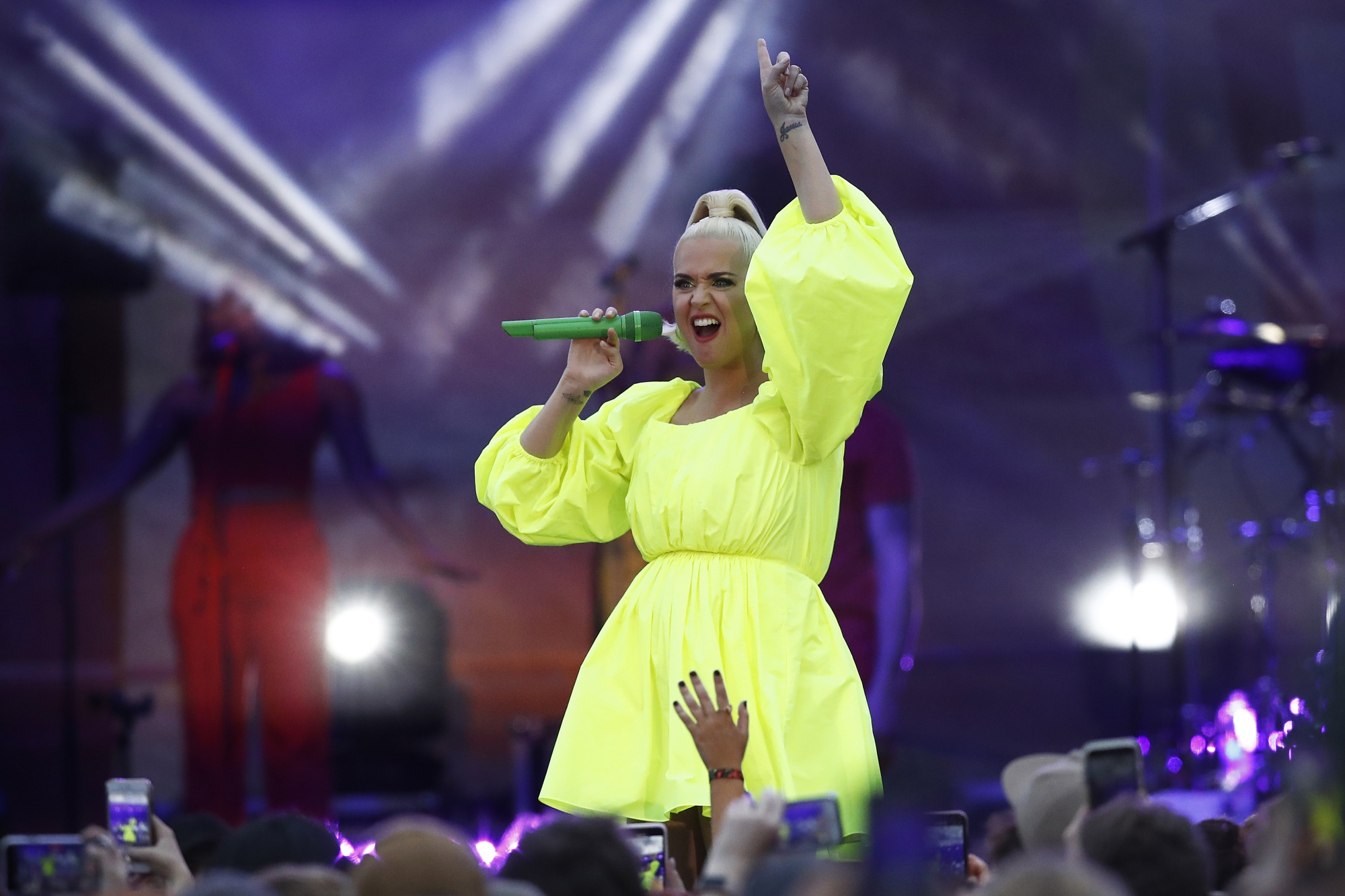 Photographer: Daniel Pockett/Getty Images AsiaPac Photographer: Daniel Pockett/Getty Images AsiaPac - Disney delayed the release of Disney+ in India. Cricket is a major selling point for Hotstar, the service it already has there.
- A court sided with Katy Perry in her copyright dispute with Christian rapper Flame. She no longer has to pay him $2.8 million.
- The Chinese government ejected several U.S. reporters from the country.
- Musicians are streaming live on Twitch to make up for lost touring money.
- The Hollywood writers' strike is unlikely in the time of COVID-19. Talent agencies, meanwhile, are already starting to fire employees.
Weekly playlist The Weeknd released a new album, and it's an absolute pleasure. I am belatedly binging HBO's "The Outsider," the most addictive TV show I've seen this year, and reading Anna Weiner's "Uncanny Valley." Let me know how you are passing the time, and stay safe! | 


Post a Comment