| Risk assets retreat once more as the hunt for a coronavirus vaccine goes on. Global banks split up their teams in an effort to roll out social distancing measures. It's boom time for traders in China. Here are some of the things people in markets are talking about today. As the coronavirus epidemic spreads across the globe, medical professionals who have been treating and studying Covid-19 patients in Wuhan shared their insights with reporters in Beijing on Wednesday. Here are three observations from the doctors at the heart of the outbreak. And the question on everyone's mind — when will there be a vaccine? The answer is quite troubling: the search for a new drug for the virus is facing long odds. Meanwhile, the U.K. and Switzerland reported their first fatalities, and the head of the World Health Organization threatened to name countries that aren't doing enough to fight the outbreak. Amid the tragedy, there was a surprising note of compassion… from Kim Jong Un. He sent South Korean President Moon Jae-in a letter expressing condolences over the coronavirus outbreak, in the North Korean leader's first public overture to his counterpart in more than four months. China also moved to honor the whistle-blowing doctor whose death fueled anger throughout the country. Asian stocks looked primed for heavy losses after U.S. equities tumbled with Treasury yields on renewed worries about the impact of the coronavirus. Gold surged with the yen and the Swiss franc, and equity futures declined more than 2% in Japan and Australia. The S&P 500 Index fell more than 3%, with investor confidence shaken as virus cases continued to rise across the U.S. despite efforts to contain the outbreak and its impact. The yield on 10-year Treasuries slumped to as low as 0.90% and Australian equivalents tracked those moves Friday, plumbing fresh all-time lows. Global equities have recovered some of the recent losses but still remain about 10% below the all-time high reached last month. Still, some saw an opportunity in the sell-off. Action from central banks and governments will counter the economic hit from the virus, according to JPMorgan Chase & Co. strategists who had previously been telling clients to trim risky bets. The team advised boosting equity holdings. What's been driving the stock market this week? Coronavirus? Optimism over Fed policy? Pessimism over Fed policy? Optimism over the government's response? Pessimism over the government's response? The Beige Book? Joe Biden? The ink's barely dry on one view, and the market goes careening the other way. Everything depends on how the virus outbreak will play out. And nobody has a clue. "When you have a 4.5% up day in the market and a 2% down day — what does that mean?" says Kathryn Kaminski of AlphaSimplex Group. "It just means we don't know what's going on." The result has been historical turbulence, swings that rank with any before. The Cboe Volatility Index, or the VIX, has remained above 30 for six consecutive sessions, the longest streak since 2011. Gains on Monday turned to losses Tuesday turned to gains Wednesday turned to losses Thursday. In nine trading sessions, three have seen the S&P 500 close up or down 4%, and four others brought 3% dives. And the fear gauge is poised to close above its emerging markets counterpart by the most on record, based on data going back to 2011. Global banks are stepping up their response to the coronavirus, shifting operations as the outbreak spreads in New York, London and other financial hubs. JPMorgan and Danske Bank in Copenhagen are dividing their sales and trading workers, sending some employees to back-up locations to reduce disruptions if employees are exposed to the virus. Wells Fargo restricted non-essential travel in the U.S., Goldman Sachs is planning to split workers among rotating teams and Royal Bank of Canada turned a conference scheduled for next week into a virtual event. The moves go beyond previous efforts — banks had been testing and adjusting plans for keeping critical operations open through a potential pandemic, but hadn't actually implemented them. Experts have been urging populations to implement social-distancing measures to limit the spread of the highly contagious virus. Global markets in turmoil and central banks rushing to arrest panic. But in China, the country most affected by the virus outbreak, it's boom time for traders. A gauge of stocks in Shanghai and Shenzhen has jumped 14% in just over a month to close at a two-year high on Thursday. One exchange-traded fund focused on 5G amassed $2 billion in days as investors clamored to chase a rally in tech shares. Seeking to maximize returns, punters have driven stock leverage and daily turnover past 1 trillion yuan ($142 billion), both near four-year highs. Government bonds have surged too, with the 10-year yield approaching its lowest level since 2002. It's a sharp turnaround from just a month ago, when the virus darkened factories across the nation, whole cities were isolated under quarantine and the stock market was hit by the most savage selling in years. The swift response from the Communist Party to arrest the spread of the disease has helped restore confidence as the number of new infections outside of the worst-hit province of Hubei has dropped. What We've Been Reading This is what's caught our eye over the past 24 hours. And finally, here's what Tracy's interested in this morning Beijing is pushing for China to get back to work but, in doing so, it clearly needs to balance the desire to restart its economy with the need to contain further spread of the coronavirus. Analysts at Nomura are already starting to worry about the possibility of a second wave of infections that, in their worst case scenario, would prolong disruptions within the country until the end of June. The way in which local governments carry out Beijing's competing policy goals — restarting economic activity while still preventing contagion — is therefore going to be crucial in gauging just when China's economy will get back to "normal." 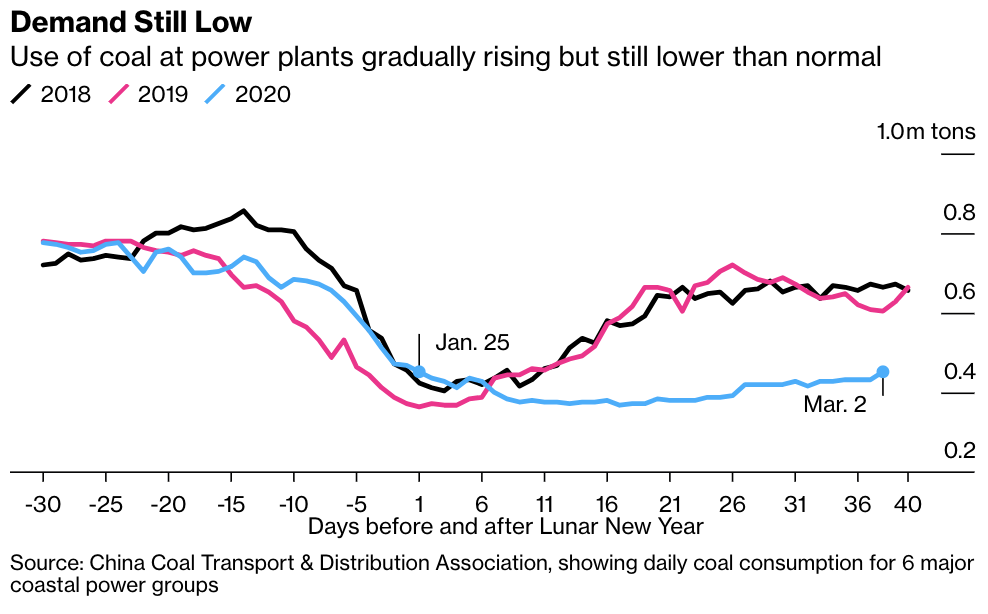 But when it comes to the local government response, there's a collective action problem at play. Local officials may be reluctant to risk contagion by encouraging people to go back to work when the economic gains from doing so are likely to still be small. As Nomura puts it: "If a local government heeds the call on resuming business of Beijing by easing its local lockdown measures, unblocking roads connecting to other regions, and shifting its focus to reopening factories and shops, the gain would be quite limited if other local governments continue to ban travels and the national logistics network remains in shambles. However, the cost could be quite high." In China's export-driven economy, that collective action problem arguably becomes more pronounced as the virus spreads globally. After all, why start making things again, if the rest of the world isn't open for business. You can follow Bloomberg's Tracy Alloway at @tracyalloway. | 


Post a Comment