This Tigger Market Owes Much to the Buck Bouncing's what Tiggers do best, as we all know. And after a big fall, we can all expect a stock market to stage a Tigger. That is certainly what happened Monday, as the S&P 500 gained more than 4% for its third best day in the last 10 years: 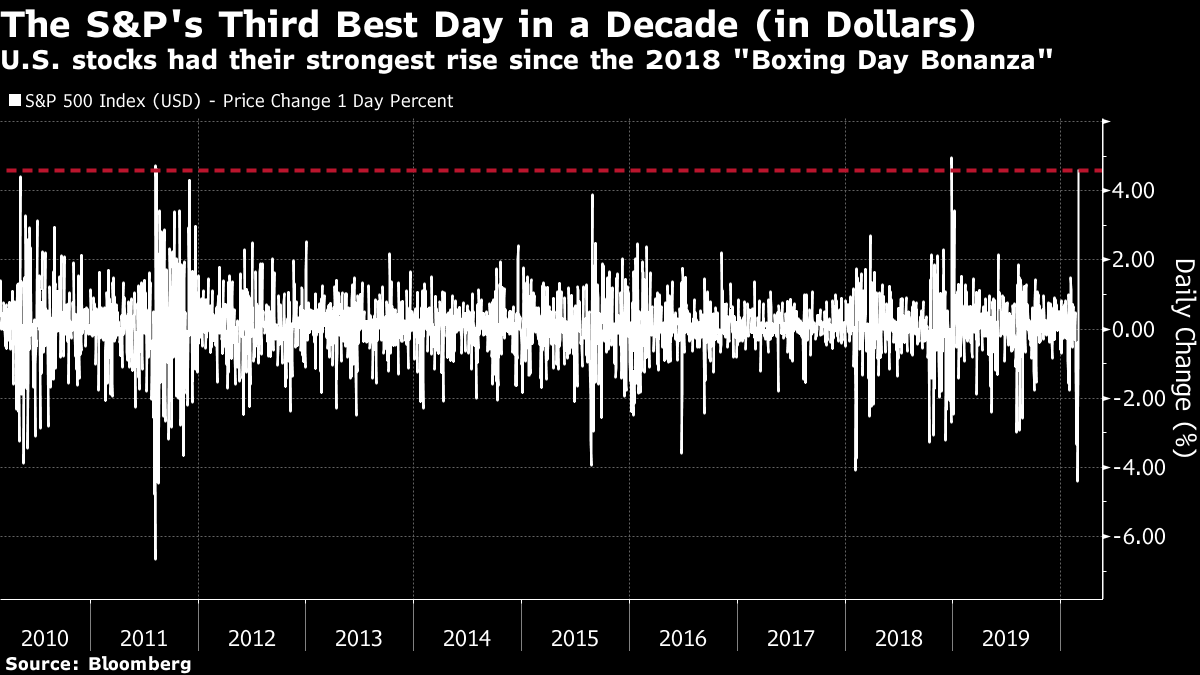 Note that all the previous big positive days come soon after big negative days. There is little reason in itself to be excited by a market like this. The scale of the bounce has much to do with the scale of the drop before it. In evidence, I can cite that the best day for the S&P since the war was Oct. 13, 2008, in the aftermath of the Lehman collapse, when the index gained 11.6%. It foretold nothing much about the future. Anyone who bought at the end of that day still had to endure another 27% selloff before the index finally hit rock bottom five months later. But beyond customary caution about trading bounces after a large fall, we also need to look at how the currency helped Tigger on this occasion. A chunk of U.S. stocks' great day was driven by the weak dollar, which makes things feel better for Americans but not people from overseas. This is that same chart, this time denominated in euros: 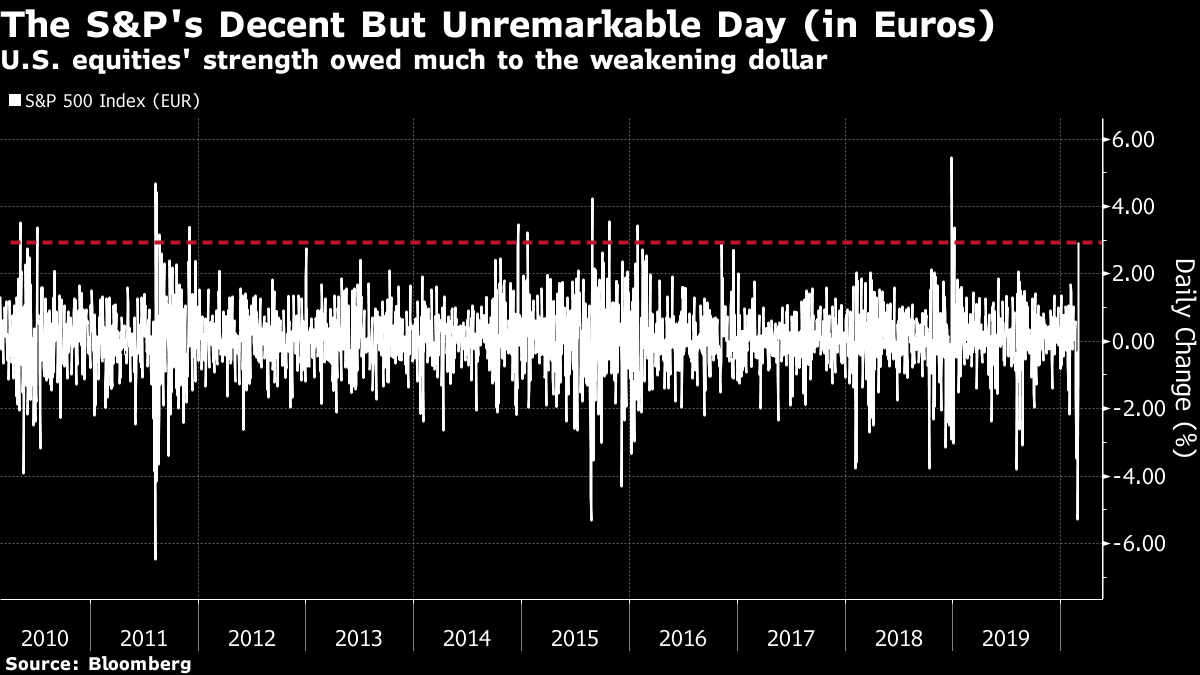 Still a good day, plainly, but no longer so remarkable. The currency's weakness is central to Monday's events in more than one way. Beyond flattering the S&P's percentage gain, the lower dollar is also an artifact of dramatic moves in rates, which in turn are driven by some dramatic and very optimistic assumptions about what central banks can do, and how much they can co-ordinate. Every decade or so there seems to be a reason for central bankers to club together. Most famously and explicitly, the Plaza Accord of 1985 weakened a dollar that many found cripplingly strong, while the G-20's London agreement in 2009 was billed by Gordon Brown, Britain's premier at the time, as saving the world. More recently, the rather more implicit Shanghai Accord in early 2016, following two disorderly devaluations for the Chinese currency, eased the pressure on Beijing. The dollar weakened, as the Federal Reserve held off on planned rate rises until the end of the year. Monday's excitement has been driven primarily by news that the G-7's finance ministers and central bankers will convene Tuesday to discuss measures to counter the economic effects of the coronavirus, in combination with hints from a succession of central bankers that they are ready to ease monetary policy if necessary. U.S. interest rates are higher than in much of the developed world, and so almost any action would involve a weaker dollar. That explains a remarkably sharp reversal for the dollar, which Monday dropped below its 200-day moving average, having apparently broken decisively upward only a month earlier: 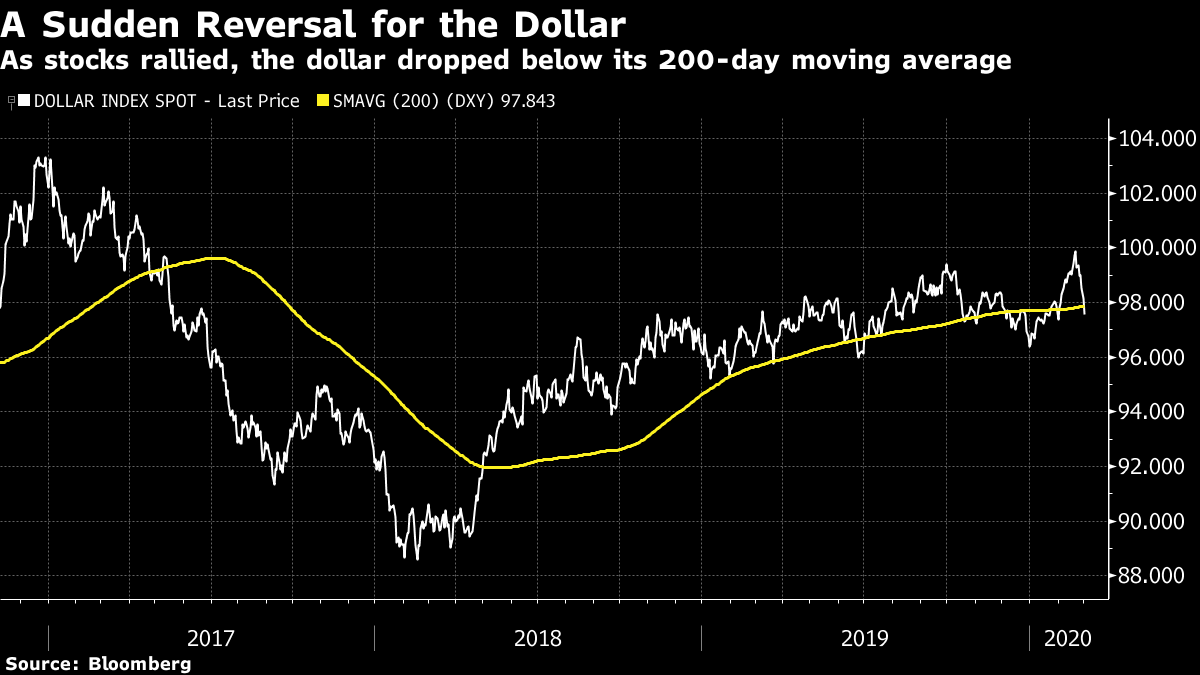 The dollar's decline has in turn been driven by the fall in U.S. rates. Generally, all else equal, higher interest rates will strengthen a currency as they attract funds. Since election day in 2016, the excess of U.S. Treasury yields over equivalent German bunds has ballooned to remarkable levels, helped both by negative rates in the euro zone, and steadily rising policy rates in the U.S in 2017 and 2018. That differential reached 2.8 percentage points at one stage. Following the slide of the last week, that gap has dropped to 1.8 percentage points. That brings it back almost exactly to where it was on election day — and the dollar-euro exchange rate is also back to its election day level: 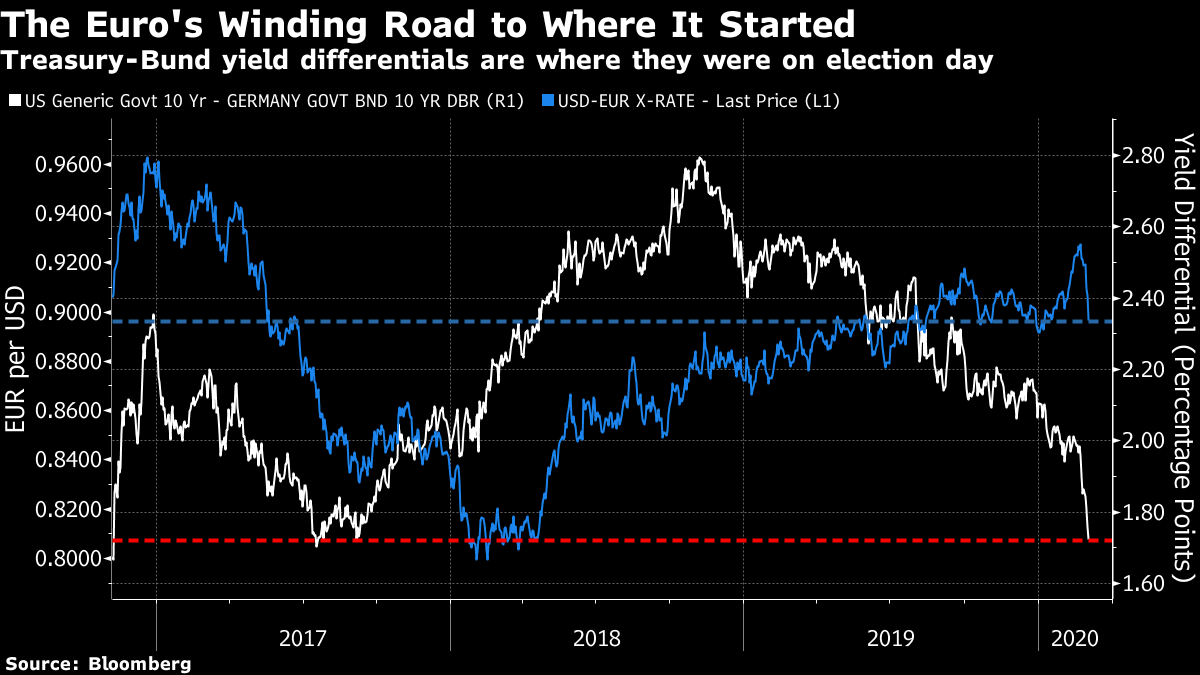 In this chart, note that we would usually expect the two lines to move roughly in alignment. Instead, the dollar stayed fairly weak as the differential in its favor widened, and then kept crawling upward as the gap narrowed. It is only in the last week that both have behaved as theory would dictate and fallen together. Why? In part, it is down to the vagaries of trading. Investors have given up on carry trades, which generally involved borrowing in euros and investing in dollar-denominated assets such as the S&P 500. That means net selling of dollars and buying of euros. Pure psychology has a role — such a sharp move in differentials commanded attention. There is also still a lot of speculative money betting on a strong dollar. That makes betting against the U.S. currency very attractive for those who believe that the Fed will cut early and aggressively. Finally, the weaker dollar reflects a belief that G-7 policymakers can deliver a meaningful package. Other central banks will be much more comfortable about loosening policy if they are assured that the Fed will ease even more; and so, bet on a weaker dollar. And coordinated fiscal measures — to make public investments that mitigate the economic effects of the virus, if not the human ones — would mean less need for the dollar as a shelter. The question is whether this has gone too far, too fast. Again, 2008 provides disquieting evidence that markets can get over-excited about politicians' ability to get their act together. The stock market was higher at the end of the week after the Lehman bankruptcy than it was at the beginning, because of excitement that Congress was about to bail out the banks. Those hopes proved premature. The coronavirus may indeed provide a convenient political excuse to switch toward fiscal expansion. Many economies could use it, and low rates make it more affordable. But fiscal expansion in the euro zone is politically and constitutionally difficult, while in the U.S. it is made far harder by the huge increase in the deficit that accompanied the 2018 tax cut. The deals of 1985 and 2009 were a long time in the making. Nothing that ambitious can come any time soon. The fact that Plaza and London and Shanghai have been widely cited in the last 24 hours does therefore suggest that there is now a lot of room for disappointment. Anatomy of the Bear This is your final reminder that the Bloomberg book club will be discussing Anatomy of the Bear by Russell Napier on Tuesday, at 11 a.m. New York time. It sifts history for lessons on how big market falls get started and how we can tell in real time that one is ready to end. Please send questions about big secular trends in stock markets, whether or not you have had the chance to read the book in these past hectic weeks, to the book club email: authersnotes@bloomberg.net. Napier will be discussing the book live with me, and with my colleague Sarah Ponczek. To whet your appetite, let me mention Napier's single most contentious call in the book, which is that March 2009 didn't mark the end of a bear market, and the beginning of a new bull market. In the U.S., where stock markets more than quadrupled since that bottom, that claim seems absurd. For the rest of the world however, as the chart shows, it seems very reasonable: 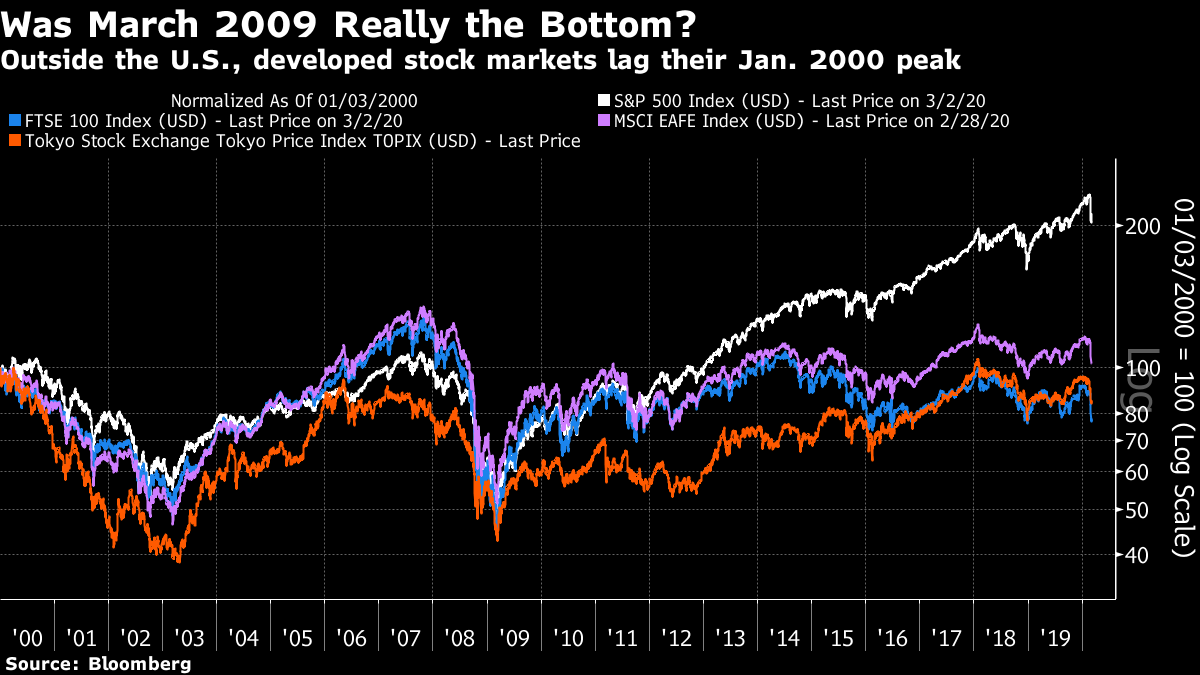 If the solution to the coronavirus involves a weaker dollar, while investors take profits where they have made them (in the U.S.), it is just conceivable that we might still live to view some date in the future as the bottom of the bear market that began in 2000. It's worth discussing. And if you vehemently disagree, please send a carefully reasoned argument to authersnotes@bloomberg.net so that we can discuss it. Like Bloomberg's Points of Return? Subscribe for unlimited access to trusted, data-based journalism in 120 countries around the world and gain expert analysis from exclusive daily newsletters, The Bloomberg Open and The Bloomberg Close. | 


Post a Comment