| The U.S. bond market is largely the invention of Alexander Hamilton. Other founding fathers, led by Thomas Jefferson, were disgusted by the mere idea of a secondary market in debt, in which the interest rate could change according to the whims of the market. Jefferson swallowed his objections after he negotiated for the nation's capital to be built in his home state of Virginia in return — and famously no one else was in the room when it happened. Hamilton largely dreamed up the concept of the modern bond market complete and ready for action in notes scribbled while he was serving as a lieutenant to George Washington during the American Revolution. He did not foresee such developments as electronic trading and derivatives, but the Treasury market remains a central pillar of the America that he and his colleagues founded. I mention this as an excuse to link to some songs from Hamilton, but more importantly to ram home that what happened on Super Tuesday in the bond market was truly historic. The G-7's finance ministers and central bankers talked in the morning, produced a statement that the market found disappointing, and then the Federal Reserve announced an emergency interest rate cut. It only had 10 trading days to wait until the next meeting. This is important; by doing this now, the Fed burns its chance to leave some monetary ammunition ready for later emergencies. It also runs the risk of looking as though it has lost control. That is what appears to have happened. Bond markets continued to push yields lower into historic territory, and didn't take a break from the unrelenting pressure. It is difficult to put together a continuous history of 10-year rates, but Robert Shiller, the Yale University Nobel laureate economist, has collated data going back to the immediate aftermath of the Civil War, in 1871. The following chart uses information from his website, with the final plot coming from the latest 10-year yield, of 0.999%. Many things have happened to the U.S. since Alexander Hamilton dreamed up the bond market — sub-1% bond yields had never happened until Tuesday: 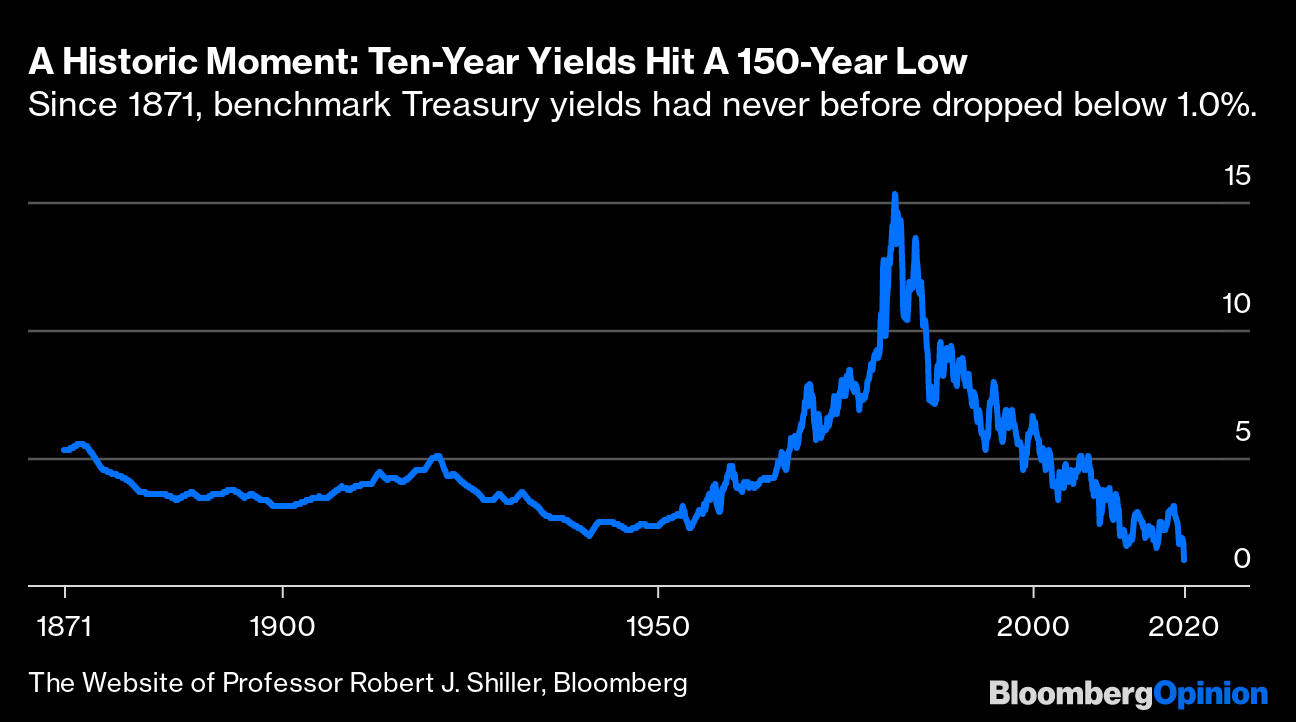 Normally, markets find it impossible to say no to this; cheap money is irresistible. Yet it appears that they aren't satisfied. Bloomberg's financial conditions index, which takes into account nine indicators, actually tightened Tuesday after the news, thanks in large part to a further fall in share prices. An emergency cut is intended to deal with extreme financial conditions (everyone knows that they cannot deal with the real world problem of viruses and contagion). These were supposed to ease sharply. The fact that they tightened suggests that the Fed has thrown away its shot, and failed to bring calm. The long-term outlook is now of drawn-out deflationary stagnation. We can see this from another amazing development — the drop in the 30-year yield to a negative level in real terms. In other words, its yield is less than the average inflation rate that can be derived from the inflation-linked bond market. Nothing like this has ever happened before: 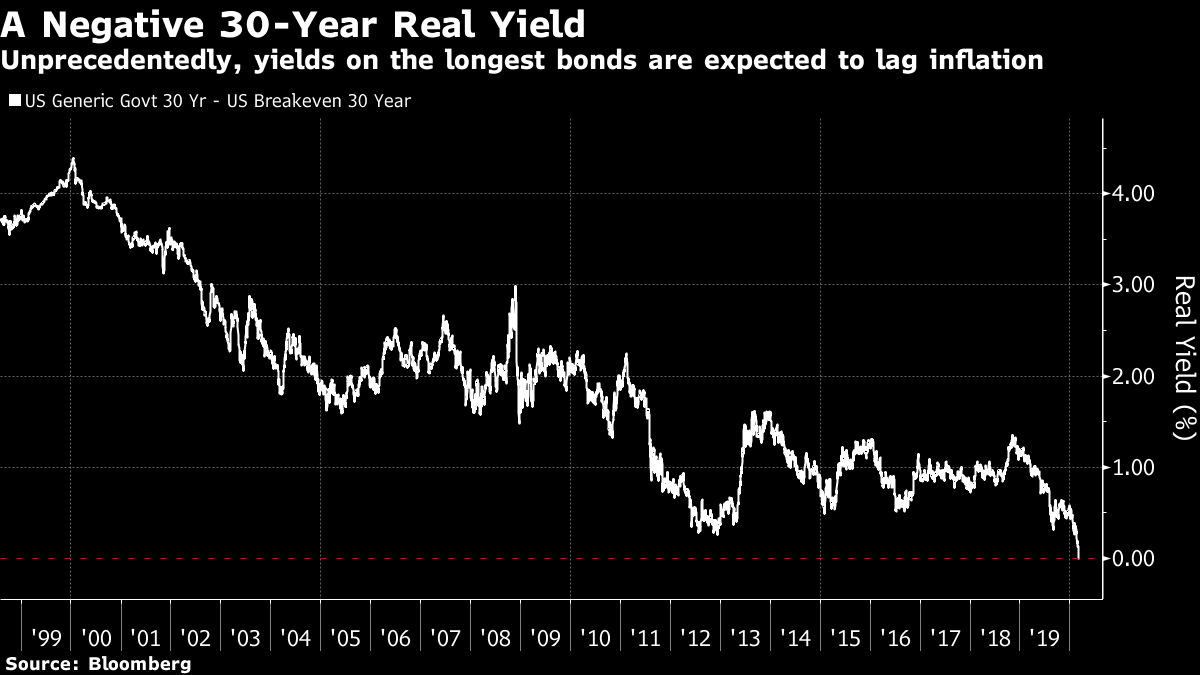 As the charts show, markets have been negative for a while, but the apparent certainty that deflation awaits has taken over very quickly in the last few weeks. That, evidently, is because of the coronavirus epidemic, which is the greatest truly exogenous, non-financial shock for the U.S. in many decades. Much of the outlook depends on the imponderable of how the virus develops from here. If it spreads as far as appears possible, and requires a drastic slowdown in economic activity to bring under control, then yes it will be the trigger for a recession. That recession will be all the deeper for the huge amounts of leverage that have been taken on during the cheap money era. The model for such a scenario is Japan. The threat of turning Japanese has worried American economists for more than a decade, and it now seems closer than ever. If the virus comes under control relatively swiftly (as may now have happened in China), causing only a temporary dip in economic activity and no recession, then the last few weeks will appear like a brief but remarkable historical blip — and there may be money to be made in buying stocks. There is a spectrum of possibilities between Japan and a return to historical normality. But the bond market has had a strong tendency to be right over its long history. In this light, the outlook for the economy and particularly for stocks is alarming. For this, look to the words of Russell Napier, the stock market historian we interrogated in a Bloomberg book club live chat that was originally scheduled to start at the same time Fed Chair Jerome Powell gave his press conference. Against a momentous backdrop, Napier made clear that deflation could lead to an abrupt and spectacular fall in share prices. The full transcript can be found here and is worth reading. He warned that key deflationary forces may be coming from far from the U.S. and that the Fed's ability to fight them is weakening. High valuations create the risk of greater falls for stocks. And while inflation can lead to long and slow bear markets, deflation could lead to a quicker and more dramatic fall. This is one of the most interesting passages: some of our bear markets last a very long time indeed, such as 1901-1921 and 1968-1982. These market valuations declined primarily because inflation and interest rates went higher and it was difficult to stop that, even over many cycles. However, all ended with the risk of deflation as the central bankers got over-aggressive against inflation. The key outlier was 1929, when we went straight to deflation without first going through a long bear market associated with the battle against inflation. Today, it is very clearly a deflationary shock we face, so valuations can fall very quickly. This happened in 1921, 1932, 1949 and even in 1982 given the U.S. banks were in crisis. Deflation brings valuations down, full stop, but to stress: Things are much much worse in Europe where valuations are a lot lower. It is possible, maybe even likely, that in a few months the coronavirus will have been contained, with limited economic damage, and we will be able to look back on commentary like that as a brief anomaly. We cannot assume that yet. For now, we must hope that doctors and public health workers do their job successfully. Investors themselves are helpless. Like Bloomberg's Points of Return? Subscribe for unlimited access to trusted, data-based journalism in 120 countries around the world and gain expert analysis from exclusive daily newsletters, The Bloomberg Open and The Bloomberg Close. | 


Post a Comment