| Welcome to your morning markets update, delivered every weekday before the European open.
Good morning. Policymakers around the world are pledging support in the midst of the coronavirus, exit polls are in from Israel and it's a big day for Spanish banks. Here's what's moving markets.
Easier Money Monetary policy-makers around the world are pledging to come to the aid of the global economy in the face of the coronavirus. European Central Bank President Christine Lagarde joined a crowd vowing to take action, echoing communications by the U.S. Federal Reserve on Friday, and the Bank of Japan and Bank of England on Monday. Overnight, Australia's central bank cut rates and signaled it's prepared to ease further. Group of Seven finance ministers, meanwhile, are preparing a response statement, though it does not specifically call for new spending or coordinated cuts, Reuters reports. Today's Trading European stock futures are flat at the moment after U.S. stocks had the best day since December 2018. Overnight trading was mixed in Asia amid an apparent lack of enthusiasm over the impact of any shift in policy, and as virus cases keep rising. Some strategists, at least, say there's money to be made in betting everything calms down in stocks, and even last week's sell off was seen by hedge funds as an opportunity to buy. Things are looking brighter for oil, too, where futures in New York have now recouped almost half of last week's 16% plunge, with OPEC and its allies expected to deepen production cuts. Israel Exit Polls After the third election in less than a year, Israel's Prime Minister Benjamin Netanyahu appears within striking range of forming the next government. Netanyahu, who has been recently indicted in three graft cases, gambled on repeat elections to win a majority in parliament and possibly keep himself out of jail. Exit polls showed his Likud party and its religious and nationalist allies defeating the opposing camp led by former military chief Benny Gantz. In a sign of the times, isolated voting stations were put up in parking lots to accommodate the roughly 5,700 Israelis under house quarantine after they were potentially exposed to coronavirus. Spanish Banks Decision It's a huge day for the Spanish banking sector, which could face billions of euros in compensation claims if the European Union's highest court delivers an unfavorable verdict on how they've been setting mortgage rates. The EU's Court of Justice is expected to decide whether banks were sufficiently transparent with customers about why they were sold mortgages with interest rates based on a Spanish central bank index, rather than the more widely used Euribor. CaixaBank SA, Banco Santander SA and Banco Bilbao Vizcaya Argentaria SA are among the most exposed. Coming Up… Keep an eye out for comments from Brussels after the U.K. set some red lines as trade deal talks with the EU got going Monday. Over in the U.S., meanwhile, it's Super Tuesday, where citizens in 14 states and one territory vote for a Democratic presidential candidate. Here's the latest on the race for the candidacy. Macroeconomic data to come includes euro area inflation, U.K. construction PMI and Italian unemployment, but they might all carry less weight given the expected virus overhang. Companies reporting earnings include vegan sausage-roll maker Greggs Plc and personal-care firm Beiersdorf AG. What We've Been Reading This is what's caught our eye over the past 24 hours. And finally, here's what Cormac Mullen is interested in this morning Speculation of co-ordinated central bank intervention was enough to stop the bloodletting in some very oversold risk assets, but the positivity hasn't extended to all areas of financial markets. As touched on yesterday, the rebound in Treasury yields was fairly modest and they headed lower again in Asia trading Tuesday. Meanwhile, U.S. real yields - those on 10-year Treasury Inflation-Protected Securities - fell to their lowest since 2013. That suggests the bond market is not holding out much hope on the effectiveness of any policy response. With money markets pricing in a half-point rate cut by the Federal Reserve this month and an additional half-point by the end of July - it's difficult to argue investors are concerned about inaction. But with initial reports on the co-ordinated G7 statement suggesting silence on rate cuts - at least according to Reuters on Tuesday - it's probable traders are worried about being underwhelmed. A viral pandemic is a new situation for financial markets to adapt to - particularly for younger traders who have yet to experience a "proper'' risk-asset bear market - so understandably, uncertainty is high. That means doubts in the bond market could remain, even after central banks start firing their silver bullets. 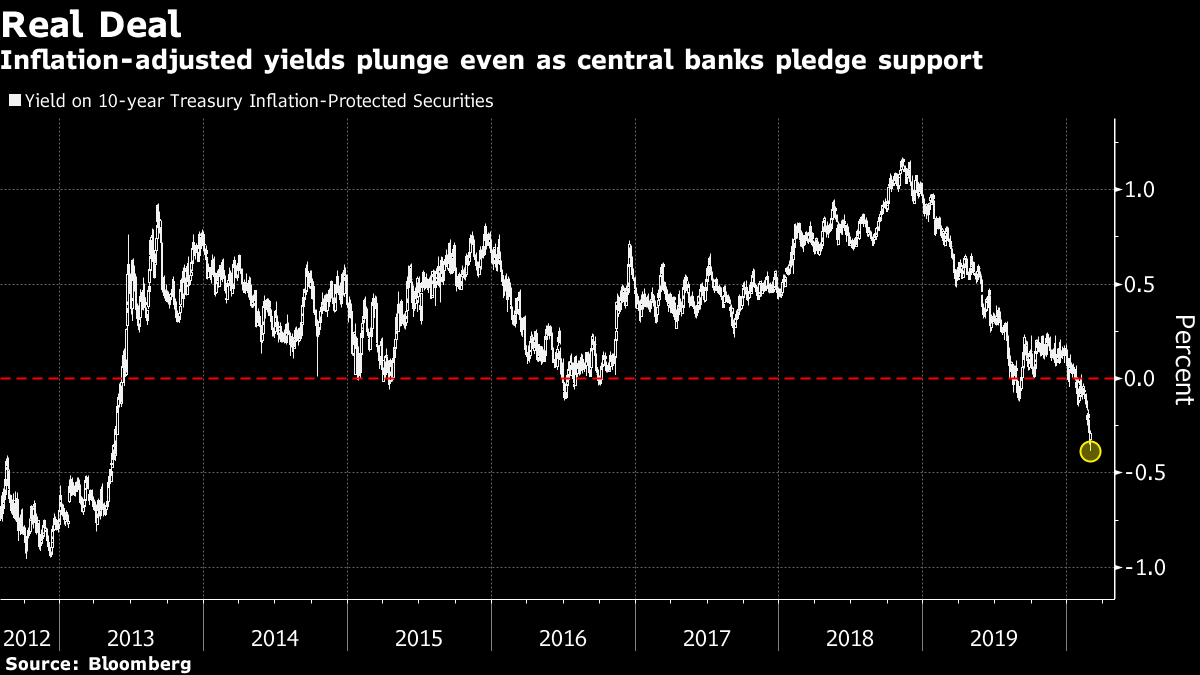 Cormac Mullen is a Cross-Asset reporter and editor for Bloomberg News in Tokyo. Like Bloomberg's Five Things? Subscribe for unlimited access to trusted, data-based journalism in 120 countries around the world and gain expert analysis from exclusive daily newsletters, The Bloomberg Open and The Bloomberg Close. | 


Post a Comment