| Congress fails to agree on stimulus, virus measures tighten further, and markets drop. No agreement yet While lawmakers in Washington are almost universally united on the need to introduce a very large stimulus bill to fight the economic fallout from the spreading coronavirus outbreak, fundamental differences remain between Republicans and Democrats on how the money should be spent. Senate Democratic leader Chuck Schumer said the GOP bill amounted to a "large corporate bailout" arguing that there should be much more money for hospitals, as his party voted against the proposal in the Senate. President Donald Trump remained optimistic, saying he thinks a deal will be done. The Senate will sit again at noon today. Lockdown While politicians in Washington argue about how to direct stimulus, the real world effects of the virus continue to mount. Delaware, Louisiana and Ohio are joining California, Illinois and New York in ordering all residents to stay at home. In Italy, one of the hardest hit countries, even stricter measures were introduced over the weekend which amount to an almost complete shutdown of industrial activity in the country. Hong Kong has banned all non-resident arrivals for fourteen days as the city faces a second wave of infections. India is trying to lock down most of its urban areas and Japanese Prime Minister Shinzo Abe said a postponement of the Olympics may be inevitable. Measuring the fallout While economists in the U.S. are still stopping short of forecasting the economy entering a depression, their outlooks are looking increasingly gloomy for the short term. Measures already announced amount to a sudden stop for the economy, meaning a recession is probably already baked in, with the next quarter likely to be the worst for growth since records began in 1947. Goldman Sachs Group Inc. predict a 24% contraction in the April-June period and Morgan Stanley see a 30.1% plunge. Federal Reserve Bank of St. Louis President James Bullard is even more pessimistic, saying growth may drop 50% and unemployment hit 30%. Markets plunge The lack of a deal in Washington, tightening measures to control the virus and increasingly bad forecasts are all pressuring global markets. Overnight the MSCI Asia Pacific Index dropped 3.2%, with Japanese stocks bucking the trend as the Topix index closed 0.7% higher. In Europe, the Stoxx 600 Index was 3.6% lower at 5:45 a.m. Eastern Time with every industry sector posting losses as investors wait for more fiscal action. S&P 500 futures, which traded limit down shortly after opening, are pointing to more red at the open, the 10-year Treasury yield was at 0.829% and gold was lower. NoTex Hopes that Texas would become an ally for OPEC in the coordination of production cuts are fading. There was some expectation that the rout in global crude prices, driven by an almost perfect storm of massive supply increases into a market where demand is evaporating, could bring the two sides together. However, objections from producers in Texas seem set to put paid to any significant move to cut output there. A barrel of West Texas Intermediate for May delivery was trading at $22.40 while Brent dropped to $25.54. What we've been reading This is what's caught our eye over the weekend. And finally, here's what Joe's interested in this morning There's still no fiscal deal in Washington D.C., but the good news is that virtually everyone agrees that there needs to be one, and that it needs to be huge. Still, if you want to be a smart-sounding pundit, you have to stroke your chin and say something like: "the government will need to spend trillions of dollars, which is why it's such a shame that we've been running such large deficits in recent years, limiting our ability to act aggressively when we most desperately need to." However such a statement is false in a trivial sense and false in a profound sense. In the trivial sense it's false, because just look at bond yields. We all get this by now. But there's something even deeper about the error. One thing the crisis is exposing is how little savings are held by so many swathes of the private sector. The layoffs have begun to explode almost instantly. And so many households have been plunged into immediate crisis because their own savings are so limited. So few entities have much of a cushion at all. This is where the concept of Sectoral Balances come in. You can think about the economy as composed of three sectors. There's the private (households and corporations), the government, and the foreign (trade with other nations). The premise is that if one sector desires to save more, another one must save less. It's really just accounting. If households want to save more, that decreases the income of businesses and it decreases tax revenue, so the government automatically runs higher deficits. If the government wants to save money, say, by cutting back on basic welfare provisions then the household sector will have to keep less of a cash cushion on hand to meet basic needs. This is all an abstraction and oversimplification, but the basic point stands. Everyone's balances have to net out to zero at any time, and not everyone can save or dis-save simultaneously. The bottom line is that the wise-talkers have it 100% backwards. This crisis did not expose the folly of running up deficits in recent years. It exposed the folly of not pursuing aggressive fiscal policies earlier that would allow households and businesses to save more money. Arguably, if we had had higher and better targeted government spending during the boom, that would have meant fewer government savings, and more private sector savings. But since the mainstream consensus in recent decades has been government spending is bad, and trade deficits are fine, the private sector has been left with no choice and no cushion. And now we wait for a multi-trillion dollar cash infusion before it's too late. 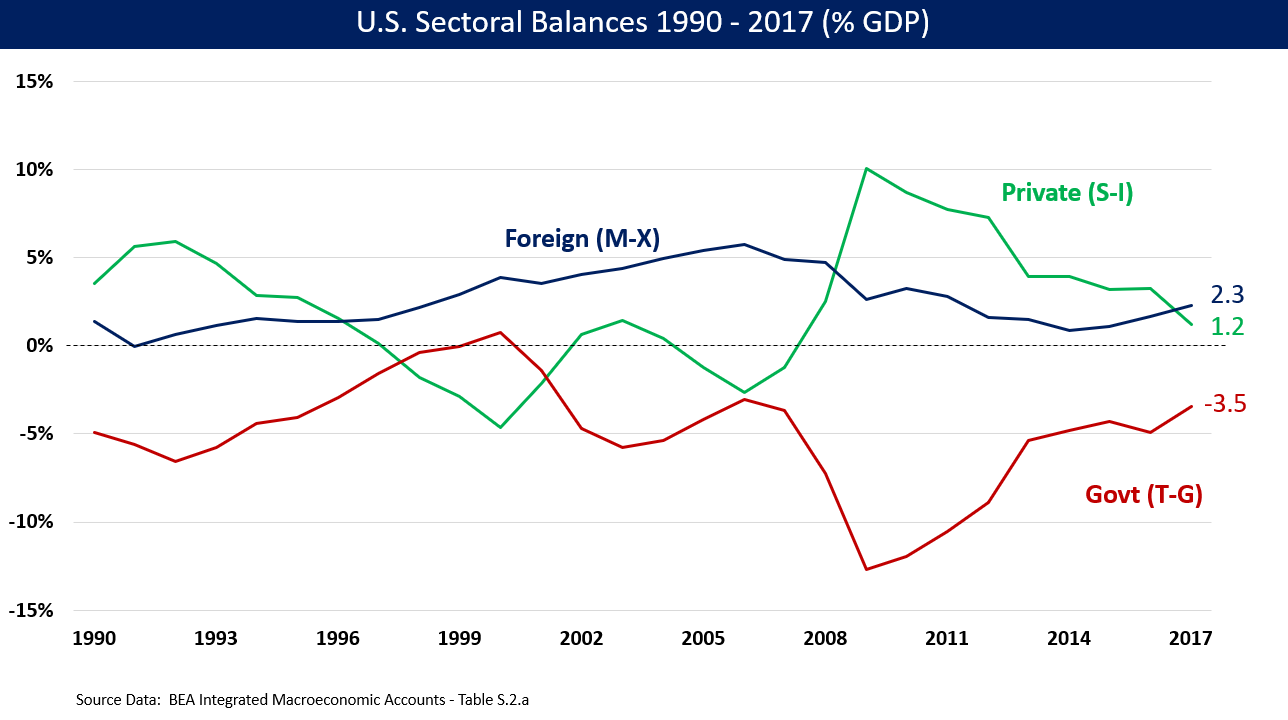 Like Bloomberg's Five Things? Subscribe for unlimited access to trusted, data-based journalism in 120 countries around the world and gain expert analysis from exclusive daily newsletters, The Bloomberg Open and The Bloomberg Close. | 


Post a Comment