| President Trump rebukes hardliners attempting to stymie sales to China, Nomura's finally making money from investment banking in Asia and Hong Kong is headed for its first back-to-back recession — ever. Here are some of the things people in markets are talking about today. In a rare public rebuke of his own administration's hardliners on China, U.S. President Donald Trump has intervened to stop plans to block sales of GE-made jet engines to China among other proposed restrictions on American exports. His reasoning? That national security is being used too often by his own officials to limit American companies' ability to transact with China. "We don't want to make it impossible to do business with us," Trump said in a tweet on Tuesday. "That will only mean that orders will go to someplace else." While some officials have been pushing stricter rules to curtail sales of U.S. technology to Beijing — from semiconductors to jet engines — Trump's declaration now comes as the president is touting a "phase one" deal with China, meant to spur a $200 billion Chinese buying spree of American exports including commercial jets and other manufactured products. Meanwhile, the U.S. has also designated five Chinese media companies as "foreign missions," a decision that reflects the Trump administration's view that the communist party of Xi Jinping is imposing increasingly draconian government-control over news services, senior State Department officials said. As the coronavirus death toll in China hits 2,000 and Russia bars Chinese citizens from entry, a top official at the World Health Organization says the country's aggressive quarantine tactics delayed the spread of the illness from the outbreak's center. Officials in China's Hubei province locked down travel to and from the province, and later sharply restricted people's ability to leave their homes. "Those measures on movement restriction have delayed the dissemination of the outbreak by two or three days within China, and two or three weeks outside China," said Sylvie Briand, the WHO's director of global infectious hazard preparedness. Hubei reported 1,693 new cases and 132 new deaths on Wednesday, bringing the total number of cases to 61,682. Here's what virus experts think is coming next for the disease. Meanwhile, it's out of the virus ship and back into quarantine for many Diamond Princess passengers. Stocks in Asia were primed for a mixed open on Wednesday as investors assess the coronavirus's effect on companies' earnings. U.S. shares earlier slipped, while Treasuries advanced with gold. A warning from Apple Inc. that spurred losses across Asia on Tuesday followed through to Europe and the U.S. Demand disruptions due to the coronavirus continue to concern investors, though signs of recent policy support in Asia have helped ease worries. The offshore yuan weakened past 7 per dollar and the euro fell after a gauge of German investor confidence plunged. Elsewhere, oil stalled after American sanctions on Russia's largest oil producer helped erase losses driven by concerns the coronavirus will cut demand. Hong Kong is heading for its first back-to-back annual recessions on record, as the coronavirus shutdown cripples an economy already battered by months of political unrest. Economists' forecasts since the start of February point to a contraction of more than 1% this year, following a 1.2% decline in 2019. That would mark a bigger decline and a slower recovery from the virus than from the SARS episode of 2003, when output roared back after the all-clear was signaled. Weakened by months of anti-China protests that have kept tourists away and slashed retail receipts, Hong Kong cannot rely on trade and arrivals from the mainland to stoke an economic comeback. China, the world's second-largest economy, is struggling to restart production after shuttering factories and businesses in an effort to stem the spread of the illness. "The likelihood of a rapid recovery is very slim this time around," said Dong Chen, senior Asia economist at Pictet Wealth Management. Nomura's finally making money from investment banking in Asia. The investment banking business is set to return to profit this fiscal year after more than a decade of losses since its Lehman Brothers Holdings Inc. acquisition, according to its division chief. Cost cuts and fees from financing will drive the profit rebound in the year ending March 31, said Kenji Teshima, head of investment banking for Asia excluding Japan. Revenue is set to rise by about one third, led by private financing and dealmaking in India and Australia, he said, while warning that some transactions in China may be affected by the coronavirus outbreak. Japan's biggest securities firm last year unveiled plans to cut $1 billion of costs at its struggling global wholesale operation, helping to revive profit that's been under pressure from years of losses abroad. What We've Been Reading This is what's caught our eye over the past 24 hours. And finally, here's what Tracy's interested in this morning Something big happened in the credit market last week. Kraft-Heinz got downgraded from BBB- to BB+ by Fitch and Standard & Poor's, meaning its roughly $28 billion of debt will now fall out of investment-grade (IG) bond indexes and into junk-rated ones. There's an argument some are making that this will be an interesting test of the long-running "BBBs are Bad" thesis. That particular theory holds that the amount of BBB-rated bonds outstanding has ballooned to a point where it will end up destabilizing the entire corporate bond market as the debt inevitably falls to junk-rated status. 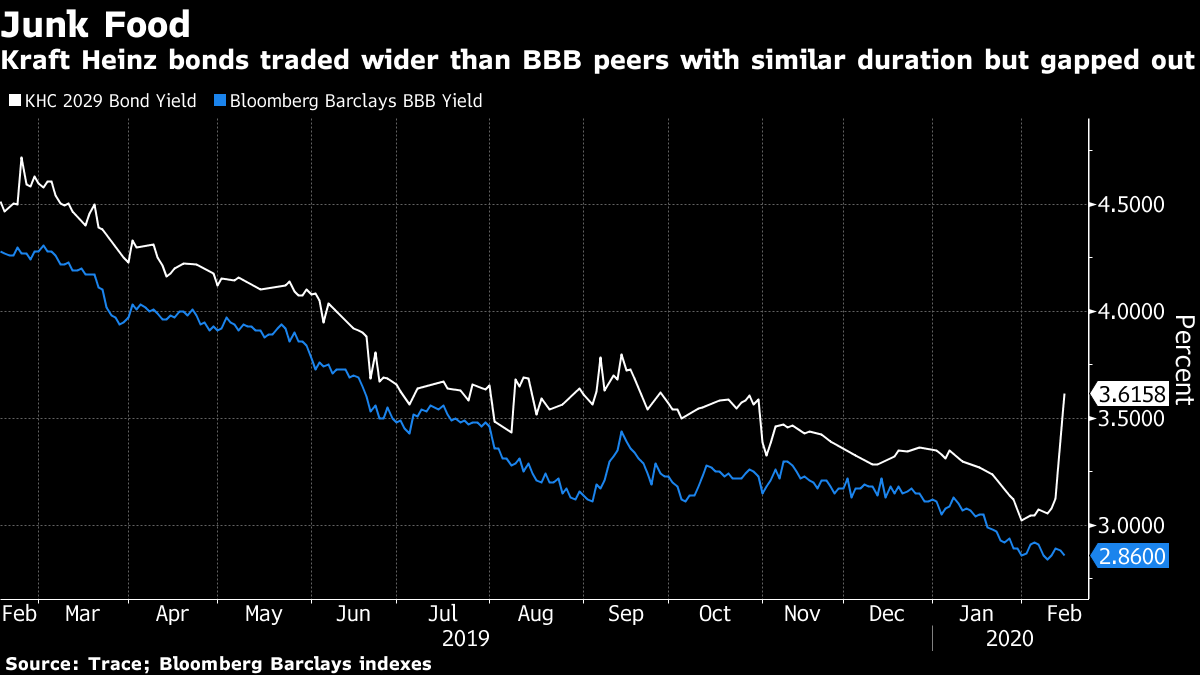 There is some Kraft-Heinz exceptionalism at play, however, that could render any BBB takeaways a little less useful. By most accounts, high-yield investors can't wait to buy this paper. Kraft-Heinz is still a strong credit compared to some others in the junk-bond index and, crucially, it has something craved by most high-yield investors: A magical financial ingredient known as duration. As Citigroup analysts point out, the average duration of Kraft bonds is almost seven years longer than the three years of the Bloomberg Barclays High Yield Index. While Kraft will probably end up being the third-biggest credit in the index in terms of the size of its debt, it will be the biggest on a duration basis, accounting for some 5% of the total index. So you might need to wait a little longer to see disruption from BBB-rated companies slipping to junk — if it happens at all. At the moment, BBB-rated debt makes up about half of the $5.9 trillion investment-grade market. You can follow Bloomberg's Tracy Alloway at @tracyalloway. The best in-depth reporting from Asia Pacific and beyond, delivered to your inbox every Friday. Sign up here for The Reading List, a new weekly email coming soon. | 


Post a Comment