| Fed chairman Powell said he's watching the coronavirus impact carefully, Mastercard won an approval to set up business in China and Lyft beat analysts estimates — but disappointed investors. Here are some of the things people in markets are talking about today. Federal Reserve Chairman Jerome Powell is keeping a close eye on the deadly outbreak of the coronavirus — which has now been officially named Covid-19. "In particular, we are closely monitoring the emergence of the coronavirus, which could lead to disruptions in China that spill over to the rest of the global economy," Powell said in remarks before U.S. lawmakers Tuesday, though he stopped short of saying the outbreak had changed the Fed's baseline outlook for the U.S. economy, or the expectation among many members of the Federal Open Market Committee that rates will remain on hold this year. U.S. equities climbed as investors digested the latest views from the Fed chair and Treasuries slipped. "The FOMC believes that the current stance of monetary policy will support continued economic growth, a strong labor market and inflation returning to the committee's symmetric 2% objective," Powell said. "As long as incoming information about the economy remains broadly consistent with this outlook, the current stance of monetary policy will likely remain appropriate." Asian stocks looked set for modest gains Wednesday as investors weighed the spreading virus against expectations for policy support. U.S. equities closed off their highs on reports of fresh antitrust scrutiny for tech firms. Futures were little changed in Australia and pointed higher in Hong Kong and Japan, which reopens after a holiday. The S&P 500 Index pared gains amid reports the Federal Trade Commission is looking into acquisitions by some large technology firms, though still posted a fresh all-time high. Ten-year Treasury yields rose, while the dollar dropped for the first time in five sessions. Elsewhere, oil bounced back from Monday's swoon and gold dipped. Bitcoin rose back above $10,000. Mastercard Inc. won approval to set up a bank card clearing business in China, gaining access to a $27 trillion payments market as part of the nation's financial opening. The announcement by the People's Bank of China on Tuesday signals the country is moving ahead with the speedier opening of its financial system that was agreed on as part of the phase one trade deal with the U.S., even as it grapples with a virus outbreak. Mastercard and its partner, NetsUnion Clearing Corp. will need to complete preparation work within a year, the central bank said. Mastercard called the decision "encouraging," with China being one of its most important markets. Further approval will also be needed after the preparations are over, it said in a statement. China is opening up its financial markets this year to allow foreign firms to set up fully owned operations to run insurance businesses, asset management and investment banking. Lyft Inc. beat analysts' revenue estimates for the fourth quarter and narrowed its net loss — but it wasn't enough to wow investors, who punished the ride-hailing company for not promising profits faster. The shares dropped almost 4% in extended trading. The company also issued a forecast for first-quarter revenue that was slightly ahead of Wall Street estimates, while the company's sales projection for 2020 as a whole was in line with analysts' expectations. Lyft said revenue for the three months ending Dec. 31 jumped 52% to $1.02 billion from the same period a year ago. Analysts had expected revenue of $985.8 million. The company shrunk its adjusted net loss, which excludes stock-based compensation, acquisition expenses and other costs, to $121.4 million during the fourth quarter, compared to $238.5 million for the same period a year ago. Analysts had expected an adjusted loss of $161.9 million, according to data compiled by Bloomberg. The first day of the Singapore Airshow usually features teeming crowds, flashy presentations and big orders for aircraft makers. The coronavirus outbreak has shot that to pieces this year as scores of companies steer clear of Asia's biggest aerospace and defense gathering. People who did attend limited their interaction to bows or uneasy elbow bumps. Changi Exhibition Centre near the city-state's airport is dotted with vacant booths displaying signs from companies apologizing for their absence, while the static display area for aircraft is virtually empty. Beyond a smattering of deals — Korean Air Lines buying engines from Pratt & Whitney Holdings, PNG Air ordering three ATR turboprops and Japan Airlines signing a service agreement with General Electric — there was little action, with rainy weather adding to the gloom. What We've Been Reading This is what's caught our eye over the past 24 hours. And finally, here's what Tracy's interested in this morning I used to ask if the trade war is inflationary or deflationary. On the one hand, you could see how adding tariffs to products would boost prices from the supply-side. But because people would presumably be buying fewer of those products (and global growth might take a hit), trade wars could reduce aggregate demand and therefore be deflationary. I never really got to the bottom of this debate, but I have a feeling we're about to have the same conversation when it comes to the impact of the coronavirus. 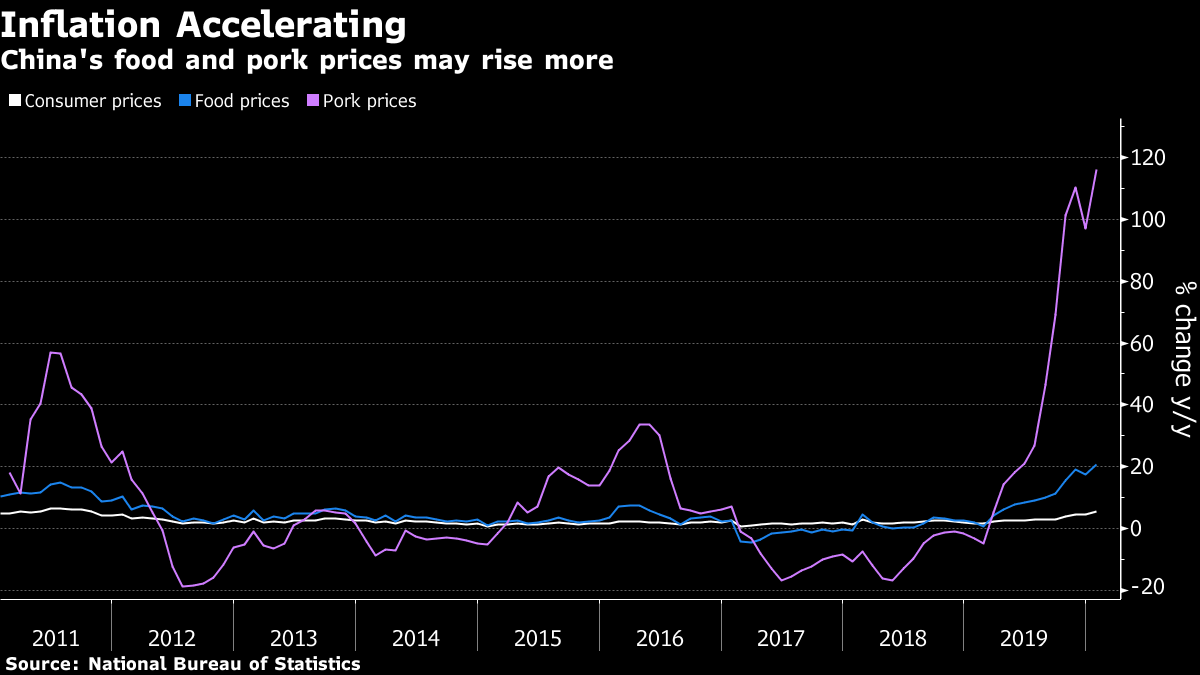 On the one hand, shuttering a vast swath of China's production capacity as part of the containment effort seems like it will push up prices as it reduces overall supply. In fact, we're seeing this already when it comes to consumer inflation, especially the price of food (think the prices of pork, vegetables, etc.) On the other hand, you might expect millions of people staying at home and an economic slowdown to be deflationary. The latest reading of producer prices in China does still have them hovering around deflation territory, at 0.1% for January. I suspect we're going to be thinking about this for a while. You can follow Bloomberg's Tracy Alloway at @tracyalloway. For a fresh, global perspective on the stories that matter for Australian business and politics, sign up for our weekly newsletter. | 


Post a Comment