| Welcome to your morning markets update, delivered every weekday before the European open. Good morning. Virus count revisions are making it hard to gauge the scope of the outbreak, UBS has started to look for a new CEO and U.K. economic policy is in disarray following the cabinet reshuffle. Here's what's moving markets. Virus Watch After a surge in reported cases of the new coronavirus on Thursday due to a new method for counting infections, China's Hubei province said there were 4,823 additional cases on Friday, suggesting the earlier spike was a one-off. Asian equity markets were mixed on the reports as investors struggled to analyze the data. Still, there was good news for some passengers on the quarantined cruise boat in Japan: Those who test negative for the virus and are of advanced age can disembark the ship, the center of the biggest outbreak outside of China. Here's more on what it feels like to catch the coronavirus. Banking CEOs It was a big week for European banking CEOs: Credit Suisse's Tijdane Thiam presented his last results, Barclays Plc's Jes Staley is under investigation by the U.K.'s Financial Conduct Authority into his ties with disgraced financier Jeffrey Epstein and UBS Group AG is searching for a successor to Chief Executive Officer Sergio Ermotti, one of Europe's longest-serving bank chiefs. As for Staley, he has the "full confidence" of the Barclays' board, it said yesterday, and Thiam said he had no "major, major regret" on his tenure, which was rocked by a spying scandal. Trump-Style Stimulus? An orderly reshuffle it was not. The economic policy of Boris Johnson's government is in disarray after a battle for control of his Finance Ministry went awry and Sajid Javid quit his post as chancellor of the exchequer following a row with the prime minister. Johnson's office can't confirm that the budget presentation will go ahead as planned on March 11, or if the government will keep to fiscal rules announced by Javid. All eyes turn to Javid's successor, Rishi Sunak, a former Goldman Sachs banker, with some wondering if a Trump-style stimulus is now in the cards. That already prompted the pound to rally Thursday. Universal IPO Vivendi SA reversed course and announced it will sell part of its $33 billion hit machine, Universal Music Group, in an initial public offering. The plan is a reversal of a 2018 decision, when the company said such a move would be too complex. The group posted a 22% increase in subscription and streaming sales last year as it turned out hits from stars including Billie Eilish and Post Malone. Like rabid fans, however, investors will have to wait. The initial public offering will happen by early 2023. Coming Up… U.S. and European futures are nudging higher. Renault SA is one of the biggest names to report earnings Friday and we'll be watching chip stocks after Nvidia Corp. gave a strong revenue forecast in the U.S., sending its shares higher in extended trading. Earnings slow down next week, but we're still looking to get updates from some big names including HSBC Holdings Plc and Deutsche Telekom AG. What We've Been Reading This is what's caught our eye over the past 24 hours. And finally, here's what Cormac Mullen is interested in this morning In another example of "exuberant" pricing in markets, Greece's benchmark bond yields have slumped to all-time lows and are now trading below the 1% mark. Yes, the bonds of the eurozone's riskiest nation have had the best performance in the region over the last year, showing a return of about 30%. Astonishingly the gains comes without the benefit of the European Central Bank's multi-trillion euro bond buying program — Greek securities are ineligible, still rated as junk by all three major debt agencies. While thankfully Greece's economy is showing signs of green shoots — growth of about 2% is expected this year — its debt-to-GDP remains around 185%. But none of this seems to be putting off investors, remember the country managed to sell 13-week bills last year at negative yields. And commentary this week suggests that a negative yield in the future on benchmark 10-year Greek debt is not being dismissed out of hand. For a bond that yielded nearly 45% less then a decade ago, that in itself tells us these are not normal times. 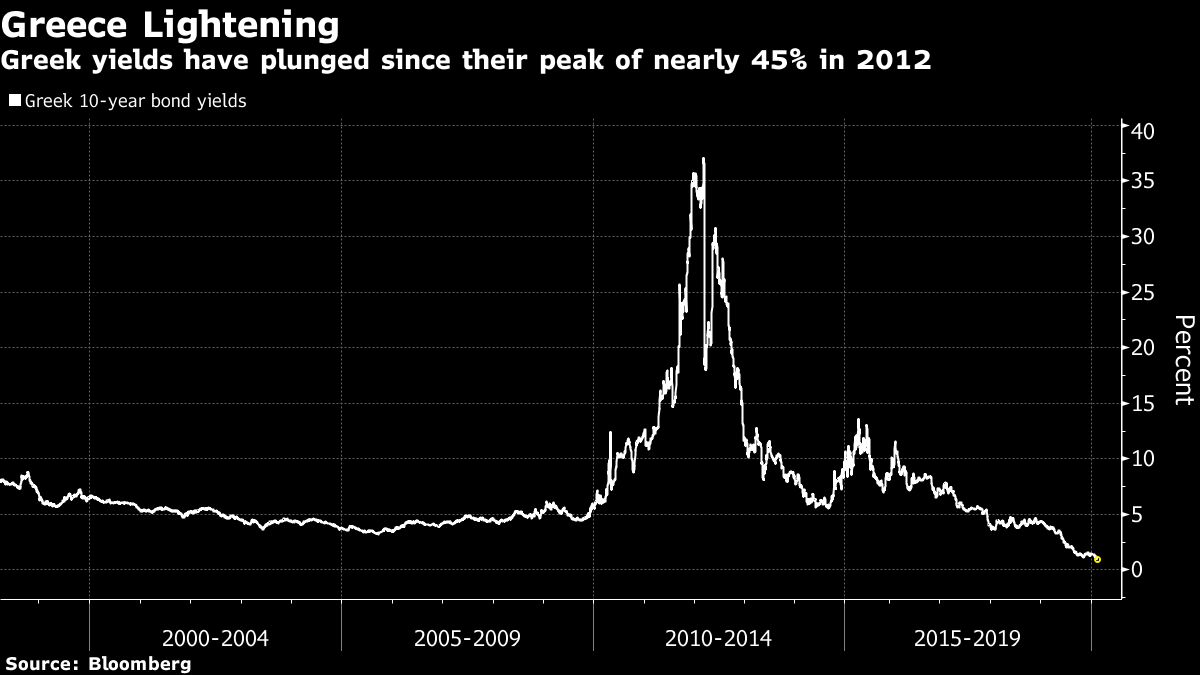 Cormac Mullen is a cross-asset reporter and editor for Bloomberg News in Tokyo. Like Bloomberg's Five Things? Subscribe for unlimited access to trusted, data-based journalism in 120 countries around the world and gain expert analysis from exclusive daily newsletters, The Bloomberg Open and The Bloomberg Close. | 


Post a Comment