The Victory of Noise Reduction Working in a large open-plan office, surrounded by people who are under at least as much stress as you are, isn't easy. The Bloomberg policy under which nobody shuts themselves off in their own private office has its advantages. You never miss out on the news stories and ideas flowing around a room with several hundred journalists in it. But the noise is a problem. And that is true in both a literal and figurative sense. How exactly can you separate signal from noise? There is a solution. My neighbor and close colleague Cameron Crise, who writes the Macro Man column, puts on noise-reduction headphones whenever he is writing. At first it is off-putting when the person sitting next to you is blocking out every word you say. But Cameron's strategy works. I now also wear noise-reduction headphones when writing. They filter out the din, leaving only the signal (such as the moments when Cameron shouts at his screen while Jerome Powell is giving a press conference). Noise reduction is usually a great strategy for markets as well. Last year it would have made sense to take off the headphones and pay attention to the noise, though. Anyone with a powerful computer and the ability to keep trading costs low can make money from this method, outlined by Joseph Mezrich, quantitative strategist at Instinet LLC. Start with a simple reversal strategy of shorting the best-performing stocks at the end of each month, and buying the worst performing. As the chart, which doesn't include the (probably considerable) trading costs shows, this gains almost nothing in the long term. Then control for how different factors performed during the month, and how different sectors performed — both of which improve returns. For a final step, exclude stocks where there is low dispersion among analysts' forecasts, on the grounds that the fundamentals of such companies are probably known and priced in. If you avoid stocks that are moving in line with their sector or factor, or in response to news about their fundamentals, the chances are that what is left is pure "noise." Betting on these stocks to reverse at the end of each month, it turns out, makes money very consistently. 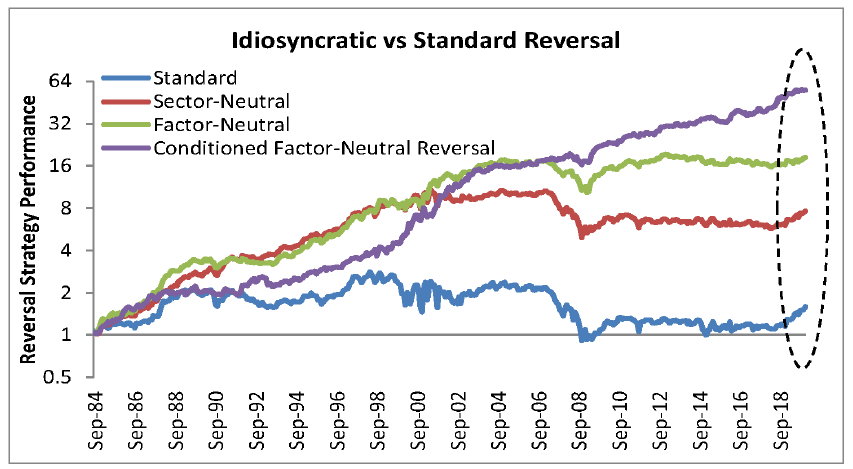 Drowning out everything else so that you can identify what is pure noise is much easier said than done. This has become one of the strongest ways to allow quantitative investors to make money, and it is a strategy that most of us shouldn't attempt. Now take a look at what happened last year. Factors reversed from month to month in a way not seen since Instinet's data started in 1985. And "standard reversal" (a crude approach of just betting on price changes to shift back without taking into account any other factors) had its best performance other than in the immediate aftermath of the bursting of the dot-com bubble. 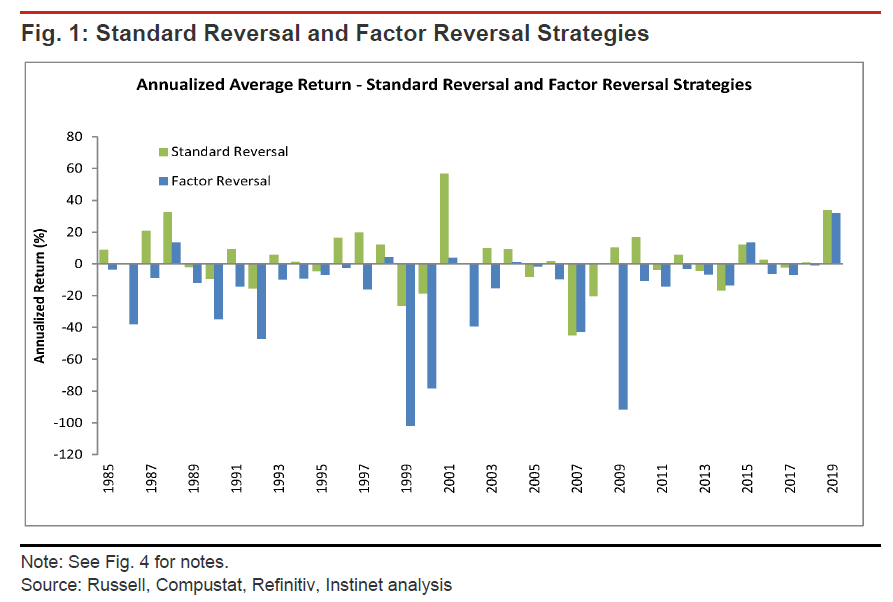 This wasn't a uniquely American phenomenon. The following chart, from Andrew Lapthorne, chief quantitative strategist at Societe Generale SA, shows returns from a simple reversal factor were if anything even more historically surprising in Europe than they were in the U.S.: 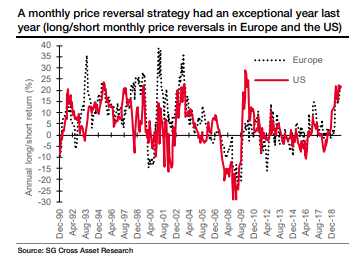 What can explain this? Plainly, the beginning of last year saw a huge about-turn on monetary policy, which intensified as the year progressed, and it also saw great uncertainty over trade. The US Economic Policy Uncertainty index twice spiked to higher levels than had been recorded since U.S. Treasury debt was downgraded by Standard & Poor's in 2011. 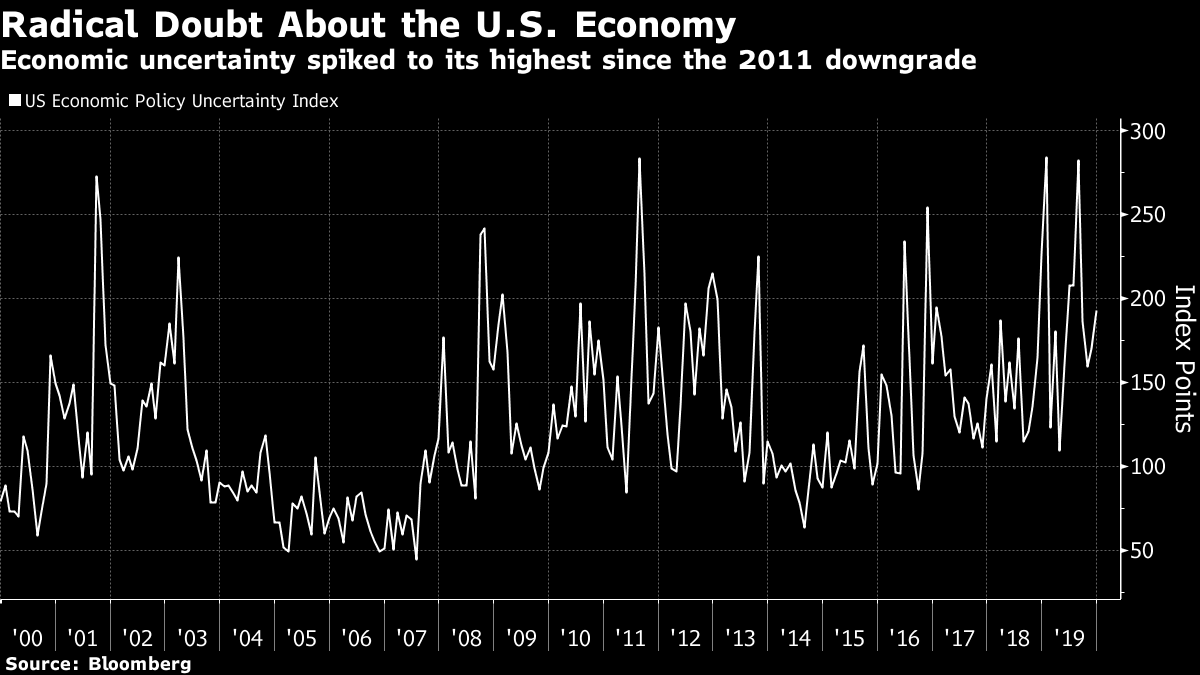 How seriously should we take the index? It is based on analysis of press articles, and is more of a sentiment indicator than anything else. When sentiment is agitated, we can see, share prices are more likely to reverse. This was a year of extreme political polarization, even if there have been many others in which more fundamental shifts have occurred to the economy. And so it appears that 2019 was one of the first years on record when the noise drowned out the signal. Returning to the headphones analogy, in the exceptionally angst-ridden and angry environment of 2019, it proved to be better not to drown out the noise, but instead follow all the distracting sounds and bet against them. This year has started with further reversals. So it is possible that the noisy environment is something we should learn to live with, and start regularly to trade against the latest noise. But my neighbor is still wearing his headphones. And for the moment, I intend to keep imitating him.
This Is the Way That Brexit Ends…
On the subject of noise reduction, the U.K. parliament at last voted irrevocably to leave the European Union, not with a bang but a whimper. Now armed with a strong parliamentary majority, Prime Minister Boris Johnson was able to squelch all opposition and drama. One leading commentator called it Blue Wednesday. The House of Lords agreed not to continue objections to the bill that formalizes the U.K.'s decision to exit, and so Brexit now needs only the assent of the Queen to become law. Brexit fatigue in Britain is now so great that this momentous news, resolving an issue that has divided the country almost directly for four years, didn't even make the front page of some British newspapers. Is this enough to revive sterling? The immediate post-election excitement is over, leaving the pound at the top of its post-referendum range, but still not clearly above it. As the chart shows, on a trade-weighted basis against a broad group of currencies, sterling has never managed to regain any of the ground it lost on referendum night for more than a few days: 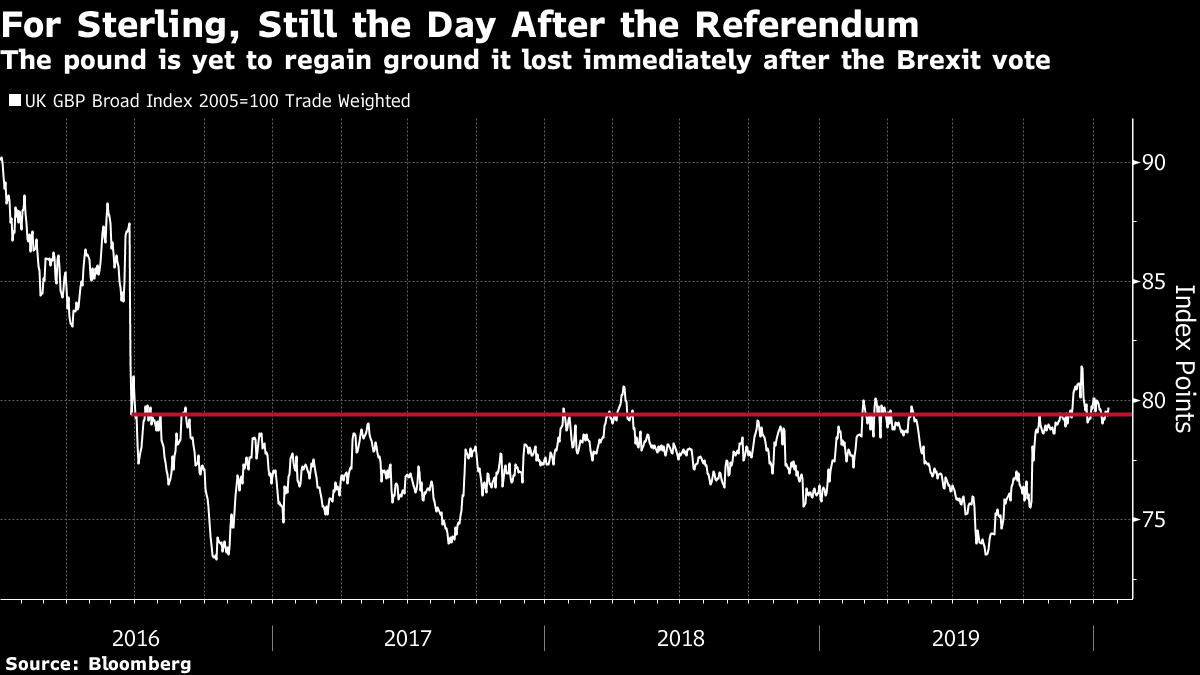 For at least a year, since it became clear that former Prime Minister Theresa May would have problems passing her Brexit withdrawal bill through parliament, sterling has moved according to a binary risk — would the U.K. leave without a deal or not? That risk is now over. So is the pound ready to recover? Possibly not. To start with one obvious problem, the U.K. has had higher inflation than its main trading partners, meaning that all things equal the pound should weaken somewhat. There are many ways of measuring purchasing power parity, but few suggest that sterling is undervalued to any significant degree. This shows how inflation has moved in the U.K. compared to the eurozone and the U.S. since the referendum in June 2016: 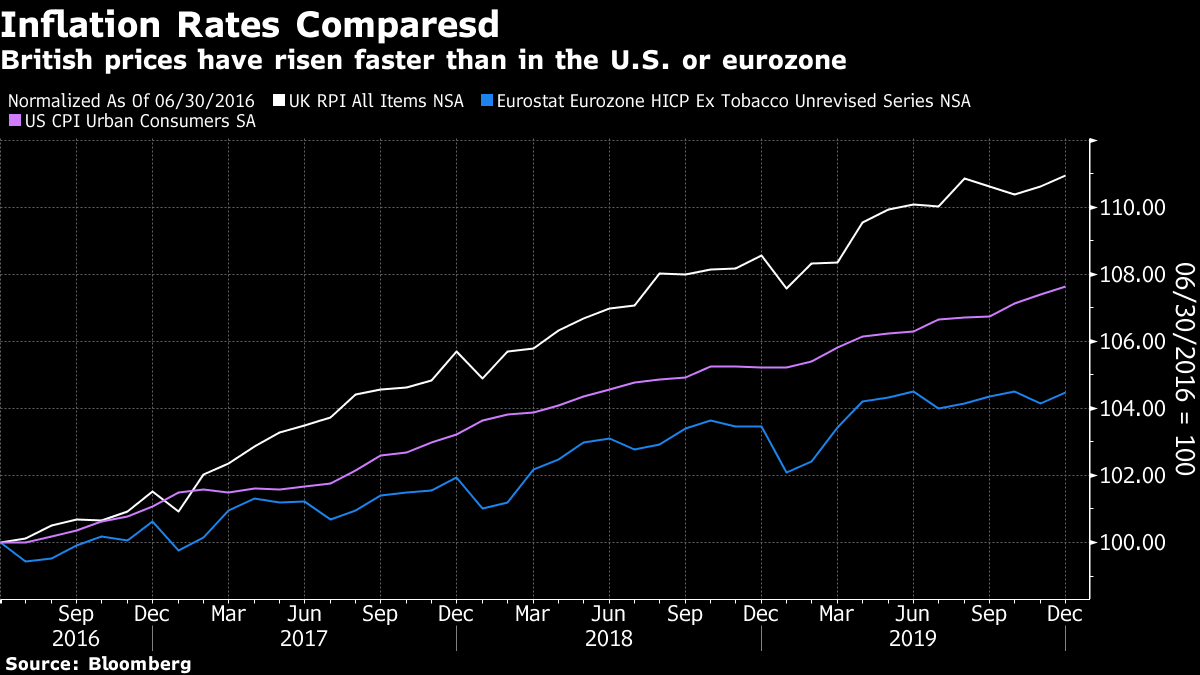 Beyond this, there is the issue that the U.K. economy has still not had to confront any of the actual effects of Brexit, even if some of the uncertainty has been resolved. The latest survey of industrialists by the Confederation of British Industry shows optimism rebounding to a level not seen since before the referendum; but actual orders continue to be very weak. 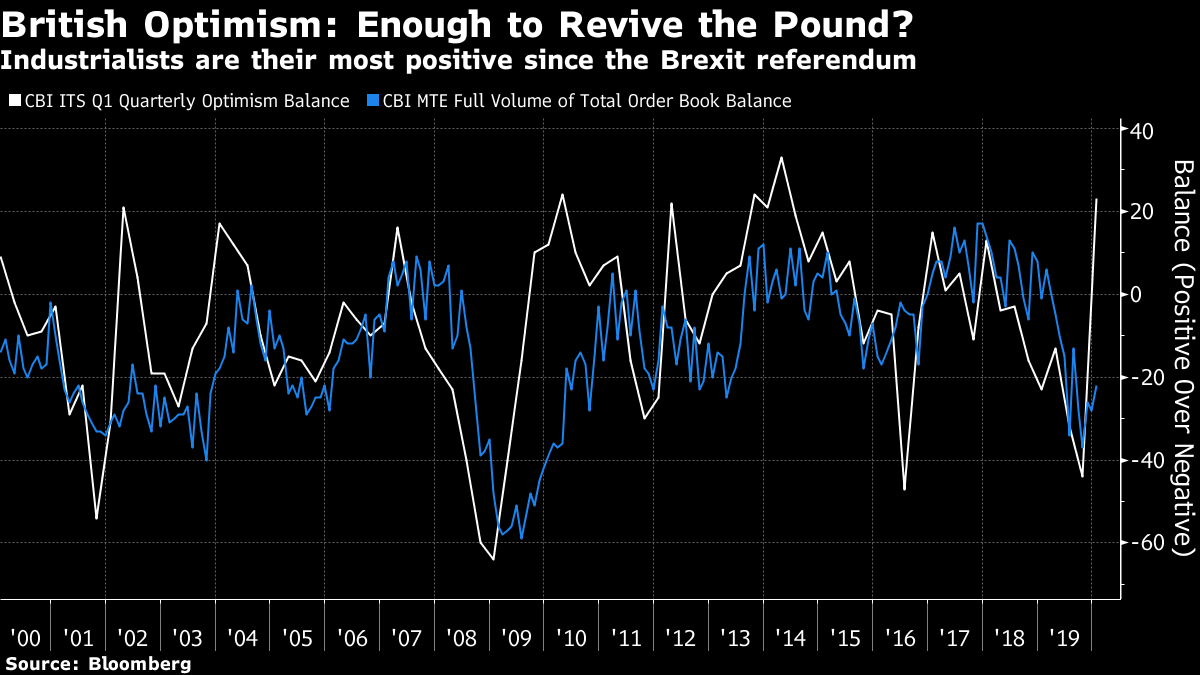 This leaves the Bank of England likely to cut rates soon and, in the opinion of markets, before any other major central banks do so. This tends to weaken the pound. The greatest issue remains Brexit uncertainty, however. The U.K. must thrash out a deal with the EU by the end of this year, while also making new trade deals with other important partners, led by the U.S. According to the chancellor, Sajid Javid, in an interview last week with the Financial Times: "There will not be alignment, we will not be a ruletaker, we will not be in the single market and we will not be in the customs union." If true, this implies dramatically reduced access to the EU market — no greater than that enjoyed by Canada, and possibly even less. This raises the issue of whether it is even worth having a deal — and thus implies that the risk of a no-deal exit is back. Meanwhile, the U.K.'s stated desire to prioritize a deal with the EU puts it at odds with the U.S. The risks aren't as binary or as alarming as they appeared for much of last year. But the uncertainty seems far too great to allow sterling to start to make good the ground it lost on referendum night. That will have to wait until a trade deal has been signed, which means at least until the end of this year. Like Bloomberg's Points of Return? Subscribe for unlimited access to trusted, data-based journalism in 120 countries around the world and gain expert analysis from exclusive daily newsletters, The Bloomberg Open and The Bloomberg Close. | 


Post a Comment