At the heart of the Trump administration's trade policy toward China is a contradiction. A successful "phase two" trade agreement, which Donald Trump is pushing for now that he's pulled off a "phase one" deal, would throw open Chinese markets to American companies by curbing the power and privileges of Chinese state-owned enterprises. Yet that outcome would be strikingly at odds with the U.S. president's publicly stated goal of bringing home manufacturing and jobs. It would also undercut a largely unstated ambition: To weaken a technological competitor. 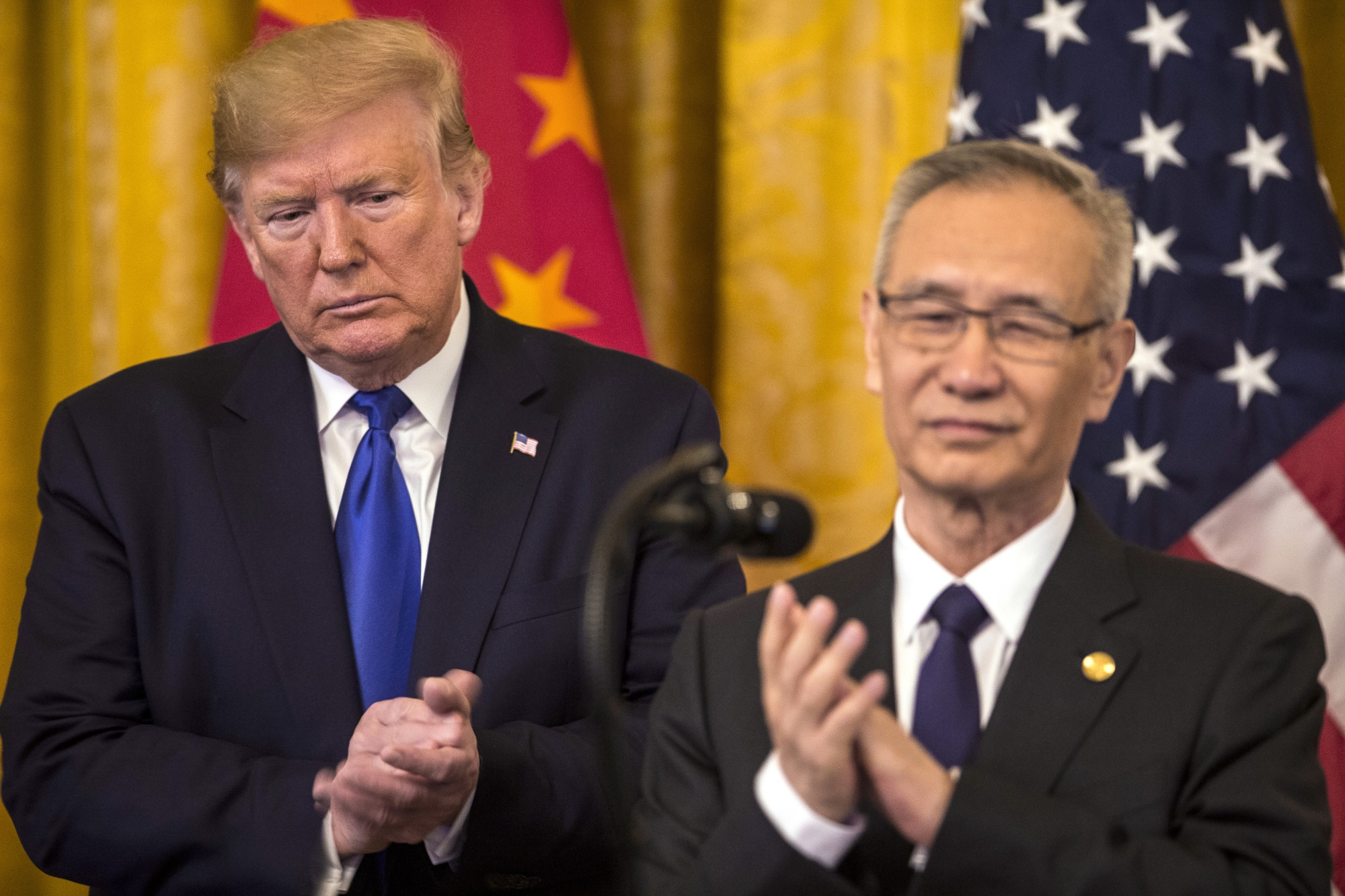 U.S. President Donald Trump applauds as Liu He, China's vice premier, speaks during a signing ceremony for the U.S.-China "phase-one" trade agreement in Washington Jan. 15. Photographer: Bloomberg This week in the New Economy "The U.S. must decide whether what it really wants is access to the Chinese market and better prices for U.S. consumers, or whether it simply wants to contain China's rise at all costs," writes Weijian Shan in Foreign Affairs. "Washington cannot have it both ways." The contradiction plays out in the White House as a battle between hawks like trade adviser Peter Navarro and doves like Treasury Secretary Steve Mnuchin. Confusion over ultimate aims greatly reduces the likelihood of a game-changing "phase two" deal. The lesson that China President Xi Jinping has taken away from this trade war is that reliance on core U.S. technologies, like semiconductors, is a key vulnerability. His impulse is to double-down on self-reliance, with state enterprises leading the charge. The "phase one" agreement includes $200 billion of additional Chinese purchases spread over two years. It further opens up China's financial services sector, removes investment ceilings and strengthens intellectual property protection. As Shan notes, however, these reforms were in the works well before the trade war kicked in—and China was pursuing them not as a result of U.S. pressure, but because they are in China's own best interests.  "With only limited concessions, China has been able to preserve its mercantilist economic system and continue its discriminatory industrial policies at the expense of China's trading partners and the global economy," writes Scott Kennedy (above), a New Economy Forum speaker and expert on the Chinese industrial economy at the Center for Strategic and International Studies. All that said, Trump has won broad acclaim at home and abroad for standing up to unfair and predatory Chinese trading practices. "First, let's give credit where it is due," writes the Cornell University economist Eswar Prasad, arguing that Trump's tough line "has shaken loose more apparent concessions from the Chinese than previous administrations managed." But at what cost? U.S. consumers have borne the brunt of Trump's tariffs. American tech giants, heavily reliant on China sales, may never recover lost sales, weakening their innovative capacity in the long term. And although much of China's extra spend will be on agricultural goods, U.S. farmers won't be much better off than they were before trade hostilities began. It's not even clear that there's market demand in China, or production capacity in the U.S., to ramp up exports to the new level. For businesses, this weak deal may be as good as it gets. The best that can be said is that it's prevented the U.S.-China relationship from falling apart entirely. But the agreement has done little to remove the uncertainty that is unraveling global supply chains, depressing investment and discouraging cross-border innovation. Rather, it's reinforced a status quo of grinding trade tensions that will flare up again and again. "Americans have paid a high economic price in the hope that China will behave better in the future as the result of this deal," argued The Wall Street Journal in an editorial. Their national interestsFar more important than resolving rows over trade, argues Robert Blackwill, is for the U.S. and China to reach an understanding about what constitutes their vital national interests. Both should abandon the illusory goal of primacy in the Indo-Pacific, accept their political differences, stop engaging in trials of strength over subsidiary issues and work together on the big stuff, like climate change. As if to illustrate his point, the USS Shiloh (below), a Navy guided missile cruiser, sailed through the Taiwan Strait this week as Trump was signing the partial trade deal and less than a week after Taiwan re-elected a leader seeking greater American military support. Chinese and U.S. leaders should carve out time to get this right, Blackwill argues. "For the two sides to conduct contentious business as usual in these corroding circumstances is myopic. It is also dangerous and morally wrong."  At home, China had some good economic news this week: Its 2019 GDP growth number came in at 6.1%. Sure, that's the slowest expansion in 29 years, but as China economist Andy Rothman pointed out in Twitter post, perspective is everything. China's economic base for that 6.1% expansion was 188% larger than it was 10 years ago, when growth came in at 9.4%. Thus, the incremental expansion in the size of China's economy last year was 151% bigger than it was at the faster growth rate a decade ago. ______________________________________________________
Like Turning Points? Subscribe to Bloomberg All Access and get much, much more. You'll receive our unmatched global news coverage and two in-depth daily newsletters, The Bloomberg Open and The Bloomberg Close. The Bloomberg Power Players Summit, held on professional football's biggest weekend, will feature CEOs, dealmakers and world-class athletes discussing the future of the multibillion dollar global sports industry. Business leaders from the Miami Dolphins, San Francisco 49ers, Dallas Mavericks and Boston Bruins will join executives from companies including Pepsico and DAZN at Soho Studios in Miami on Friday, Jan. 31. Register here. Download the Bloomberg app: It's available for iOS and Android. Before it's here, it's on the Bloomberg Terminal. Find out more about how the Terminal delivers information and analysis that financial professionals can't find anywhere else. Learn more. | 


Post a Comment