China virus spreads, Trump impeachment trial opens, and Davos gathering continues. ContagionThe mysterious respiratory disease in China which has already killed six people has entered a new phase with the illness spreading from person to person. The number of confirmed cases rose to 291, with the new virus a cousin of the severe acute respiratory syndrome, or SARS, that killed almost 800 people 17 years ago. Authorities in the country say the outbreak is controllable ahead of the new-year travel season where hundreds of millions of people make journeys for the holidays. For investors, the memories of the impact of the SARS outbreak are increasing nerves, with markets selling off in Asia and Europe where luxury goods makers in particular were badly hit. Trial dateThe impeachment trial of President Donald Trump is set to begin at 1:00 p.m. Eastern Time today in Washington, with Democrats accusing him of "high crimes and misdemeanors" in relation to Ukraine aid and blocking a congressional investigation. While there is very little risk that the Republican-controlled Senate will vote to remove Trump from office, the trial itself is likely to inflame divisions during this election year. The first thing in the order of business is for the Senate to agree on how it will proceed, with the rules approved by a majority in that chamber. DavosWhile his impeachment trial kicks off in Washington, Trump is in Switzerland attending the annual Global Economic Forum in Davos. He tweeted on his way to the meeting to say his aim is to bring "Hundreds of Billions of Dollars" back to the U.S., with his speech trumpeting his domestic economic achievements. This year the meeting is dominated by climate change, with activist Greta Thunberg saying "pretty much nothing" has been done to address the issue. Markets dropGlobal markets are moving to a risk-off stance as investors try to price in the risks from the outbreak in China. Overnight, the MSCI Asia Pacific Index slipped 1% while Japan's Topix index closed 0.5% lower. China's Shanghai Composite Index ended the session down 1.4%. In Europe the Stoxx 600 Index had lost 0.7% by 5:50 a.m. with every sector trading lower. S&P 500 futures also pointed to red at the open, the 10-year Treasury yield was at 1.802% and gold dropped. Coming up…While today's economic slate for the U.S. is blank, there was some good news from Europe where the German ZEW survey showed investor confidence rising to the highest level in four years. It is a big day for earnings with Netflix Inc.'s results expected to give a clear view of how the company is faring against new competition from Disney+. International Business Machines Corp., Haliburton Co. and United Airlines Holdings Inc. are among other companies announcing performance. What we've been readingThis is what's caught our eye over the weekend. And finally, here's what Joe's interested in this morningFrom time to time you read articles about the ongoing "Japanification" of Western economies. This is almost always meant as a bad thing: an ominous warning about years of slow growth and low inflation for which central bankers have no obvious recourse. But there's another feature about Japan which isn't so bad: the low unemployment rate. It's currently just 2.2%, and over the last 50 years, the worst it's been is 5.5%. I thought about that this morning when seeing the latest U.K. labor data that showed ongoing improvement, and an unemployment rate holding steady at a four-decade low of 3.8%. Given Brexit uncertainty and everything else going on, the U.K. is nobody's idea of a hot economy right now. And yet the unemployment rate refuses to move higher. It's like that all around Europe these days. You read all these stories about the struggles of German industry and exporters, and how the government should spend more money (they should!), and yet its unemployment rate remains at multi-decade lows, not moving higher at all. Obviously more growth and higher wages and all that is desirable, and it's a problem if that's never achieved. But if Japanification is going to be a thing in Europe and maybe the U.S. too then there's a silver lining in structurally lower unemployment rates (and lower employment volatility) going forward. 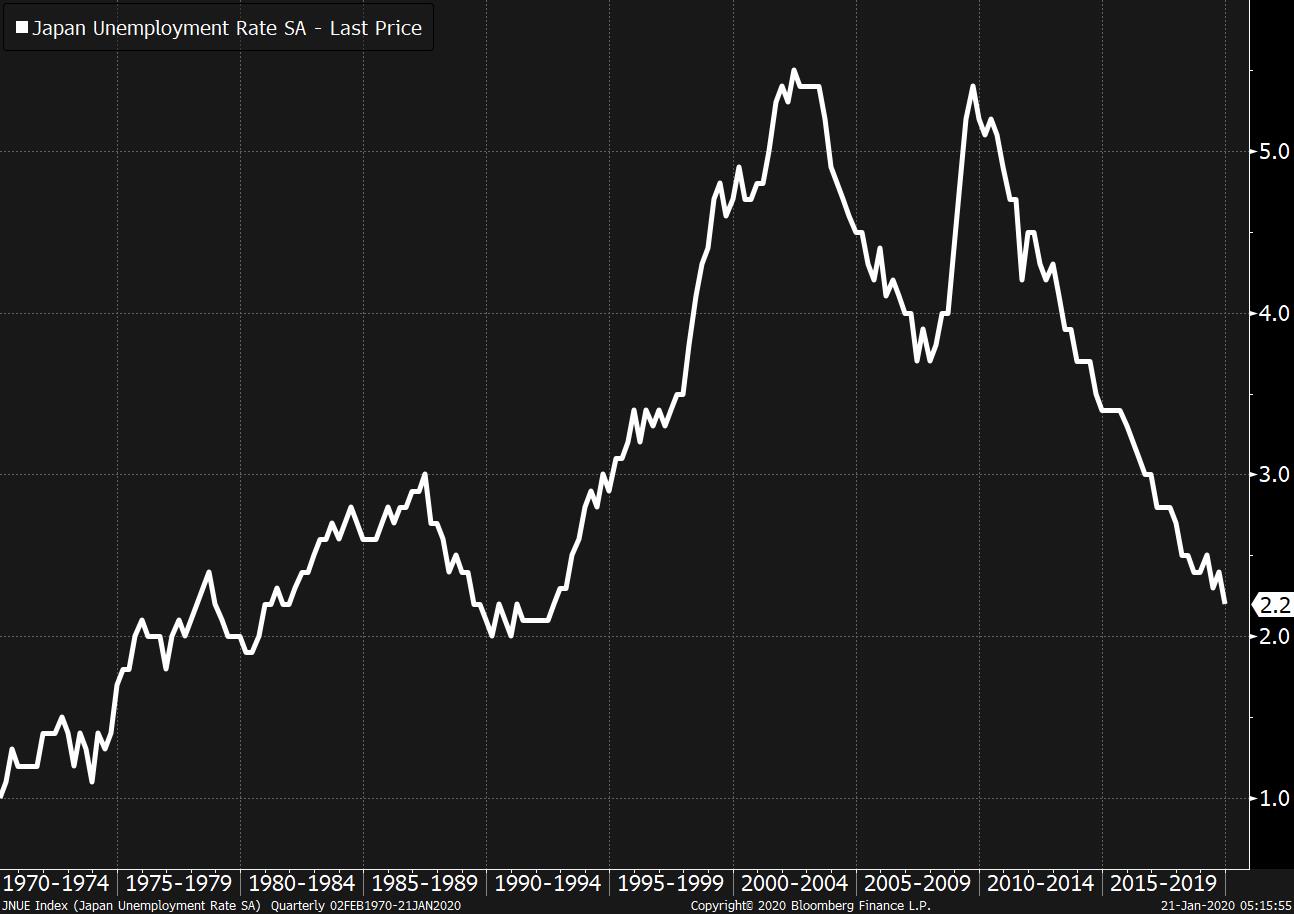 Like Bloomberg's Five Things? Subscribe for unlimited access to trusted, data-based journalism in 120 countries around the world and gain expert analysis from exclusive daily newsletters, The Bloomberg Open and The Bloomberg Close. | 


Post a Comment