| Welcome to your morning markets update, delivered every weekday before the European open. Good morning. Coronavirus concerns are showing few signs of abating, Brexit's current timeline may be somewhat optimistic and Trump impeachment arguments rumble on. Here's what's moving markets. Virus Update The chief of the World Health Organization is heading to China to assess the country's response to the coronavirus as the death toll continues to rise, new cases keep being found and with concerns that it is being spread before sufferers start showing symptoms. The global efforts being made to stop the virus from spreading further are also stepping up, with the U.S. advising any citizens planning to travel to China to reconsider, while car companies are evacuating personnel, coffee houses and restaurants are suspending business and Asian stocks are still taking a hit, particularly in China and now in South Korea. Market Fallout Jittery market participants are working hard to price in the fallout from coronavirus but it was made abundantly clear which asset classes are in favor and which are bearing the brunt of the worries. Stocks were slapped hard, with airlines, miners, luxury goods and technology stocks the most severely bruised, while oil prices continued to drop overnight amid nerves surrounding China's economy and the potential for demand to be sapped. European stock futures, though, are pointing higher for Tuesday. On the flip side, the attraction of safe havens spiked, sending the world's pile of negative-yielding debt soaring and pushing the gold price to the highest since 2013. More Time Michel Barnier, the European Union's chief Brexit negotiator, says the U.K. will probably need "much more" time to strike a trade deal and settle its future relationship with Europe than the 11 months currently in the diary. Unsurprisingly, Barnier's main concern is that there remains a lack of clarity on exactly how aligned a post-Brexit U.K. wants to be with the EU amid conflicting statements from various U.K. politicians on the subject. Given the likelihood that the U.K.'s relationship with the U.S. could face some strain over Britain's decision to give China's Huawei Technologies Co. partial access to its 5G network, Prime Minister Boris Johnson is going to have a very full plate on the trade front. Bolton Bombshell President Donald Trump's impeachment lawyers largely ignored the revelations from an upcoming book by former national security adviser John Bolton, continuing to argue that a lack of first-hand evidence undermines the case against the president. Two Republican senators, however, disagree and said Bolton's book, which claims Trump tied aid for Ukraine to an investigation of a political rival, has bolstered the argument to subpoena more witnesses. Trump himself denied the allegations, saying Bolton is just trying to sell books. Coming Up… It should be a quiet day on the economic data side but the technology sector will be in focus on both sides of the Atlantic, first with German software giant SAP SE and then, after the U.S. close, with results from Apple Inc. The latter's outlook for iPhone sales and any comments it has on the impact of coronavirus and U.S.-China trade will be closely scrutinized. SAP has raised its profit forecast for 2020. Also keep a close eye on French airplane maker Airbus SE, which is said to be close to reaching a settlement with U.K. authorities over bribery allegations that have loomed over the group for years. What We've Been Reading This is what's caught our eye over the past 24 hours. And finally, here's what Cormac Mullen is interested in this morning Investors are wrestling with attempts to quantify the economic impact of the coronavirus as global efforts to curb the spread of the disease intensify. Outside of the initial risk-asset selloff and haven bid, its potential longer-term effect is beginning to be priced into markets. Growing concerns about the outbreak has sparked traders to bring forward expectations for the next Federal Reserve rate cut. Fed funds futures markets show a full quarter-point cut is now priced in by the end of October, while just a few weeks ago a reduction wasn't seen until early 2021. Of course everybody still expects the central bank to keep its target rate range unchanged this week, at 1.5%-1.75%. Coincidentally, the bottom end of that range mirrors another growing consensus in markets — that that's where benchmark U.S. Treasury yields may find some support. The 10-year yield fell as much as 9 basis points to 1.60% Monday amid the selloff in risk assets. 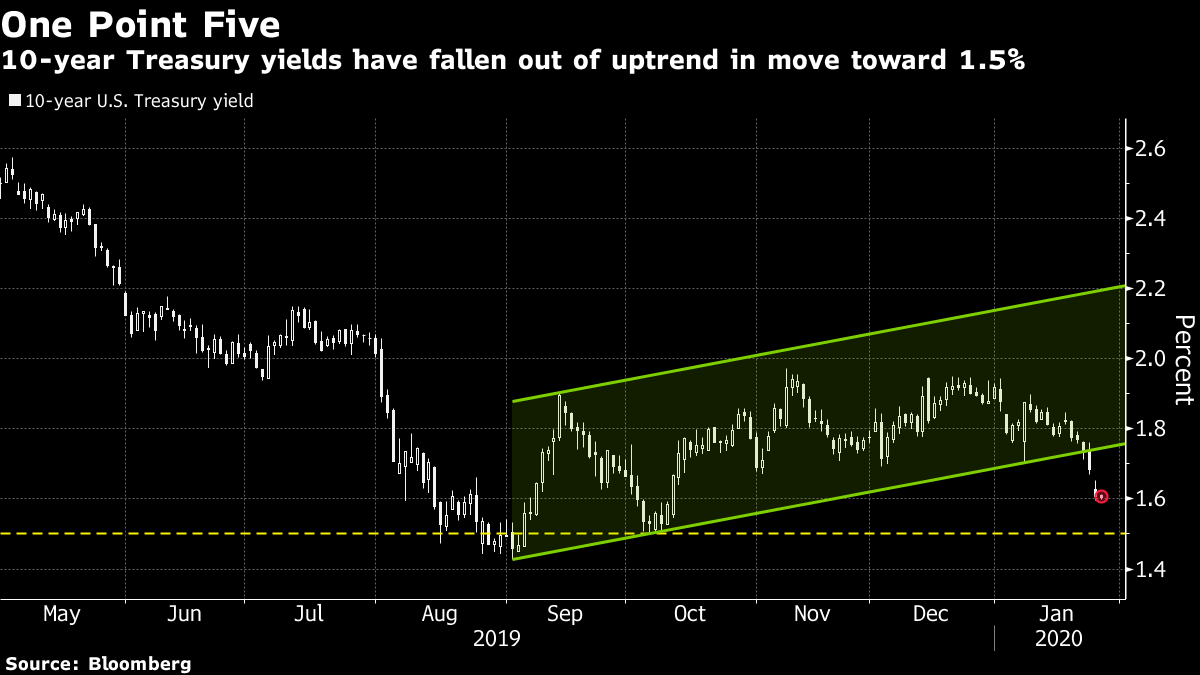 Cormac Mullen is a cross-asset reporter and editor for Bloomberg News in Tokyo. Like Bloomberg's Five Things? Subscribe for unlimited access to trusted, data-based journalism in 120 countries around the world and gain expert analysis from exclusive daily newsletters, The Bloomberg Open and The Bloomberg Close. | 


Post a Comment