| This is Bloomberg Opinion Today, a lokshen kugel of Bloomberg Opinion's opinions. Sign up here. Today's Agenda 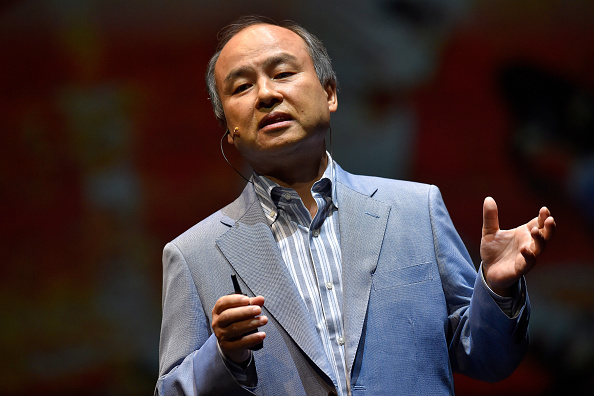 When Masayoshi Son speaks, fewer people are listening. Photographer: Koki Nagahama/Getty Images AsiaPac A Tale of Two Oracles You'd probably be just as happy swapping lives with Warren Buffett as with Masayoshi Son. Both are ludicrously wealthy, with endless opportunities to meet interesting people and buy their companies. Both are also at career crossroads. Still, you'd probably rather be Buffett than Son, assuming you could stomach all the Coca-Cola. It's not just that Buffett is richer, by about $66 billion. It's that his current professional crisis is one we'd all probably like to have; as Tara Lachapelle writes, he has too much cash and no way to spend it. His investment vehicle, Berkshire Hathaway Inc., has had a transformative decade, Tara notes, but lagged the broader market again this year. The longer it goes without a big acquisition, the more becalmed it will be. Son's year has been far worse. The godfather of the unicorn era, via his Vision Fund, has suffered repeated blows, from disappointing IPOs to the spectacular collapse of WeWork. Unlike Buffett, Son doesn't have endless cash flow to solve his problems, notes Shuli Ren. Worse, his image has been downgraded from tech visionary to robber-baron capitalist — and not even a particularly good one. As Buffett has shown, being considered an oracle has its upside. Finally, Some Decent Climate News It's so rare to get any remotely good news about climate change that it's worth celebrating when it actually happens. Climate scientists increasingly think the absolute worst-case scenario for global warming laid out by the UN's Intergovernmental Panel on Climate Change looks unrealistic, notes Noah Smith. That's because it assumes a late revival of widespread coal use almost nobody sees coming. President Donald Trump still carries a torch for the filthy fuel, of course. And his EPA is rolling back pollution regulations on the industry, endangering the environment and Americans' health, writes Tatiana Schlossberg. But Trump has been unable to reverse the ebbing tide of coal use, Noah notes, not just in the U.S. but around the world. 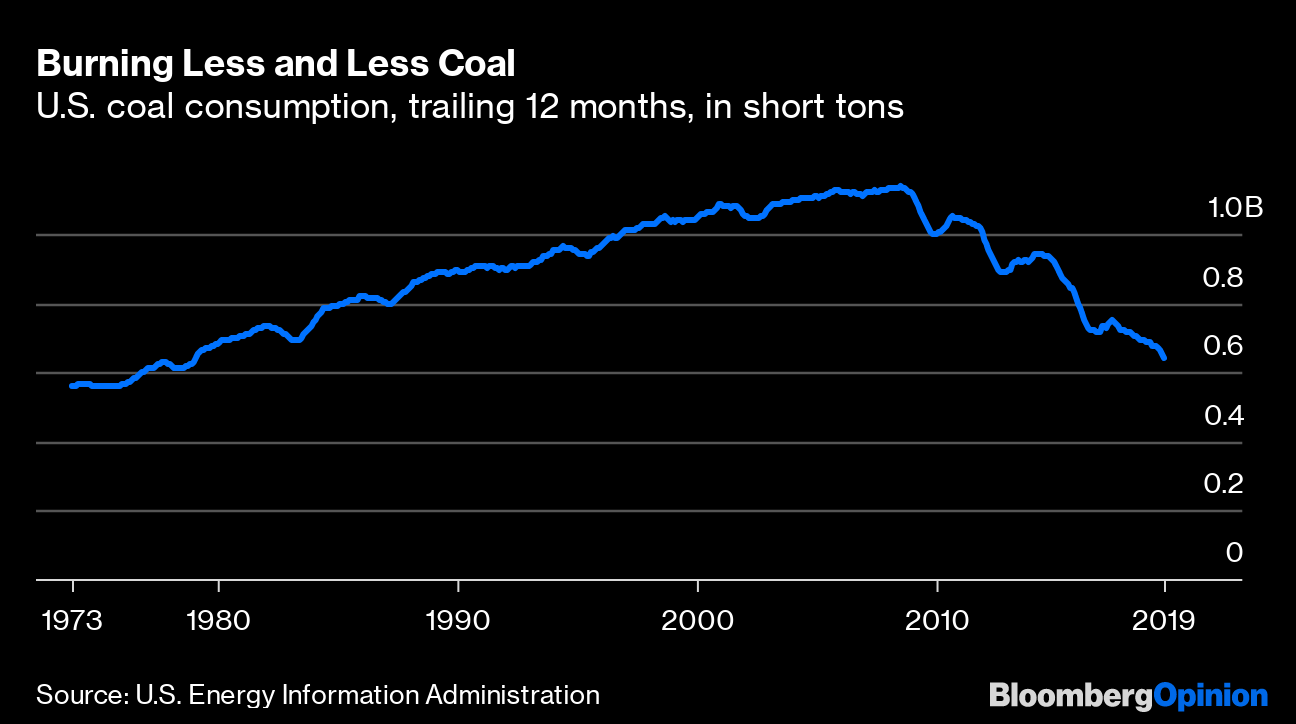 This is of course not an excuse to do nothing about climate change. There are still many difficult choices ahead. The global shipping industry, for example, is curbing sulfur pollution to save lives near shipping zones. But one ironic silver lining of sulfur pollution is that it slows global warming, notes Julian Lee. So the industry will have to find an offset. Because even the second- or third-worst-case scenario for the planet is still unacceptable. Bonus Reduce, Reuse, Recycle Reading: Earth's recycling business is starting to look a lot like that of the "Star Wars" universe. — Adam Minter Boeing's Not-So-Big Change Boeing Co. today replaced its CEO, and the first question is what took so long. Somebody needed to pay for the 737 Max's fatal crashes and grounding, and Dennis Muilenburg has not covered himself in glory with his handling of the crisis, writes Brooke Sutherland. The second question, though, is whether this change really helps Boeing, and the answer to that is probably no, Brooke writes. Muilenburg wasn't solely responsible for the corporate culture that spawned the 737 Max problems, and it's not clear his replacement has any better ideas. Increasingly, Boeing resembles rapidly diminishing General Electric Co., and not in a good way. Telltale Charts The dawn of the 2010s was the age of the Tea Party, whose railing about high deficits and budget brinksmanship helped trigger a U.S. credit-rating downgrade. At the dawn of a new decade, it's clear absolutely none of its fears came true, writes Brian Chappatta. And the austerity the Tea Party gave us helped fuel the rise of a radically different approach at the dawn of this decade: Modern Monetary Theory. 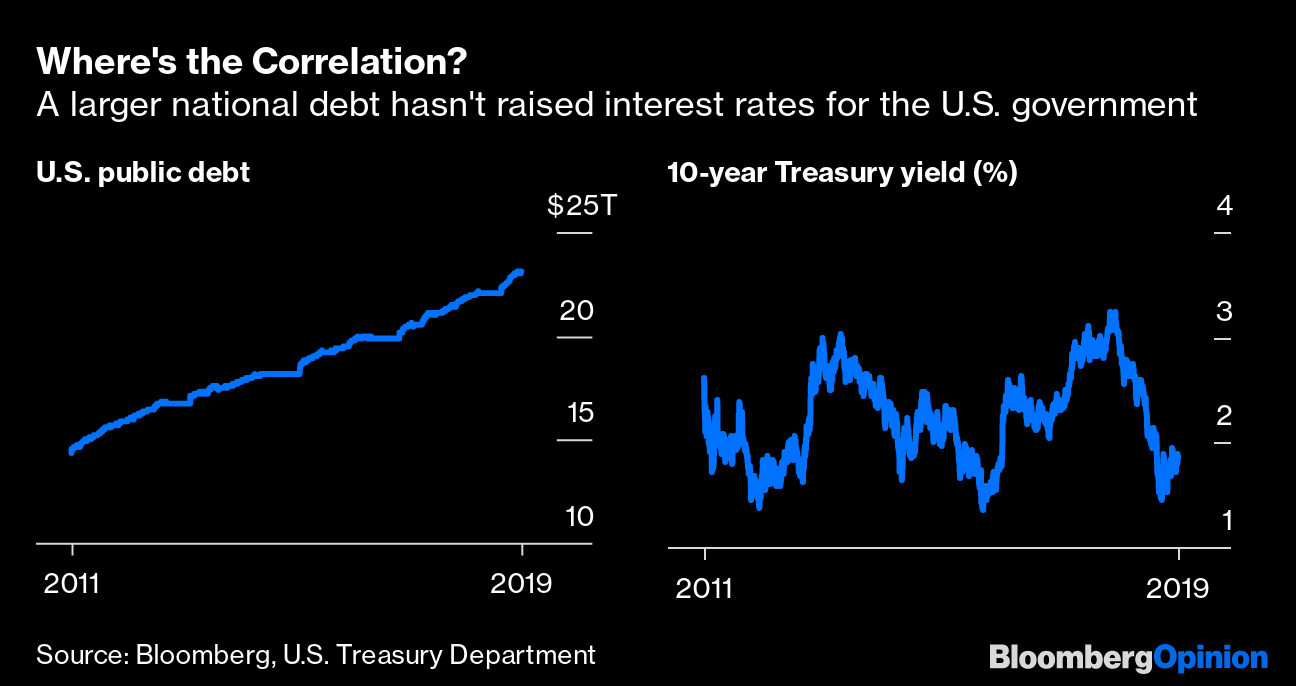 Companies with negative value increasingly dominate the stock market, writes John Authers. No wonder markets are terrified of higher interest rates. 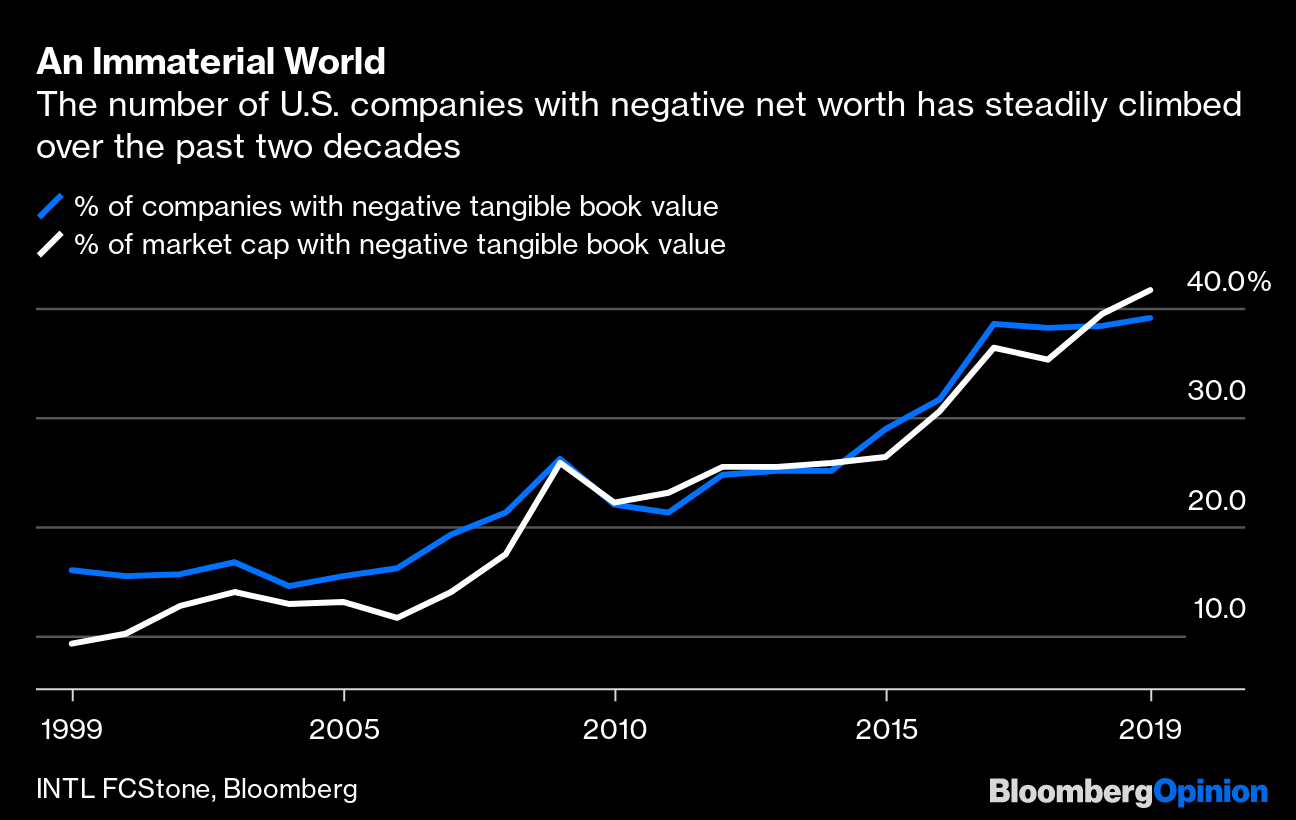 Further Reading Online-only retail's big moment turned out to be a dud; now it's being absorbed by old-fashioned brick and mortar. — Sarah Halzack If Trump has truly been impeached, then the Senate trial can start already. Otherwise he hasn't. — Noah Feldman We should pay workers to leave distressed economic locales. — Michael R. Strain The Credit Suisse spying scandal keeps looking worse and worse for its CEO. — Lionel Laurent The City of London is starting to fracture over whether to stick to EU regulations post-Brexit. — Elisa Martinuzzi Joke all you want, but the Space Force is an idea whose time has come. — James Stavridis "The Great British Bake Off" shows cultural change and national identity don't have to be mutually exclusive. — Virginia Postrel ICYMI The Fed may be masking its efforts to calm repo markets. Saudi Arabia sentenced five to death in the Khashoggi murder. John Bolton knocked Trump over North Korea. Kickers Scientists revive hours-dead pig brains. (h/t James Greiff) Scientists find more evidence of a new boson and a new force. (h/t Scott Kominers) The 10 weirdest science studies of 2019. (h/t Mike Smedley) Three theories for why you have no time. Note: Please send time and complaints to Mark Gongloff at mgongloff1@bloomberg.net. Sign up here and follow us on Twitter and Facebook. | 


Post a Comment