Narendra Modi is on the march.
India's prime minister, aided by his powerful Home Minister Amit Shah, is bent on using his second term to entrench Hindu nationalism in the world's biggest democracy, a land of multiple faiths. As the economy sputters, it's useful to corral the Hindu majority behind the ruling party.
Modi already scrapped nearly seven decades of autonomy in the Muslim-majority region of Kashmir. In the state of Assam, some 1.9 million people, mostly Muslims and many of them poor, risk losing their citizenship unless they can produce documents dating back decades. And Hindus won a court case over a religious site disputed for centuries in the city of Ayodhya, where Modi's party has promised a grand temple.
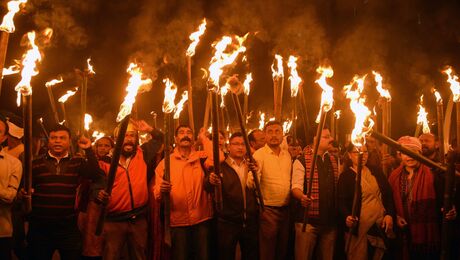
Now, India's parliament is considering a law to prevent Muslim migrants from neighboring countries receiving citizenship. The bill has prompted protests, as Upmanyu Trivedi and Bibhudatta Pradhan explain, with concerns that millions could be left stateless. There are questions about whether it'd violate India's secular constitution, and it has set off talk of U.S. sanctions.
There's also the question of priorities. Infrastructure remains patchy. The millions of jobs Modi promised in his first term have not materialized. Many live daily with deadly air pollution. Women are gang raped.
With loads of untapped potential, India is often talked about as the next economic giant after China. But to take advantage of that, it may need Modi to turn his gaze back to jobs and growth.
— Rosalind Mathieson




Post a Comment