| Welcome to your morning markets update, delivered every weekday before the European open. Good morning. The U.K. election enters the final stretch, the tariff deadline looms and there's going to be central bank debate aplenty. Here's what's moving markets. Final Stretch The U.K. general election campaign enters its final week with the Conservative Party in the lead but still a distinct lack of certainty when it comes to the nuances of the overall outcome, each of which stands to have a significant and different impact on local assets. The major short-term risk factor for investors is whether there will be a clear majority for the Tories, which is perceived to at least give a degree of clarity on the path for Brexit. Or the polls prove wrong, Labour beat expectations and a hung parliament looms. One would be well-advised to train an eagle eye on the polls, the pound and the FTSE 250. Deadline One would be equally wisely counseled to remember that the U.K. vote is not the only major event this week and indeed, for the global economy, nowhere near as important as the looming deadline for more tariffs to be imposed on Chinese goods by the U.S. The latest Chinese export data released over the weekend demonstrates the impact the tit-for-tat tariff battle is having, with exports to the U.S. falling by 23% in November and overall exports posting a surprise fall. Another underlying source of tension between the two sides is also showing few signs of abating, with pro-democracy protests in Hong Kong over the weekend the largest seen in months. Policy Debates The next few days will also be dominated by debate on central bank policy, with the Federal Reserve and the European Central Bank policy decisions ahead, the latter the first of ECB President Christine Lagarde's tenure. Central banks are expected to spend the next decade pumping more money into the economy, albeit at a slower pace than before, but the real discourse will be around what other tools they will be able to employ to ensure that monetary policy can continue to be effective in battling the next downturn, with the "shock and awe"-style methods of the past potentially out of fuel. Refocusing The U.K.'s largest supermarket chain, Tesco Plc, is considering offloading its Thailand and Malaysia operations, which could be worth around $9 billion. It would mark a move by the group to refocus itself on its core U.K. business, which continues to face challenges not only from Brexit but from intense competition that has driven down prices and made margins razor thin. At the much smaller end of the U.K. deals spectrum, engineer Senior Plc is said to be exploring a sale of its aerostructure unit. Coming Up… Asian stocks kicked off the week in a muted, cautious fashion ahead of the flood of central bank meetings and the looming tariff deadline, with European stocks likely to follow suit. Crude prices remain close to 12-week-highs after the surprise move by Saudi Arabia announced on Friday to curb oil output beyond what it had agreed with OPEC+ members, prompting Goldman Sachs to raise its 2020 oil forecasts. German export data and euro area investor confidence will top the economic agenda, with earnings thin on the ground for Europe. What We've Been Reading This is what's caught our eye over the weekend. And finally, here's what Cormac Mullen is interested in this morning It's been a long journey but they've finally got there. The S&P 500 Financials Index, which fell more than 80% during last decade's financial crisis, closed at the highest since June 2007 on Friday. As my colleague Michael J. Moore pointed out, the gauge has risen 27% this year thanks to a combination of buoyant U.S. stocks, a strong domestic economy and lower tax rates. European investors can only look on in envy — the Stoxx Europe 600 Banks Index is up a mere 4% in comparison weighed down in a mire of negative interest rates and sluggish economic conditions. Still, while government programs and rising rates helped U.S. lenders rebound quickly after the financial crisis, there is no guarantee the current tailwinds will continue. Much will depend on the direction of U.S. rates with question marks still swirling around whether the global economy can successfully reflate next year. And the specter of political risk could soon weigh on the sector with a number of Democratic candidates including Elizabeth Warren and Bernie Sanders touting financial transaction taxes among their policy proposals. The journey isn't over yet. 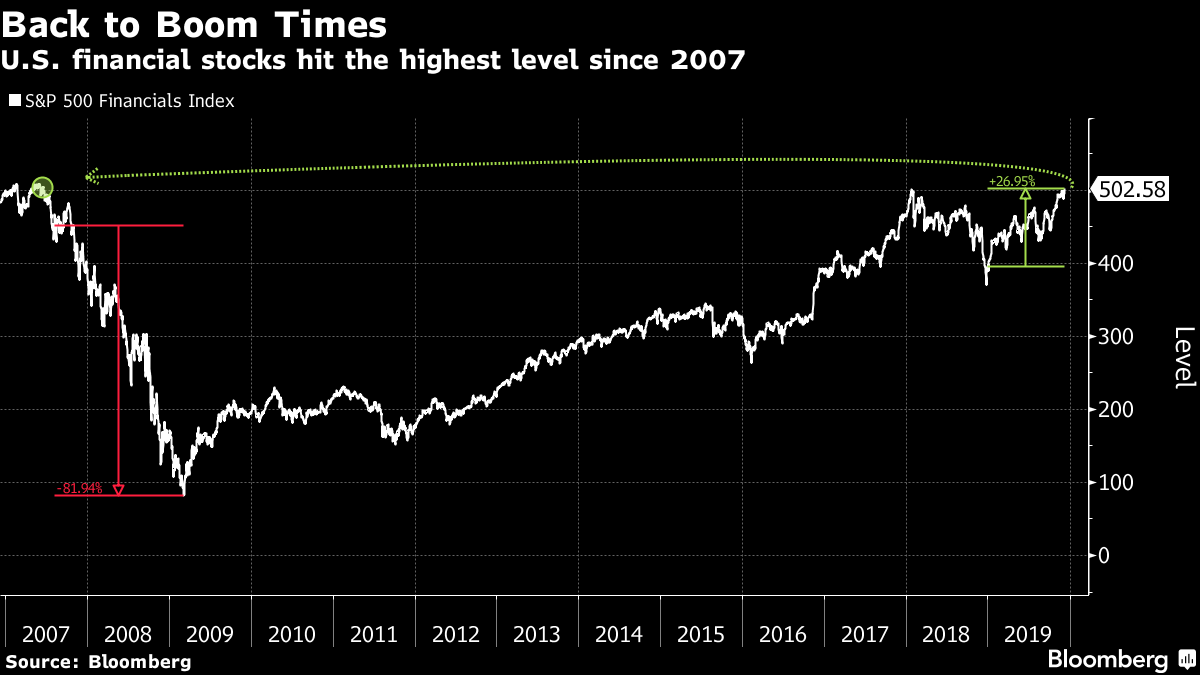 Cormac Mullen is a cross-asset reporter and editor for Bloomberg News in Tokyo. Like Bloomberg's Five Things? Subscribe for unlimited access to trusted, data-based journalism in 120 countries around the world and gain expert analysis from exclusive daily newsletters, The Bloomberg Open and The Bloomberg Close. Before it's here, it's on the Bloomberg Terminal. Find out more about how the Terminal delivers information and analysis that financial professionals can't find anywhere else. Learn more. | 


Post a Comment