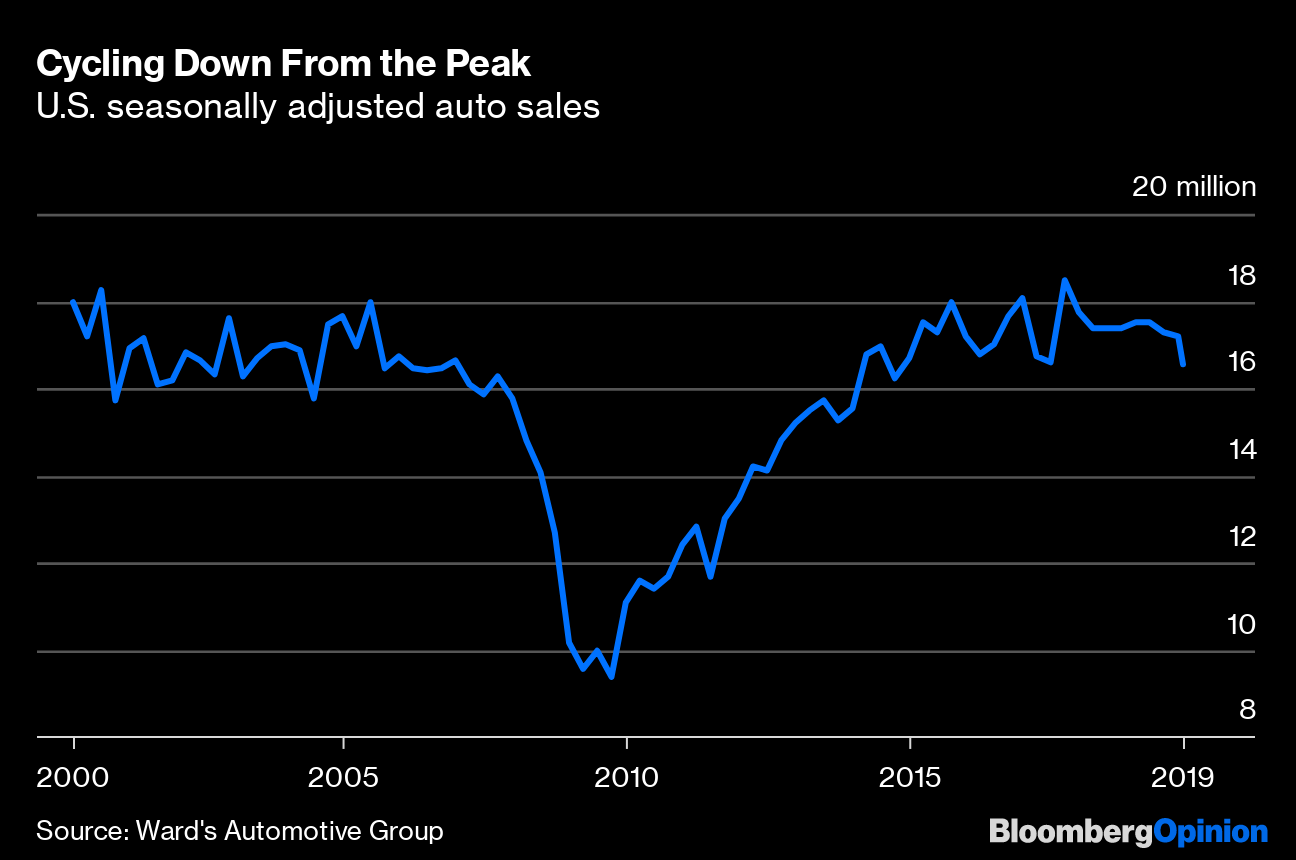
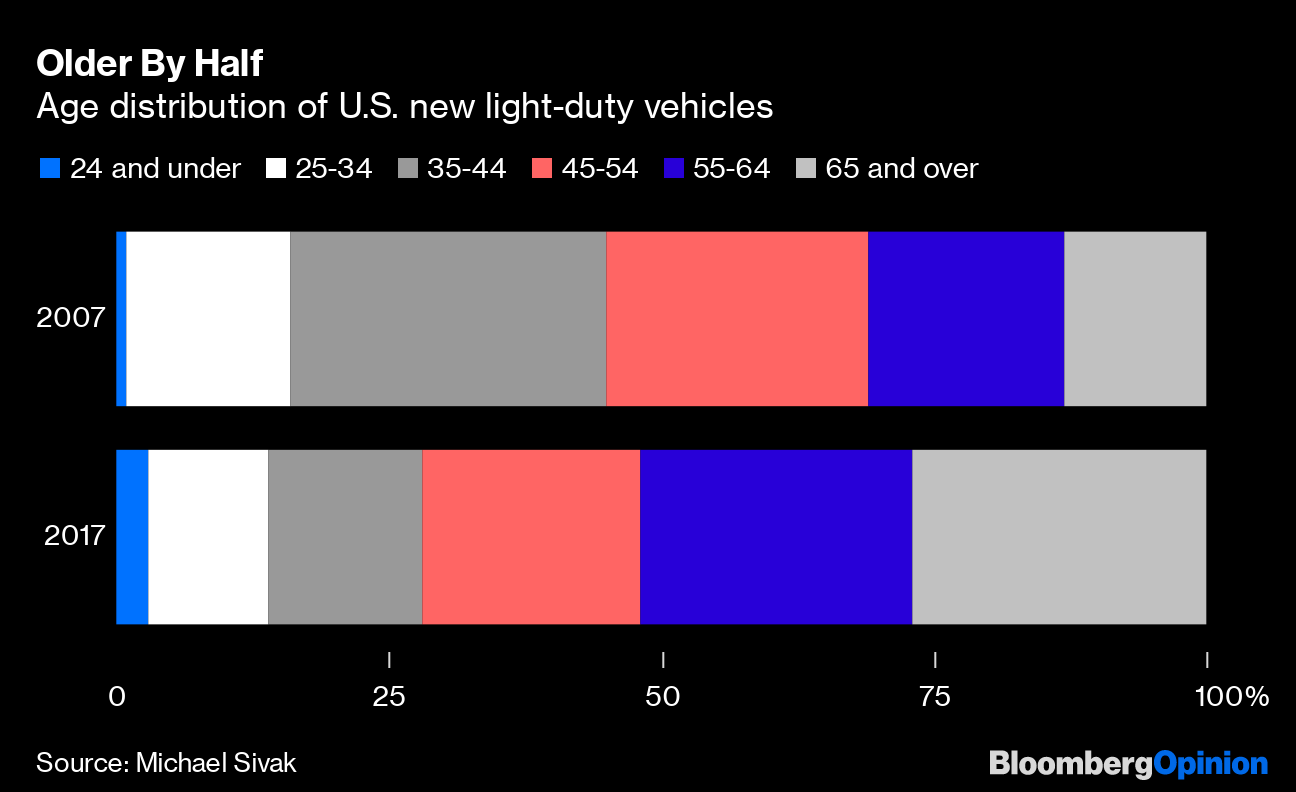
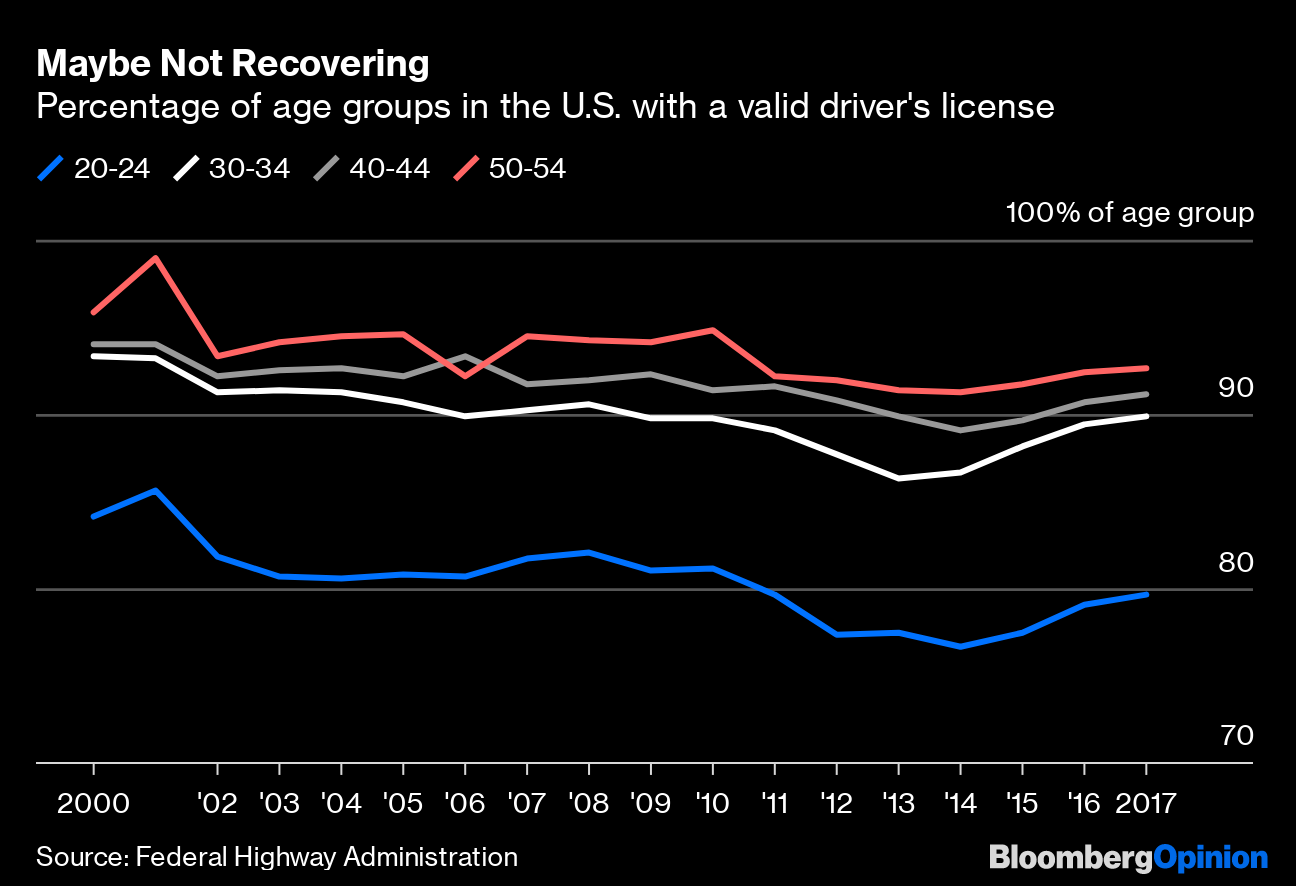
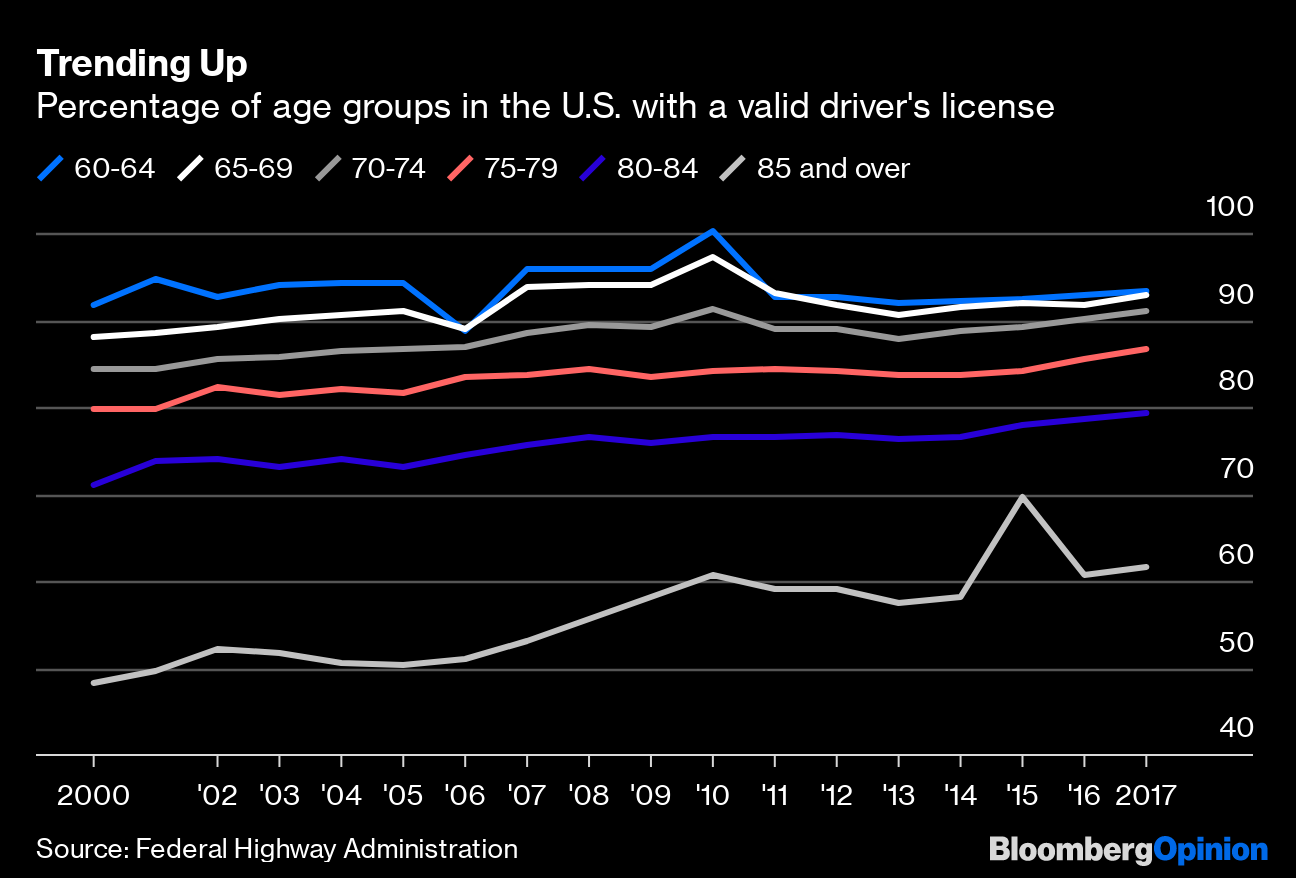
| In October, seasonally adjusted U.S. auto sales topped 16.5 million, making the U.S., unsurprisingly, the second-biggest auto market in the world after China. Big as that figure is, it's down by more than 2 million vehicles from two years ago and back to levels seen in 2014, 2007 and 2002. There's a major difference between the auto market of the late 2000s and the late 2010s, however: the age of buyers. Auto market researcher Michael Sivak recently noted the distinct shift in new-car purchasers toward older buyers. In 2007, nearly half of all light-duty vehicle buyers in the U.S. were under the age of 44; in 2017, more than half were over the age of 55. Something else has happened to the U.S. driving population. Since 2000, the percentage of the population with driver's licenses has fallen in every age group from 16 to 59. To be clear, those figures have also recovered from their lows in 2013 and 2014, but they remain below where they were at the beginning of the century. For ages 60 and up, however, the trend is reversed: I've written before on how older Americans are holding onto their driver's licenses. I've also written about how today's passenger vehicles stay on the road twice as long as they did four decades ago. Add in the fact that more than half of new car buyers are over the age of 54, and the U.S. auto market looks older than ever. It's a market of old used cars, older buyers of new cars and older drivers. Weekend reading - The National Transportation Safety Board says that an " inadequate safety culture " contributed to Uber's fatal automated test vehicle crash. The NTSB's report, executive summary and recommendations are here .
- The widespread arrival of ride-hailing apps has reduced the number of alcohol-related crashes in cities while also enabling more binge drinking .
- A transportation committee on Manhattan's Upper West Side has an idea: Eliminate street parking .
- The value of the Saks Fifth Avenue flagship store in New York has dropped 60% in five years , from $3.7 billion to $1.6 billion.
- BMW's i4 all-electric sedan will hit the market in 2021, with range of 372 miles.
- The massive coal-fired Navajo Generating Station in Arizona has gone dark after almost five decades of producing power.
- Bloomberg Opinion's David Fickling on what Bill Gates gets wrong about fossil fuels : Equity divestment matters little; debt is a different matter entirely.
- New York University professor Aswath Damodaran does the math on Saudi Aramco's IPO; he says in one valuation lens that " this stock is a dressed-up bond."
- Securities and Exchange Commission Chairman Jay Clayton has apparently been duped into limiting the power of dissenting shareholders by a " laughably clumsy " public relations campaign.
- Two of Australia's richest people, Atlassian Corp. co-founder Mike Cannon-Brookes and Fortescue Metals Group Ltd. Chairman Andrew Forrest, are investing millions in a project to export solar power from Down Under to Singapore via a 2,800-mile transmission cable.
- For architect Norman Foster, the science fiction of his youth is the reality of today , and the science fiction of today will be reality for the next generation.
- Rose Eveleth's recent podcast travels to 1919 to see how three events shaped the last 100 years and will continue to shape the future.
- An obituary for Azellia White , one of the first African American women to earn a pilot's license in the U.S. She was 106.
- The U.S. military deserves the right to repair its own equipment, says Captain Elle Ekman of the U.S. Marine Corps.
|


Post a Comment