| Powell says the Fed is "in a good place," U.S.-China trade deal plan hits yet another snag, and Jho Low strikes a $1 billion 1MDB deal with the U.S. Here are some of the things people in markets are talking about today. Third Cut "We believe monetary policy is in a good place." That's what Federal Reserve Chairman Jerome Powell told a news conference after officials reduced interest rates by a quarter-percentage point for the third time this year, signalling a pause in further cuts unless the economic outlook changes materially. The Federal Open Market Committee altered language in its statement following the two-day meeting, dropping its pledge to "act as appropriate to sustain the expansion," while adding a promise to monitor data. They cited the implications of global developments in deciding to lower the target range for the central bank's benchmark rate to 1.5% to 1.75%. Here are six strategists explaining why stocks didn't lose it over Powell's tougher stance. Markets Stocks in Asia looked set to gain after U.S. equities rose to a fresh record high following the Federal Reserve's decision to cut interest rates and indicate it is unlikely to move in either direction any time soon. Treasuries gained and the S&P 500 turned higher when Powell said rate hikes won't occur as long as inflation remains persistently cool. The offshore yuan climbed. After the close of trading, Apple and Facebook advanced after posting results. The yen was steady ahead of the Bank of Japan's policy decision. Billion-Dollar Pact The U.S. Justice Department has struck a deal with fugitive financier Jho Low to recoup almost a billion dollars looted from Malaysian investment fund 1MDB, in what would be the biggest recovery from a decade-old anti-corruption crackdown. The 1MDB global corruption scandal has toppled a government, ensnared Goldman Sachs and set off investigations across the globe. The proposed settlement was filed Wednesday in a California court. The deal, if approved by a federal judge, would help resolve forfeiture cases tied to Low, who prosecutors say orchestrated the theft of more than $4 billion from 1MDB that ended up paying for a private jet, a superyacht, mansions, diamonds and even Hollywood movie productions. The agreement doesn't include an admission of guilt or wrongdoing. It's unclear whether it affects the criminal charges against Low in the U.S. "Phase One" Snags There seem to be hurdles left, right and center when it comes to "phase one" of a U.S.-China trade accord. The first installment of the agreement is now being thrown into question after Chile canceled an upcoming summit where Donald Trump and Xi Jinping planned to meet. The cancellation — announced as social unrest continued to rock Santiago — appeared to catch the White House off guard. Still, the administration insisted that it would continue to press on in finalizing the agreement in coming weeks, but it wasn't clear whether U.S. officials would be able to find an alternate venue for a meeting with Xi. How Long, Hong Kong? The Hong Kong government will release data Thursday expected to show that the economy has slipped into a recession, after nearly five months of increasingly violent protests in the city. Third-quarter GDP figures are expected to show a further 0.6% retreat after a 0.4% contraction in the second quarter from the previous three months, the first technical recession since the global financial crisis a decade ago. This week Financial Secretary Paul Chan said that a full-year contraction is "very likely." The city's economy has shown the faintest of positive glimmers since the initial shock of the protests' impact this summer, when tourists began staying away. One of the biggest questions in determining if and when Hong Kong will recover is whether mainland Chinese tourists will return, given the anti-China tone of the demonstrations. What We've Been Reading This is what's caught our eye over the past 24 hours. And finally, here's what Tracy's interested in this morning It's a Halloween tradition here at Bloomberg to ask investors and analysts for the charts that scare them the most. My colleague Luke Kawa rounded up some truly scary ones. One I want to focus on, via George Pearkes of Bespoke Investment Group, shows U.S. crude oil imports drifting steadily down as the U.S. ramps up domestic shale production. 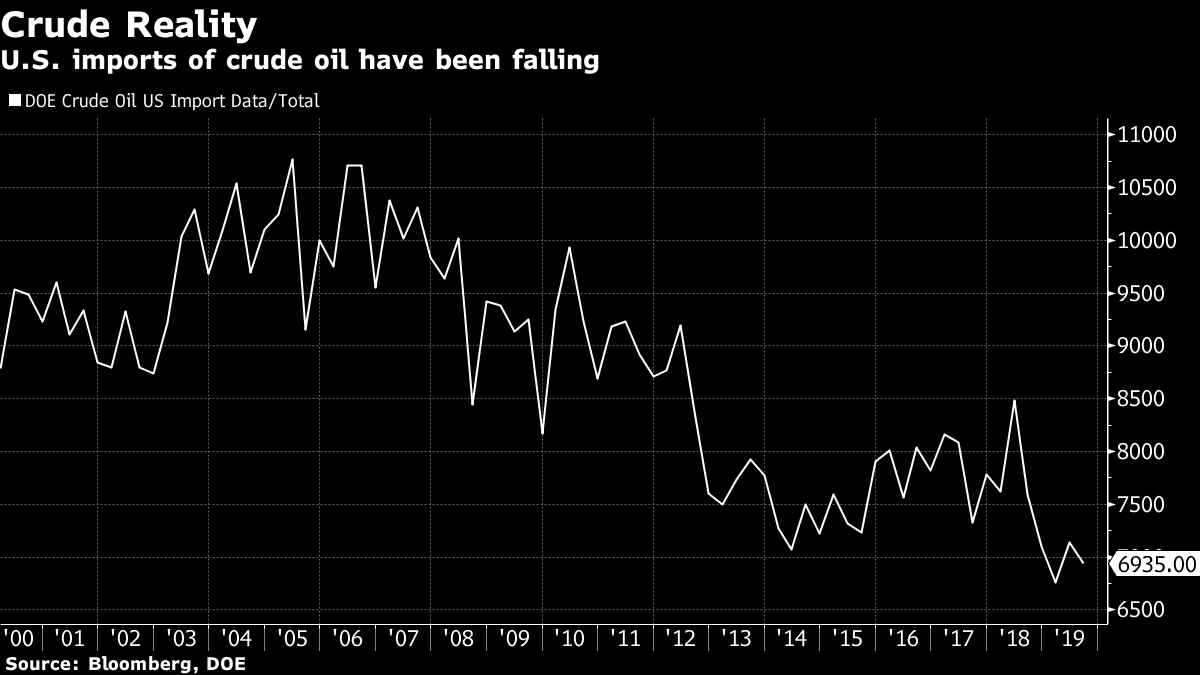 So why's that so scary? Pearkes points out that the rise of shale production basically means the U.S. is exchanging far fewer dollars in return for the world's oil, which limits the amount of petrodollars circulating around the world. As Pearkes puts it: "Add on what might happen as electric vehicle deployment ramps up, and the prospects for a net crude trade surplus in the near future mean one source of dollar liquidity ... drying up." It's almost certainly going to happen, and it's a huge change that has the potential to impact the entirety of global markets. Spooky! You can follow Bloomberg's Tracy Alloway at @tracyalloway. The best in-depth reporting from Asia Pacific and beyond, delivered to your inbox every Friday. Sign up here for The Reading List, a new weekly email coming soon. Before it's here, it's on the Bloomberg Terminal. Find out how the Terminal delivers information and analysis that financial professionals can't find anywhere else. Learn more. | 


Post a Comment