| Welcome to your morning markets update, delivered every weekday before the European open. Good morning. A major financial-services acquisition is dead, the U.S. is sanctioning some Chinese companies and the Brexit saga grinds on. Here's what's moving markets. HKEX Walks Hong Kong Exchanges & Clearing Ltd. is dropping its unsolicited, $36.4 billion takeover offer for London Stock Exchange Group Plc after less than a month, ending one of the more audacious cross-border deals of recent years. The bid surprised investors all the more given that it came amid rising political unrest in Hong Kong and mounting tensions between China and Western countries over trade and security, and it left bankers in a tough spot. LSE shares have gained almost 10% since HKEX announced its interest, so the stock may come under pressure today. But now the one-time target is free to push ahead with its $27 billion purchase of Refinitiv, the financial data and trading platform provider, an acquisition that investors greeted enthusiastically. Technology Sanctions Speaking of tensions with China, the U.S. put eight Chinese technology giants on a blacklist, alleging they're implicated in human rights violations against Muslim minorities in the country's Xinjiang region. The move came as negotiators from the U.S. and China began preparing for high-level trade talks Thursday in Washington. Shares of two of the companies singled out were suspended from trading Tuesday but iFlytek Co., one of the eight, slid as much as 3.1% in Shenzhen. The move takes President Donald Trump's economic war against China in a new direction, though the administration said it's unconnected to the trade negotiations. Brexit Watch The clock is ticking on the U.K.'s departure from the European Union, and there's little sign of a breakthrough that would prevent the country from leaving without a deal on Oct. 31. Prime Minister Boris Johnson's government is preparing for talks with the EU to collapse, the Spectator magazine reported, though at least one government official says an extension followed by a U.K. general election is still the most likely path forward. The discussions about his Brexit plan, announced last week, are due to continue today in Brussels. Ireland, one of Western Europe's fastest-growing economies, is preparing for collateral damage: Finance Minister Paschal Donohoe will sketch out his plan to limit the effect of a no-deal Brexit when he delivers his 2020 budget this afternoon in Dublin. Firmer Tone Stock trading resumed in Hong Kong after yesterday's holiday and investors are in a mildly risk-on mood despite continued anti-China protests. European and U.S. stock-index futures are edging higher as well, further evidence that investors have become hardened to some of the geopolitical risks hanging over the market. Some investors are thriving, too: Hedge funds are having their best year since 2013, even if as a group they're still lagging behind the broader market. Coming Up… Watch for industrial production data from Germany this morning after a disappointing reading yesterday on factory orders in the nation's slumping economy. Officials from the European Central Bank and the Bank of England are out speaking today, though the big monetary policy news may come after European markets close, when several Federal Reserve officials, including Chairman Jerome Powell, have events scheduled. The European earnings calendar is pretty much empty, aside from a trading update from EasyJet Plc. What We've Been Reading This is what's caught our eye over the past 24 hours. And finally, here's what Cormac Mullen is interested in this morning. With all eyes on the high-level U.S.-China trade talks starting Thursday as rumors swirl of potential complications, one measure of volatility is holding remarkably stable. China's onshore yuan market reopened Tuesday with one-month implied volatility in the yuan little changed over the past two weeks and in line with its 50-day moving average. It seems yuan traders are nonplussed about negotiations beginning just five days before U.S. tariff hikes on $250 billion of Chinese products come into effect Oct. 15. In fact, the reaction in many markets to negative pre-negotiation newsflow has also been very sanguine. Global stocks and the yen were little changed when the Trump administration placed eight Chinese technology giants on a U.S. blacklist on Monday. And Hong Kong shares rose after a holiday despite violent protests and President Donald Trump warning China that if the country does anything "bad" to quell them, trade negotiations would suffer. It doesn't quite smack of complacency on behalf of traders but the moves certainly suggest there is a degree of (over?)confidence in the market that the negotiations will end well. 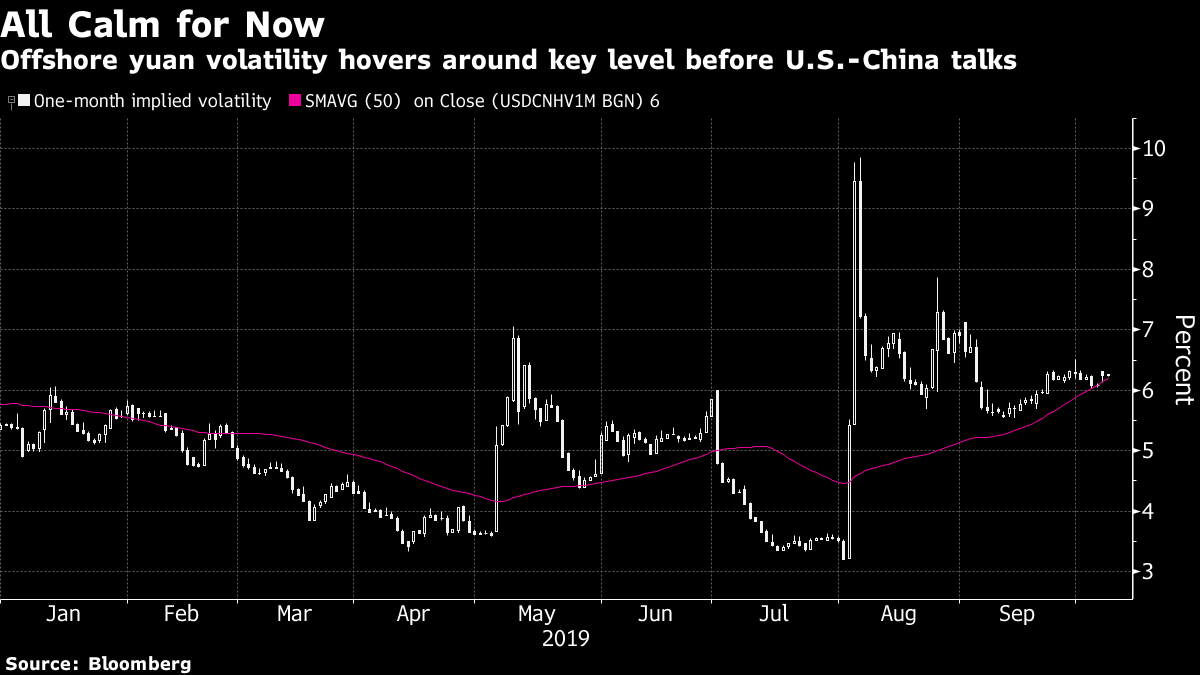 Cormac Mullen is a cross-asset reporter and editor for Bloomberg News in Tokyo. Like Bloomberg's Five Things? Subscribe for unlimited access to trusted, data-based journalism in 120 countries around the world and gain expert analysis from exclusive daily newsletters, The Bloomberg Open and The Bloomberg Close. Before it's here, it's on the Bloomberg Terminal. Find out more about how the Terminal delivers information and analysis that financial professionals can't find anywhere else. Learn more. | 


Post a Comment