| We're looking for your feedback to help improve this newsletter. Please follow this link to our survey, which will only take a few minutes. Saudi Arabia tries to move beyond the worst oil disruption in its history, Hong Kong activists visit Washington, D.C. and Vietnam finds it's hard to win a trade war. Here are some of the things people in markets are talking about today. Moving On Saudi Arabia has restored almost half the output lost at its Abqaiq oil facility after an attack on the plant at the weekend, and expects to be back to pre-strike processing levels by the end of the month. Oil prices plunged on the news, with WTI futures falling the most since August 1. Nonetheless, progress is slower than was initially expected and crude prices remain elevated as traders factor in higher risks for Saudi supply. Even as Aramco fixes the damage at Abqaiq, the possibility of further escalation of conflict in the Middle East hangs over the market. Here's what you need to know about the conflicts that led to the attack. Market Open Asian equity futures are higher after U.S. stocks eked out a gain and Treasuries rallied Tuesday, a day before the Federal Reserve is expected to cut interest rates. Crude gave back some of Monday's 15% surge as Saudi officials said they had restored just under half the output lost at the Abqaiq plant, one of the world's biggest oil facilities. Ten-year Treasury yields fell to 1.8% and the dollar weakened after the Federal Reserve took action to calm money markets, injecting billions in cash to quell a surge in short-term rates that was threatening to drive up borrowing costs for companies and consumers. Hong Kong Pressure Hong Kong activists visiting Washington, D.C., found a receptive audience for their pleas that the U.S. should act to support the city's pro-democracy movement. Joshua Wong, a prominent student leader of Hong Kong's 2014 Occupy movement, said: "I hope that historians will celebrate the United States Congress for having stood on the side of Hong Kongers, the side of human rights and democracy." U.S. lawmakers say they are moving forward with attempts to pressure Hong Kong's government by threatening the territory's special trading status. The Hong Kong Human Rights and Democracy Act of 2019, which would allow sanctions on Chinese officials and require annual assessments of whether the city is sufficiently autonomous from Beijing to continue its special trading status, may be taken up by the Foreign Relations Committee as soon as next week. The Other Trade Feud In the latest sign of trade tensions, South Korea has removed Japan from its list of most trusted trading partners. The move comes after Japan last month cut South Korea from a list of so-called "white nations" it deems safe for export of strategic materials, and means that exports of some strategic goods to Japan will receive greater scrutiny than shipments to 28 other fast-track destinations. The dispute between the two countries stems largely from differences in perception as to whether Japan has shown sufficient contrition for its 1910-45 colonization of the Korean Peninsula. In a statement, South Korea's trade ministry said the change to the list is to improve the country's control of strategic material exports, and is not a retaliation against Japan. Too Popular Vietnam is becoming a victim of its own trade-war success. The Southeast Asian country is by far the biggest winner to date from U.S.-China tensions, as importers look to divert their orders to bypass higher tariffs. It's got a young and growing middle class, a horde of free-trade agreements, and a booming manufacturing industry. But more and more businesses are complaining about congested ports and roads, rocketing costs for land and labor, and regulations that aren't being loosened fast enough. For now, the money keeps rolling in. But if Vietnam isn't able to close its infrastructure gap quickly, it risks losing its "mini-China" status, Bain & Co.'s Singapore-based vice president Gerry Mattios said. That might mean producers take their business to the likes of Sri Lanka or Cambodia instead. What We've Been Reading This is what's caught our eye over the past 24 hours. And finally, here's what Tracy's interested in this morning If you want an indication of what market professionals are talking about, you could do much worse than taking a look at Bloomberg's <Read> function on the terminal. On Tuesday, at least three of the five most-read stories were about carnage in money markets. That's after we saw repo rates — the cost of borrowing overnight money against "safe" collateral like U.S. Treasuries — soar to 10%. That prompted an emergency liquidity injection from the New York Fed, which succeeded in bringing the repo rate back down to 2.5%. 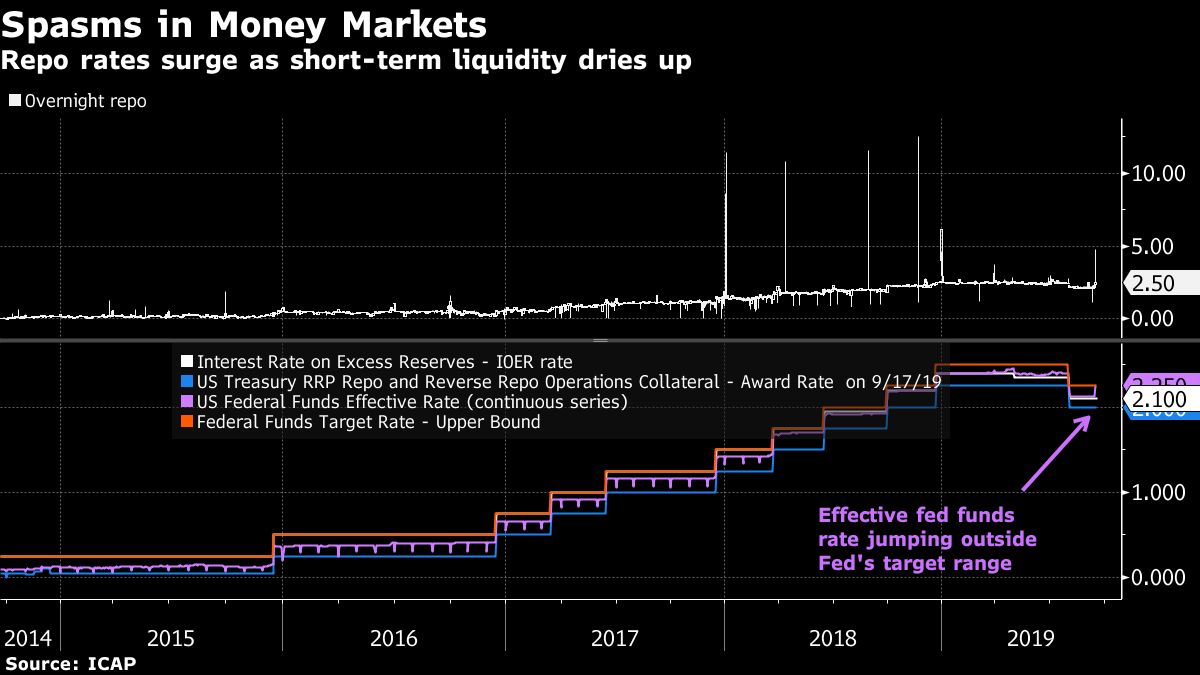 There are all sorts of theories about what caused the sudden move in lending rates but in this small space I'm just going to focus on two things. Regardless of what the catalyst is, it's worrying that the repo market appears to have gotten structurally more volatile. We've now had multiple big spikes in the overnight lending rate in less than a year, and that affects market sentiment. Moreover, the spike in repo rates effectively means tighter financial conditions at a time when the Federal Reserve is trying to loosen them. We know that the central bank is going to have to juggle a bunch of thorny issues when it meets this week — from trade uncertainty to the recent jump in oil prices. Now money market mayhem and the possibility of something gone awry in the belly of global funding markets just got added to the mix. Good luck! You can follow Bloomberg's Tracy Alloway at @tracyalloway. The best in-depth reporting from Asia Pacific and beyond, delivered to your inbox every Friday. Sign up here for The Reading List, a new weekly email coming soon. Before it's here, it's on the Bloomberg Terminal. Find out more about how the Terminal delivers information and analysis that financial professionals can't find anywhere else. Learn more. | 


Post a Comment