| Welcome to your morning markets update, delivered every weekday before the European open. We're looking for your feedback to help improve this newsletter. Please follow this link to our survey, which will only take a few minutes. Good morning. The revelations keep coming around Donald Trump's Ukraine call, the U.K. and EU negotiation teams meet again and the doves are ruling the roost at the European Central Bank. Here's what's moving markets. 'Perfect' Call The call between U.S. President Donald Trump and Ukraine President Volodymyr Zelenskiy is dominating conversation in Washington and there's no reason to think that'll change any time soon. The whistleblower's complaint which has brought the call to light claims White House officials tried to "lock down" the details of an interaction Trump has now called "perfect" on a couple of occasions in addition to attacking the whistleblower in a private meeting caught on tape. As Democrats push forward with a formal impeachment inquiry, markets will have to continue to decide how to process it. 'Lance the Boil' U.K. Brexit Secretary Steve Barclay and European Union chief negotiator Michel Barnier will meet in Brussels with the hope that some progress can be made towards agreeing to an exit deal as British lawmakers continue to squabble. U.K. Prime Minister Boris Johnson, still defiant following the historic court defeat his government suffered this week, is sticking to the view that getting Brexit done will "lance the boil" which has been characterized by an atmosphere in the House of Commons that the speaker had to condemn. The meeting will also take place amid a prediction that a no-deal Brexit would most likely result in a 2020 recession. Doves in Charge European Central Bank Chief Economist Philip Lane says he thinks there remains room for the bank to cut rates again and said the stimulus program which has split policymakers was "not such a big package." Very dovish words, particularly after the surprise resignation of one of the more hawkish members of the board and likely to encourage bond investors enjoying the rally. There could even be signs that Germany is starting to come around to the idea that it may have to loosen the budget purse strings in the face of urging from the ECB to support monetary easing with fiscal stimulus. Damage to Both Sides The boss of plane maker Airbus SE has said the escalating battle between the U.S. and European Union over aircraft subsidies threatens to do damage to both sides, a common refrain from many onlookers throughout the trade war. Where damage appears to have been swerved however is in the continued opening up of China's financial system, with Wall Street titans showing no signs of a slowdown in meetings with top regulators to capitalize as the country opens its doors. Where the trade war is hitting is for Chinese companies, where August profits fell and demonstrated the impact the tensions are having. Coming Up... Japanese stocks took a beating from a swathe of ex-dividend names on Friday, but overall Asia trading was broadly mixed and European and U.S. stock futures are providing little clue to direction. Watch for any impact on the European tech sector from results released by Micron Technology Inc., the U.S. chipmaker, which released a disappointing forecast and warned on the impact of trade tensions. Euro area consumer confidence, Italian business and consumer sentiment and U.S. personal spending data will all be released. What We've Been Reading This is what's caught our eye over the past 24 hours. And finally, here's what Cormac Mullen is interested in this morning While U.S. stock bulls are enjoying an encouraging backdrop of positive economic surprises, their European counterparts are stuck with exactly the opposite. Citigroup Inc.'s economic surprise index for the euro zone, a gauge of whether economic data beats or falls short of analyst expectations, plunged to its lowest level since February on Monday after a slew of disappointing readings. Europe's benchmark Stoxx 600 Index has had a reasonable correlation with the gauge over the last 12 months, suggesting stocks may come under pressure if economic data doesn't start surprising to the upside. Further signs of weakening sentiment came Tuesday, with business expectations this month in Germany falling to the lowest in a decade. The mood among factory executives was the main reason, with the Ifo institute, which compiles the sentiment report, saying the only direction was "downward." The news is another blow to Europe's largest economy after a report Monday showed factory activity is shrinking at the fastest pace since the depths of the financial crisis. With the benchmark Stoxx 600 Index still sitting on a year-to-date gain of over 15%, it wouldn't be surprising for the deepening gloom to soon translate to profit taking. 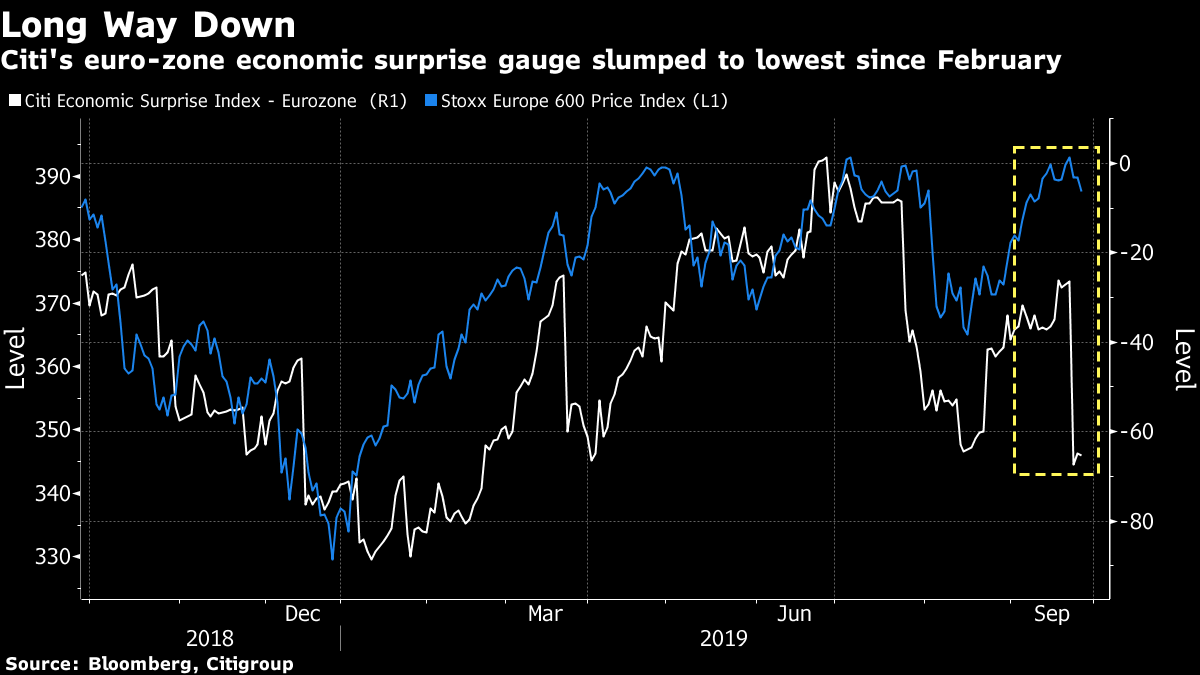 Cormac Mullen is a cross-asset reporter and editor for Bloomberg News in Tokyo. Like Bloomberg's Five Things? Subscribe for unlimited access to trusted, data-based journalism in 120 countries around the world and gain expert analysis from exclusive daily newsletters, The Bloomberg Open and The Bloomberg Close. Before it's here, it's on the Bloomberg Terminal. Find out more about how the Terminal delivers information and analysis that financial professionals can't find anywhere else. Learn more. | 


Post a Comment