| U.S. futures sink and havens rally as trade war deepens, Trump regrets not slapping higher tariffs on China, and Hong Kong's protests take a more serious turn. Here's what's moving markets. Market Turmoil The yen climbed and stocks were headed for steep losses in Asia after the U.S.-China trade war ratcheted up. S&P 500 Index futures tanked more than 1% while contracts indicated losses of more than 2% in Tokyo and Hong Kong. The yuan retreated. U.S. stocks slumped on Friday and Treasuries rallied amid the trade chaos. On the data docket this week, the U.S. releases GDP and durable goods reports that may show how tariffs on Chinese imports are affecting the economy. Hong Kong trade is also due Monday and likely to show a plunge in exports in July amid the trade war and weaker Chinese and global demand. Tuesday brings China industrial profits. There's a Bank of Korea rate decision on Friday, as well as Hong Kong retail sales. Trump's Trade Regrets Donald Trump acknowledged having second thoughts on escalating the trade war with China at the Group of Seven summit in France — only for his top spokeswoman to later say he meant he regretted not raising tariffs even more. White House Press Secretary Stephanie Grisham now says the media misinterpreted the U.S. president's initial remarks. Trump doesn't regret starting a trade war but he does have second thoughts on whether he should have hit the Chinese even harder. On Friday, Trump bumped existing levies to 30% from 25% and planned duties to 15% from 10%. China said it will follow through with tariffs on $75 billion of U.S. goods and vowed to fight the trade war to the end as it prepares for the worst. Meanwhile, two top White House officials said Trump has the authority to force American companies to leave China — as he claims, and which trade experts question -- yet whether he invokes those powers is a another question. Hong Kong Tensions Escalate Tensions flared again in Hong Kong as an effort to form a peaceful human chain across the city culminated in police clashes that led to the firing of a weapon and the deployment of water cannons for the first time. In the 12th weekend of disturbances, police and protesters were involved in several violent clashes in the New Territories district. On Saturday, Hong Kong Chief Executive Carrie Lam held a meeting with former officials and other prominent people to find a way out of the impasse that has rocked the former British colony. Meanwhile, China signaled it may send troops into Hong Kong. Some Trade Cheer: U.S. , Japan May Have a Deal The U.S. and Japan agreed in principle on a trade deal under which Japan will slash tariffs on U.S. beef, pork and other agricultural products, while continuing to face levies on its own auto exports. Announcing the deal Sunday, Trump also said Japan would purchase large quantities of U.S. wheat and corn. Japanese officials may consider that a good deal if they can elicit a promise in return that its automakers will be shielded from Trump's threat of more painful tariffs. The U.S. president and Japanese Prime Minister Shinzo Abe announced the agreement Sunday in Biarritz, France, at the G7 summit following a bilateral meeting. Meanwhile, at Jackson Hole Central bankers who attended this year's policy symposium in Jackson Hole, Wyoming, have a lot to mull over as they head home from their annual retreat. Hosted by the Kansas City Federal Reserve Bank, this year's conference examined the timely issue of challenges facing monetary policy as officials confront slowing global growth stemming from uncertainty over trade policy. One takeaway: Trump's trade shocks risk recession central banks can't prevent. With the gathering under way, Trump not only escalated the pressure on China, he also pondered on Twitter whether Fed Chairman Jerome Powell was perhaps a bigger "enemy" than Chinese President Xi Jinping. What We've Been Reading This is what's caught our eye over the weekend. And finally, here's what Tracy's interested in this morning We've talked before in this space about how Trump's use of tariffs has similar effects to monetary policy. When he ups his trade threats, U.S. financial conditions tighten (and it's then left to the Federal Reserve to decide whether it should loosen them again). That dynamic was on full display yet again on Friday, when the world's central bankers met at their annual Jackson Hole gathering. For a reminder of just how much monetary power Trump now wields, check out this quote from Bloomberg's summary of the past few days. "When Powell was giving his speech, I could see everybody on their iPhones, refreshing Twitter, waiting for the tweet from Trump," said Robert Eggertsson, a former New York Fed economist. "The most powerful central bankers in the world, all in the same room, would — rather than listen to Powell, they're checking on Twitter waiting for when Trump is going to tweet." 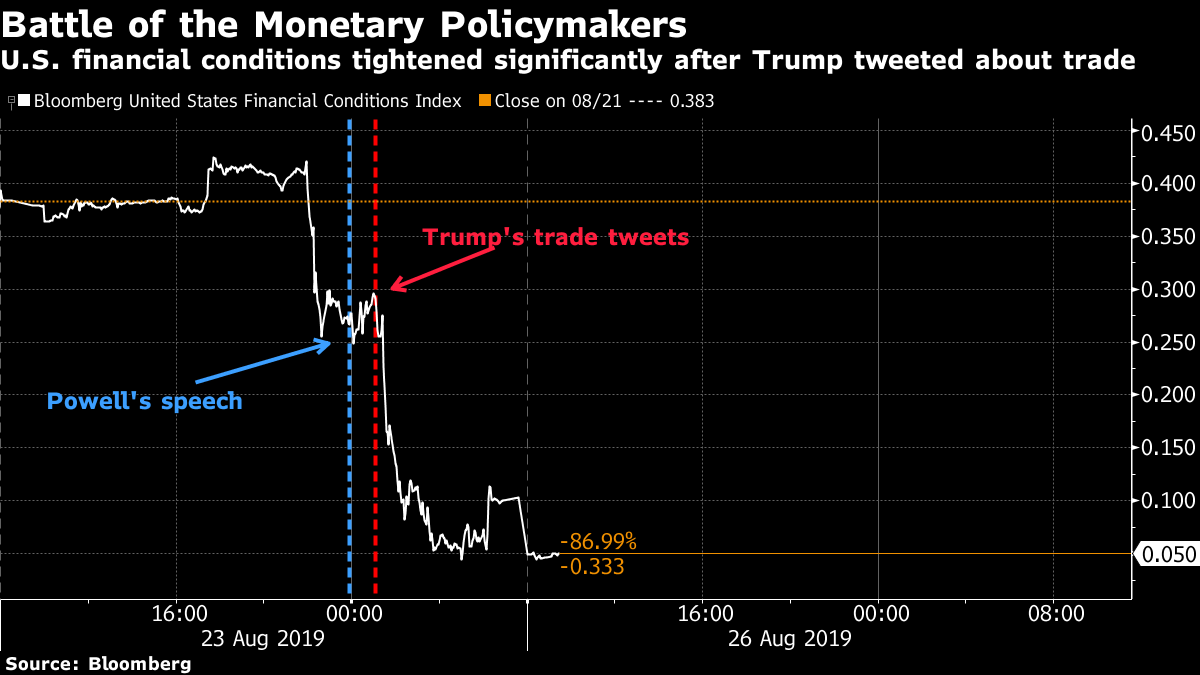 You can see the impact of a relatively dovish Jackson Hole speech from Fed chair Jerome Powell followed by a series of Trump tweets in the intraday move of U.S. financial conditions on Friday. Financial conditions hovered (and loosened very slightly) when Powell spoke in Wyoming. Then they tightened significantly when Trump starting tweeting about trade. In the battle of monetary policymakers (Powell vs. Trump) it seems like the unofficial central banker is winning out. You can follow Bloomberg's Tracy Alloway at @tracyalloway. The best in-depth reporting from Asia Pacific and beyond, delivered to your inbox every Friday. Sign up here for The Reading List, a new weekly email coming soon. Before it's here, it's on the Bloomberg Terminal. Find out more about how the Terminal delivers information and analysis that financial professionals can't find anywhere else. Learn more. | 


Post a Comment