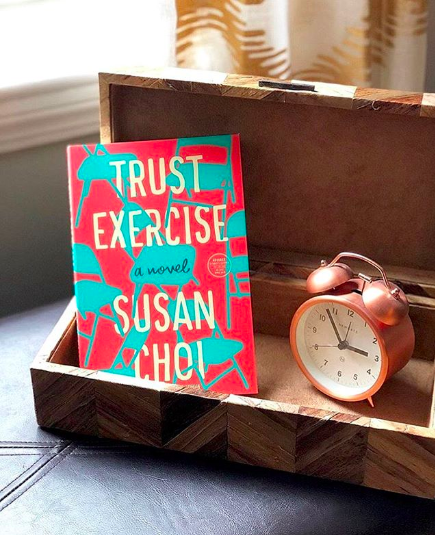
ICYMI: We're starting to read Trust Exercise by Susan Choi. (Catch an excerpt of the novel here!) This month, Maris Kreizman will be our guest host. She's written an introduction of the novel where she explains why you'll be hooked on this novel from the start: Dear BuzzFeed Book Club,
It's difficult to figure out how to introduce Trust Exercise to readers who haven't yet read it. There are so many different ways to spoil the novel, and spoilers would take some fun out of reading it. But knowing that there are spoilers is a spoiler in itself, isn't it? Before I say way too much and get way too meta, why don't I just begin with a question: If we write anything at all — even if what we write is fiction — aren't we always writing about ourselves in some way or another?
The concepts of fact and fiction get twisted in Susan Choi's remarkable fifth novel. Set in the 1980s in a suburban performing arts high school, pre-Internet but not pre-Cats, Trust Exercise captures the magic of finding your people, the ones who are into the same weird shit that you are. As a teenager I was a suburban theater kid who was looking for more drama in my life, both in acting classes and beyond, so I feel like I know these characters. They're precocious theater snobs who revere Shakespeare but secretly adore Andrew Lloyd Weber, kids who feel like they've invented every human emotion but are much less sophisticated than they think they are. As characters they also seem just a little bit off, not quite as real as they might be. There are holes in the narrative, and through those holes their story shifts and transforms.
I'm usually a one-and-done kind of reader — there are too many books in my to-read pile to linger — but Trust Exercise is one of those rare books that I wanted to read again immediately after finishing. It gets better with each read, the more scrutiny you put in, and the more you pay attention. There will be so much to talk about as we dig in, and I'm excited to discuss this book with you!
Happy reading! Maris Behind the Book: Susan Choi Susan Choi shares with the BuzzFeed Book Club the origins of Trust Exercise, what inspired her to keep writing, and how current events played a role in her writing process: "I started writing Trust Exercise so long ago I can't place the time except to say it was definitely more than five and probably less than ten years ago. I was sitting in the stacks of the Pratt Library in Brooklyn trying to make the daily word count and the first line — "Neither can drive" — and then over the course of a few days, the first scene came to me. In the scene, a drama teacher at an American high school turns off all the lights in a windowless classroom, and instructs the students to explore the classroom, and each other, through touch. The students follow his instructions, groping each other, inevitably sexually, in some cases with mutual willingness, and in some cases without. When I finished the scene I set it aside, in a document called Trust Exercise. It seemed like a scene from a coming-of-age story, and that wasn't a story I wanted to write. But in the years that followed I would abruptly pick up the material again, always after a long interval, and always when I felt irresistibly compelled to work on it instead of my 'real' project, a book about my father's side of my family, which involved a lot of research and was going badly (and still is). I would add to the Trust Exercise material in a burst and then hit the wall as abruptly as I'd started, and I'd set it aside again. This was the opposite of the way I've worked on all my other books and it was weird, so I didn't take the material seriously. I felt uncertain writing about high school students because I thought the adult readers who usually read my books would find the subject matter trivial. I didn't realize for a long time that this bias was really mine, that I found it hard to take seriously this period of time that's a part of almost everyone's history and usually one of the least favorite. But despite this unconscious bias of mine I couldn't seem to leave the Trust Exercise material alone.
Because I couldn't take the material seriously enough to dedicate myself to it, and yet kept on being irresistibly compelled to pick it up again, I have a unusually clear recollection of exactly the times I found myself playing hooky on my 'real' project with this one: the fall of 2015, when my return for the first time as a instructor to my alma mater, Yale, coincided with historic upheavals on campus; the fall of 2016, when Donald Trump had just secured the Republican nomination for the presidency; and the fall of 2017, when Harvey Weinstein and #MeToo happened. Because my work on this book was so sporadic I didn't even recognize it as a book for years, it took me until much later to understand that the painful conflicts at Yale reminded me in the most visceral way of the expectations students have of their teachers, and the cost when those expectations are disappointed. Trump's nomination victory and everything else about him made the act of storytelling in which I participate as a paid professional appear potentially specious, an exercise of power. Harvey Weinstein's disgrace recalled me to the fictional milieu where I'd started, a theatre program full of young people desperate to be granted admission into the exalted world of celebrity. But it wasn't until the book was entirely finished that I realized that the theme of the book, as I see it, was already present in that opening scene that takes place in the dark. I think Trust Exercise is a book about the ways in which the powerful tamper with the powerless - by manipulating the boundaries of behavior and self by which we understand who we are, and what our place is, and how to interact with others; by normalizing circumstances which ought to be challenged; by co-opting the exact values we most cherish, like freedom and self-determination, so that the meaning of those values is deformed; and even by failing to see themselves as powerful at all, as playing any role in a structure that does harm." BuzzFeed, Inc.
111 E. 18th St.
New York, NY 10003 Unsubscribe |








Post a Comment