| China prepares its response to fresh U.S. tariffs. Economists are confident of another U.S. rate cut next month. Alibaba defies a slowing Chinese economy. Here are some of the things people in markets are talking about today. Beijing Retaliates China blasted looming U.S. tariffs of 10% on a further $300 billion of Chinese imports as a violation of accords reached by Presidents Donald Trump and Xi Jinping. In a short statement the State Council Tariff Committee said China "has no choice but to take necessary measures to retaliate." Meanwhile Trump said a phone call with Xi was on the cards to discuss the trade war. That could give him an opportunity to expand upon his advice on how China might resolve the protests that have rocked Hong Kong for two months. "If President Xi would meet directly and personally with the protesters, there would be a happy and enlightened ending to the Hong Kong problem," he tweeted. China, however, isn't too keen on "foreign forces" interfering in the issue. Another Cut The U.S. data pouring in supports Federal Reserve Chairman Jerome Powell's forecast of solid economic growth and higher inflation. Still, economists remain confident that Powell will cut interest rates again next month as insurance against a global slowdown. Powell may give a hint of his thinking when he speaks on Aug. 23 at the annual central bankers retreat in Jackson Hole, Wyoming. On Wednesday talk of recession reared its ugly head when a key portion of the Treasury yield curve inverted — meaning short-term rates were higher than long-term rates — which has previously provided an early warning. Fed officials, however, have consistently said they don't see any imminent risk of recession. Rocky Session Stocks in Asia looked set to drop after another tumultuous session on Wall Street and further declines in Treasury yields, on heightened trade uncertainty and fears of a slowing global economy. Futures pointed lower in Japan, Hong Kong and Australia. Contracts on the S&P 500 Index edged higher after the U.S. gauge swung more than 1% for a 12th straight day in above-average volume before finally ending the day up. Ten-year Treasury yields slid below 1.5% to a three-year low and New Zealand's 10-year yield dropped below 1% for the first time. Shopping Surge Alibaba's first-quarter results rode a surge in internet shopping, which defied a slowing Chinese economy. Its horde of mobile monthly active users jumped to 755 million, topping the 721.5-million consensus, and net income was bolstered by its Ant Financial stake. The company's riding a surge in internet shopping, as online sales in China have been accelerating thanks to sales promotions that unfolded across the country's largest e-commerce platforms. Things are gong less well for Baidu. Stimulus Package Thailand is set to announce a fiscal stimulus package to shore up growth as the U.S.-China trade war and currency strength sap its export-reliant economy. There's potential for 60 billion baht ($1.9 billion) to 80 billion baht of stimulus steps, with every 30 billion baht able to lift economic growth by 0.1 percentage point, Siam Commercial Bank estimates. The government is expected to provide details of the package after a ministerial meeting Friday. What we've been reading This is what's caught our eye over the last 24 hours. And finally, here's what Tracy's interested in this morning With bond yields touching new lows and global monetary policy set to loosen further, it's worth asking what it all means for banks. Though stock markets are generally trading close to record valuations, bank equities are trading near historic lows, which clearly reflects some pretty bearish assumptions about their future. Bronte Capital's John Hempton will be the guest on the next episode of the Odd Lots podcast, and he walks us through what's ailing banks. Ultimately, Hempton says, a huge portion of bank earnings rests on assumptions about the future. As he puts it: "Banks are quintessentially estimate machines." That characterization becomes more important as you think about the banking business in an era of low rates. If a bank can't make money from lending, then one of the few sources of profit available is through tinkering with those assumptions in a way that releases cash, or booking capital gains on financial assets. 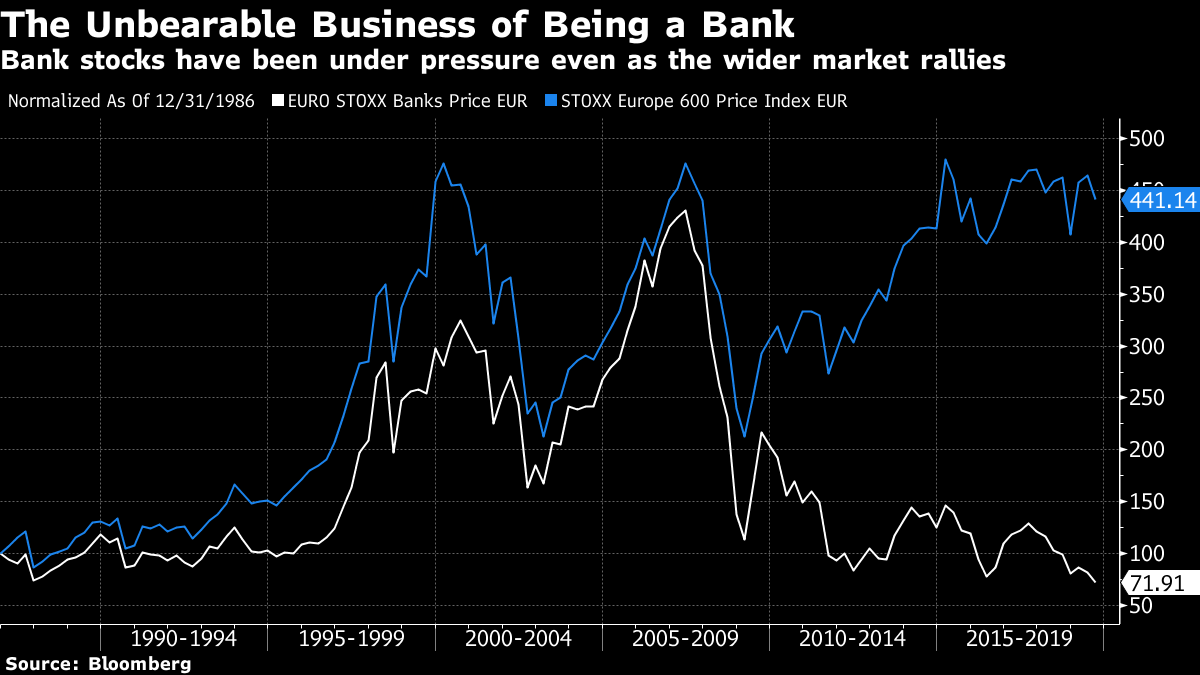 The only problem is there are limits to how long you can do it. On which note, it's worth reading this article on bank profitability published this week by the European Central Bank. "The most significant [bank] profitability driver in 2018 was lower net impairment flows from financial assets," the ECB says. "Historical data suggest that impairments are now at a level where there is little room for further improvement." You can follow Bloomberg's Tracy Alloway at @tracyalloway. The best in-depth reporting from Asia Pacific and beyond, delivered to your inbox every Friday. Sign up here for The Reading List, a new weekly email coming soon. Before it's here, it's on the Bloomberg Terminal. Find out more about how the Terminal delivers information and analysis that financial professionals can't find anywhere else. Learn more. | 


Post a Comment