What's next for Hong Kong's protests. U.S. officials send mixed messages on trade talks. And Italy's prime minister says arrivederci. Here are some of the things people in markets are talking about today. Crucial Time for Hong KongThe next six weeks are particularly sensitive for Hong Kong's pro-democracy protests. Oct. 1 is the 70th anniversary of the People's Republic of China, and will feature a military parade through Beijing personally inspected by President Xi Jinping. That has raised some fears that Xi will seek to get Hong Kong under control by then to avoid any headline-stealing violence. Much may depend on what happens in the first week of September, when students who have been driving the demonstrations are set to return to universities and high schools. In the meantime, here's how China is trying to quell the protests without sending in troops. Let's Not Make a DealU.S.-China trade talks are likely to continue despite friction over Huawei. U.S. Secretary of State Mike Pompeo said other firms present national-security risks but didn't name them during an interview with CBS. He also called on Beijing to respect Hong Kong demonstrators' rights and the city's autonomy in order to fulfill its promises—which is important for a trade deal. President Trump showed no urgency to resolve trade friction with China, saying "I'm not ready to make a deal with China." He also called for Russia to be readmitted to the G-7, threatened to tax European automobiles and agreed to drastically scale back plans to slash billions of dollars in foreign assistance. Facebook Under FireLibra is in the EU's crosshairs. Antritrust regulators are already probing Facebook's two-month-old digital currency project, according to a document seen by Bloomberg, "investigating potential anti-competitive behavior." Officials are concerned about how Libra may create "possible competition restrictions" on the information that will be exchanged and the use of consumer data. It adds to another EU investigation into whether the social network uses its size to squeeze smaller rivals. Facebook also came under fire from the English-language China Daily newspaper for closing accounts that it said originated in China and were attempting to manipulate news about the protests in Hong Kong. We Confuse"A masterpiece of obfuscation." That's how an analyst described the prospectus for WeWork's share sale. The We Co., which is expected to raise about $3.5 billion, must have made a big effort to conceal the unit economics behind its offering, Triton Research CEO Rett Wallace said. "If the underlying facts were positive, why would a company go to so much trouble to prevent you from understanding them?" Conte ConcedesItalian Prime Minister Giuseppe Conte said he'll resign, and pointed the finger for Italy's current political crisis at "irresponsible" Deputy Premier Matteo Salvini. President Sergio Mattarella is expected to accept the resignation and will begin consultations on a possible alternative government Wednesday. Italian bonds rallied, leading euro-area gains, while its benchmark stock index fell. Chinese ChecksChina is cracking down on banks and brokers that it suspects of inflating bond trading volumes in an effort to win more business, people familiar said. A PBOC subsidiary has been monitoring large transactions on the X-Bond system for signs of abnormal trading, after turnover on a China Development Bank note spiked to a record July 16 and then plummeted. What we've been readingThis is what's caught our eye over the last 24 hours. And finally, here's what Tracy's interested in this morningThere are some stunning stats on the bond market right now. Hans Mikkelsen, strategist at Bank of America Merrill Lynch, notes that the average yield on non-U.S. government debt is now negative for the first time ever at -3 basis points. That means yield is now a "Made-in-America phenomenon," with 95% of the world's available positive-yielding investment-grade debt coming from U.S. assets, according to BofAML's estimates. Unsurprisingly, this has led to a huge influx of money into U.S. corporate bonds as foreign investors flee negative rates in Europe and Japan (what Mikkelsen calls a "wall of new money.") 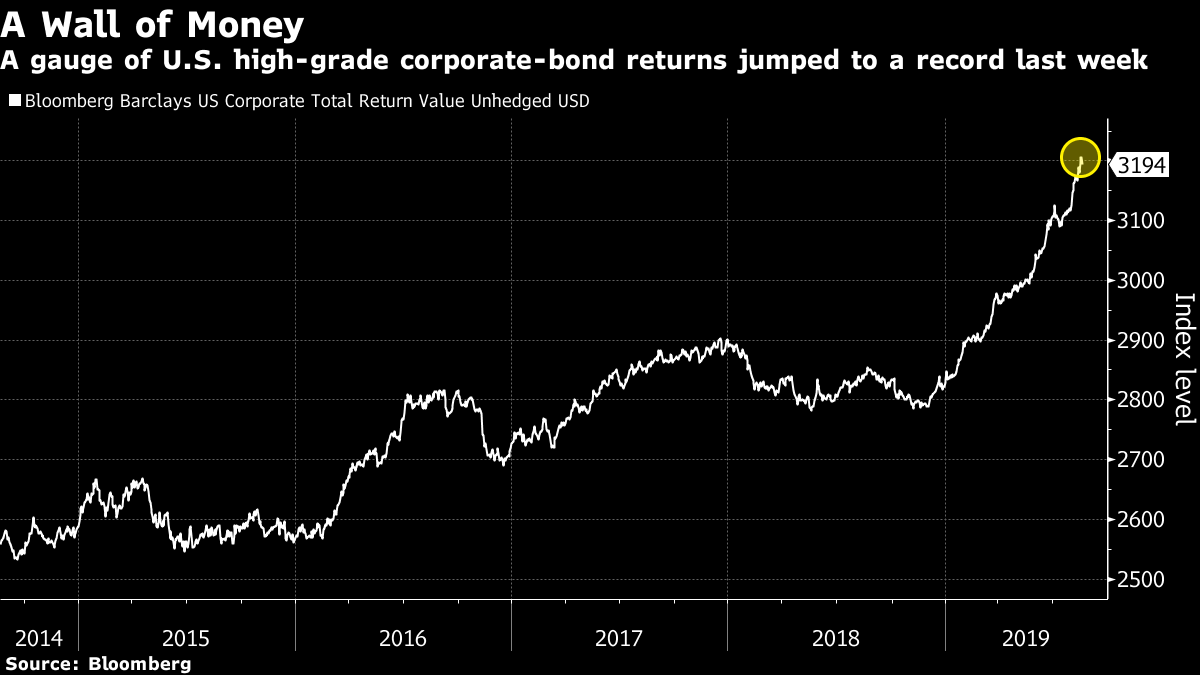 So much money flowing into U.S. assets raises the question of how much information we can glean from the bonds—particularly in U.S. Treasuries, where recent curve inversions have been interpreted by many as a looming recession signal. It's a thought that's crossed JPMorgan's collective mind too. As analysts led by Nikolaos Panigirtzoglou put it recently, the inversion in the U.S. Treasury curve "is less of a reflection of U.S. recession risks and more of a reflection of the desperation for yield by foreign investors." Even if you don't agree curve inversion is—to quote the old market maxim—"different this time," thinking about the wall of overseas money flowing into U.S. debt is a good reminder that yields don't exist in a vacuum but can be impacted (and distorted) by what's going on in other parts of the world. You can follow Bloomberg's Tracy Alloway at @tracyalloway. The best in-depth reporting from Asia Pacific and beyond, delivered to your inbox every Friday. Sign up here for The Reading List, a new weekly email coming soon. Before it's here, it's on the Bloomberg Terminal. Find out more about how the Terminal delivers information and analysis that financial professionals can't find anywhere else. Learn more. | 


Post a Comment