China used fake social media accounts to target Hong Kong protesters, Twitter and Facebook say. Huawei gets a breather. And billionaire Li Ka-shing bets big on Brits and beer. Here are some of the things people in markets are talking about today. China Infiltrates TwitterChina is waging a social media campaign to undermine the Hong Kong protests. Twitter found and deleted hundreds of accounts it said Beijing used to undermine the pro-democracy movement and calls for political change. Facebook, acting on a tip from Twitter, found and eliminated similar content. "Based on our intensive investigations, we have reliable evidence to support that this is a coordinated state-backed operation," Twitter said. Sanctions Eased Huawei got a reprieve. The U.S. will extend for another 90 days a narrow set of exemptions meant to protect U.S. customers from a ban on doing business with the Chinese company. "We're giving them a little more time to wean themselves off," Commerce Secretary Wilbur Ross told Fox News. The move doesn't address wider national-security concerns about Huawei or answer the question of whether U.S. chip companies and other major suppliers will be allowed to sell parts to China. Asian Futures UpAsian stocks are set for modest gains after U.S. equities rallied on Huawei-fueled optimism and speculation central banks are poised to shore up their economies. Treasuries declined despite President Trump's call for more Fed easing. The dollar rose to this year's high, gaining against every G-10 peer save the Norwegian krone. Oil jumped, while gold dropped more than 1%. China's New Lending RateThe PBOC's first fixing of its new lending measure Tuesday should make debt a bit cheaper for Chinese firms. The central bank may set the Loan Prime Rate, or LPR, at 4.24%, according to a Bloomberg survey. That compares with 4.31% for the prior measure and the one-year benchmark of 4.35%. Beijing is aiming to tie borrowing costs to financial markets, making them less sticky. Pub DealRaise a glass to Li Ka-shing. CK Asset Holdings, backed by the Hong Kong billionaire, bought U.K. pub chain Greene King for 2.7 billion pounds ($3.3 billion), betting Brits will continue to like lager as Brexit bites. Greene King, which operates almost 3,000 pubs and restaurants, had lost almost a third of its value over the last four years. It's the second big U.K. pub deal in as many months as the falling pound makes assets cheaper for overseas buyers. What we've been readingThis is what's caught our eye over the last 24 hours. And finally, here's what Tracy's interested in this morningThere's a strange new cultural dogma in global markets: A belief that interest rates can (and should) be as low as possible and that money should be freely given in the hopes of future growth. I'm going to call it "Free Money Syndrome." FMS is the direct result of mass distrust of the existing financial system post-2008 and the normalization of years of low interest rates. It's best expressed in financial markets as the inflow of capital into loss-making firms. (Tech unicorns, from Uber to WeWork, are prime examples.) There are even shades of FMS in Modern Monetary Theory, which argues that government budgets are bound only by inflation. Now that at least one bank is offering a mortgage at a negative interest rate, FMS is going mainstream as people clamor to "get paid to borrow." 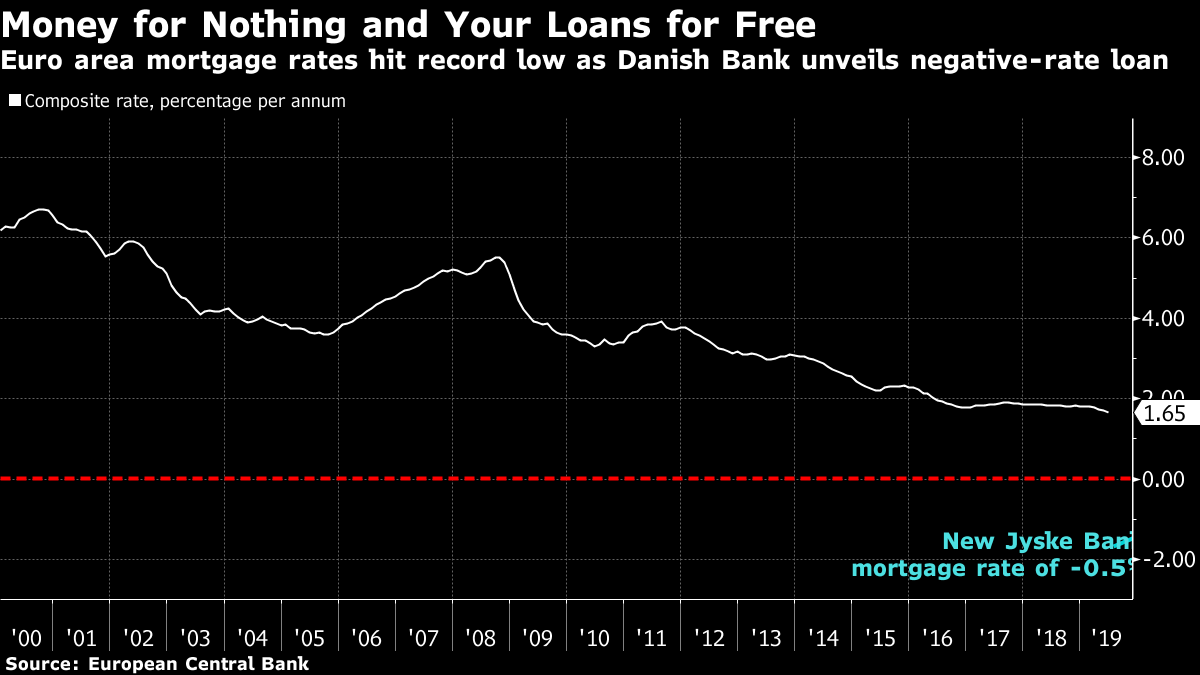 There's something intuitively gratifying about the notion that individual borrowers can personally benefit from negative rates. But can "free money" ever be truly free? For starters, there's the damage done to the banking system and a big question over whether banks will try to recoup lost interest income through fees. There's also misallocation of capital as money flows into loss-making and often disruptive enterprises, such as the unicorns mentioned above. Finally, there's the slow grind lower of financial returns. None of these arguments is particularly sympathetic, I know, but it seems fairly obvious that completely "free money" is too good to be true. Even if the financial system has gifted you a negative-rate loan, it's taken away your ability to earn interest on your existing money over time. You can follow Bloomberg's Tracy Alloway at @tracyalloway. The best in-depth reporting from Asia Pacific and beyond, delivered to your inbox every Friday. Sign up here for The Reading List, a new weekly email coming soon. Before it's here, it's on the Bloomberg Terminal. Find out more about how the Terminal delivers information and analysis that financial professionals can't find anywhere else. Learn more. | 


Post a Comment