| Greetings, I'm Andy Browne, editorial director of the Bloomberg New Economy. From Cairo to Caracas, we've grown used to images of popular uprisings against misrule and economic hardship in some of the most deprived parts of the world. Hong Kong presents a startling picture of an ultra-rich society in open rebellion for much the same reasons. The titans of Wall Street who've become so anxious about the social consequences of extreme wealth gaps in their own country should be watching how the revolution unfolds in this glittering financial metropolis. It's not likely to end well. If they aren't actually pulling out their money, the Hong Kong elites are planning for the worst. 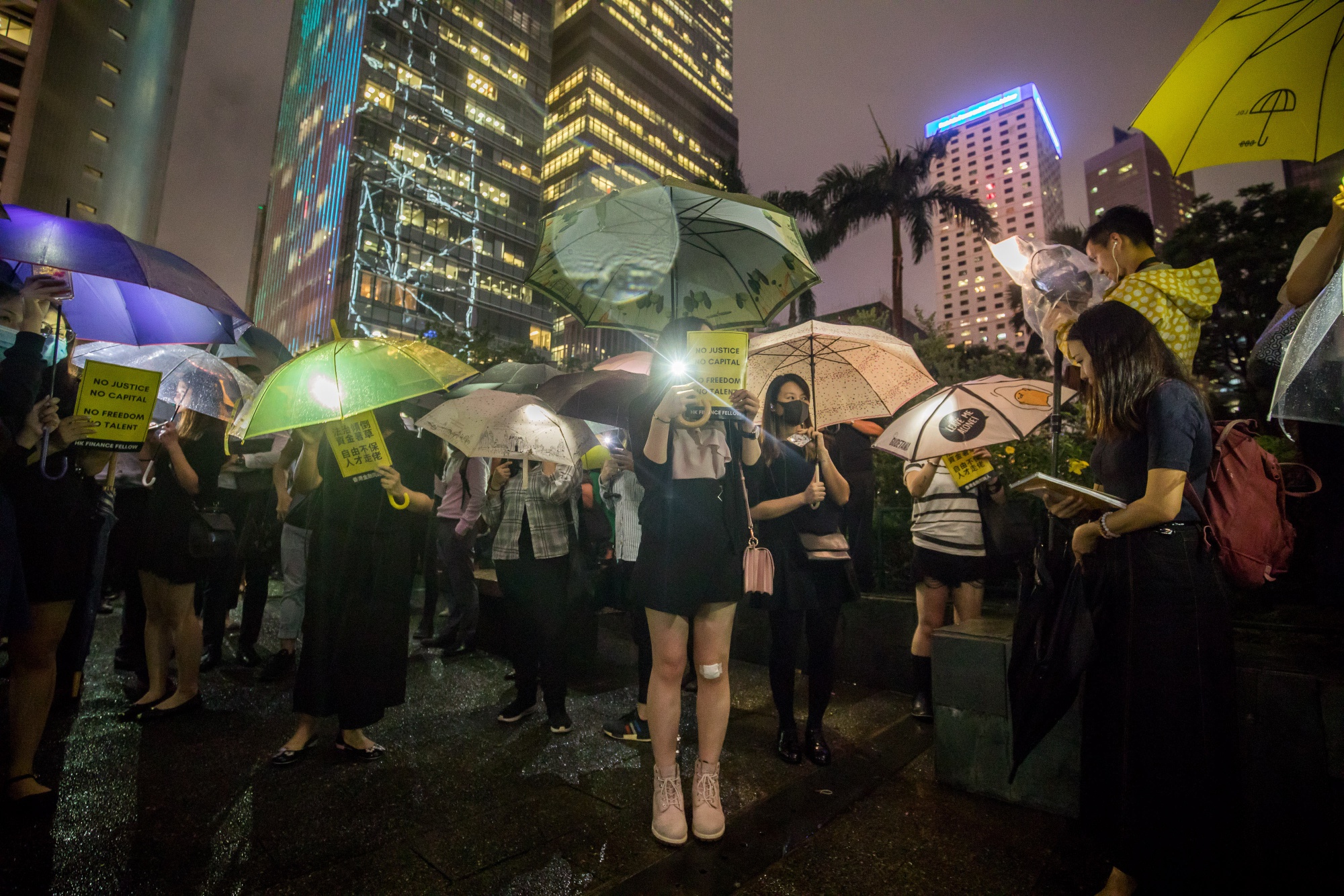 The biggest question is whether China, which took control of the territory from Britain in 1997 under a "one country, two systems" formula, will send in the People's Liberation Army. That prospect, it must be said, is almost unthinkable barring a total breakdown of law and order. If it did happen, though, the two systems would merge — and Hong Kong, as we know it, would disappear. The likes of Ray Dalio, the billionaire founder of Bridgewater Associates LP, a hedge-fund, have been warning for some time that capitalism faces a day of reckoning. Certainly, there's an element of class warfare in the protests that have engulfed Hong Kong. One in five residents live in poverty. Rents are higher than in New York or London, though the minimum wage is less than $5 an hour, meaning that Hong Kongers are slaves to work. Many of those starting out in life have no hope of ever owning their own apartments; the destitute elderly often end their days in closet-sized "cage homes" and "coffin cubicles." The trigger for the Hong Kong protests, however, was political. While large pockets of society are shut out economically, the entire city of 7.4 million has been disenfranchised, Beijing having reneged on its promise to introduce elections. Instead, China established a method for selecting the territory's top leader by a committee packed with pro-Beijing members, thus ensuring that the job goes to a person who represents China in Hong Kong rather than the other way around. Hence, Carrie Lam, the current leader, may have hoped to please her mainland masters by proposing legislation that would have allowed Beijing to extradite Hong Kong residents — and even visitors — for trial in its highly politicized courts. At any rate, the plan backfired spectacularly. After two million residents poured into the streets to show their anger, Lam declared the legislation "dead," although she hasn't withdrawn the bill. So the protests continue, with escalating violence. Meanwhile, many in Hong Kong believe that Lam wants to step down but Beijing won't let her, on the grounds that she needs to clean up the mess she created. That won't be easy. Just as Dalio and his anxious peers (count Stephen Schwarzman, the Blackstone Group Inc. chief executive among them) are biting their nails, so too are Hong Kong's moguls. In private conversations, several of the most prominent say they wish Lam would go, which isn't surprising since the extradition bill threatened them in a personal way. Their Chinese counterparts, after all, live in constant fear of detention and expropriation. It's more unexpected to hear property tycoons — the ones who've grown fabulously wealthy on Hong Kong's rigged land market — speak of the urgent need to build public housing. Among other ideas floated by these corporate bigshots, or "taipans": Empty the government coffers into tech startup funds to give graduates new opportunities and hope for the future. Unfortunately, these suggestions, serious or not, are percolating in a leaderless society. Hong Kong suffers from the same government dysfunction that afflicts many Western democracies, only in more acute form. Beijing has rendered the territory all but ungovernable, so much so that the only way its citizens can make their voices heard is by flooding the streets — and even then the government only half-listens. However much China may blame the protests on American "black hands," this revolution is homegrown and broad-based. Among 44 people charged with "rioting" this week were 14 students, a teacher, a nurse, a chef and an airline pilot. Five were unemployed. And they are girded for a long and violent struggle. Prosecutors say those charged were variously equipped with goggles, gloves and kneepads as well as cutters, folding knives and metal tongs.  The economist Tyler Cowen, my Bloomberg Opinion colleague, argues that Hong Kong has always been a kind of "bellwether for the state of freedom in the wider world." Years ago, Milton Friedman held it up as a shining example of free-market capitalism, and his modern disciples still see it that way, which is why Hong Kong regularly tops the Index of Economic Freedom published by the conservative Heritage Foundation and the Wall Street Journal. But Cowen believes that Hong Kong's current predicament forces us to rethink what true freedom means. It's not "merely the ability to buy and sell goods at minimum regulation and a low tax rate," it is "also about the narratives people live by and the kind of future they imagine for themselves." In simple terms, economic and political freedom go hand-in-hand. Hong Kong may end up losing both. The kings of Wall Street, if they're paying attention, ought to be very afraid. Do you have a good solution to a big problem? Click here and tell us about it. Like Turning Points? Subscribe to Bloomberg All Access. You'll get our unmatched global news coverage and two premium daily newsletters, The Bloomberg Open and The Bloomberg Close, and much, much more. See our limited-time introductory offer. Download the Bloomberg app: It's available for iOS and Android. | 


Post a Comment