Welcome to your morning markets update, delivered every weekday before the European open. Good morning. Donald Trump really, really wants the Fed to cut rates, Boris Johnson is planning a Brexit blitz and governments are testing the temperature of the bond market. Here's what's moving markets. 100 Basis PointsIn what has become a favored topic for President Donald Trump on Twitter, he called for the Federal Reserve to cut rates by at least a full percentage point in order to weaken a dollar whose strength, he said, was "sadly hurting other parts of the world." He also accused Democrats of holding out hope for a recession before the next election. The Fed's minutes from its last meeting are coming on Wednesday but the attention will be on Chairman Jerome Powell when he speaks at the Jackson Hole symposium on Friday, where he's expected to signal the potential for another, likely Trump-pleasing cut, though some of his colleagues are not convinced. Boris BlitzThe battle lines are being drawn again in British politics. U.K. Prime Minister Boris Johnson reiterated the country will be ready to leave the European Union without a deal by the current deadline at the end of October and is planning a September publicity blitz to prepare the public for a so-called hard Brexit. Labour leader Jeremy Corbyn, having failed to get support from other parties for a caretaker government, appears to be gearing up for an election by giving backing to a second referendum and vowing to do everything necessary to avoid a no-deal exit. Bond TestsThese are precarious times for the global bond market and the biggest issuers are starting to do more to test the waters on what investors want. Germany is set for a flurry of debt sales in the next couple of weeks offering negative rates and this week will sell a 30-year bond with a 0% coupon for the first time. The U.S. Treasury also appears to be taking the chance to issue ultra-long bonds, an idea shelved in the past but which could now have its moment as investors continue to search further out in global yield curves for returns as the spreading pile of negative-yielding securities grows. Great British PubsHong Kong leader Carrie Lam has pledged to establish a platform for dialogue with protesters in the country, potentially opening an avenue towards calming the turmoil in the city. But it was elsewhere that Hong Kong's influence was felt on Monday. Victor Li, the head of Hong Kong's largest conglomerate, made a $3.3 billion bet on the post-Brexit future of the pub with a deal to buy Greene King Plc. The immediate debate raised after the surprise bid is whether more pubs are likely to close down but another question to ask is to what extent this was driven by the cheap pound and whether more bids to pick up U.K. property estates could emerge. Coming Up...Asian stock indexes were mostly in the green on Tuesday amid signs of progress being made on trade negotiations and speculation about government stimulus to shore up economies globally. European and U.S. futures look mixed. On a relatively quiet day for earnings and economic data, all eyes will turn to Rome and the likely breakdown of the current coalition government. The question will be whether another government can be formed by alternative parties, likely leaving out Matteo Salvini's League, or if new elections will be required. What We've Been ReadingThis is what's caught our eye over the past 24 hours. And finally, here's what Cormac Mullen's interested in this morningIt seems the power of a Trump tweet has limitations. Despite a series of posts from the president this month lamenting the strength of the dollar, including a fresh one Monday, the greenback has risen to its highest this year. In fact by one measure, the Federal Reserve's Trade Weighted Broad Dollar Index for goods, the U.S. currency is at a record high. And however much Donald Trump rails against this strength, the truth of the matter is he likely caused it by instigating a trade war with China. A look at real yields is a good illustration of this, courtesy of my colleagues Masaki Kondo and Hiroko Komiya. Their calculations show the dollar has advanced against seven of 10 major peers this year even as the premium on inflation-adjusted Treasury yields over that of other major debt markets has narrowed since November. The divergence suggests it is fears over the impact of the trade war and a consequent demand for havens which is keeping the greenback strong -- not rate differentials. While a resolution in the trade dispute with China would seem like an obvious solution for Trump to reverse this, the risk for global investors is he turns to currency intervention to do what his tweets have not. 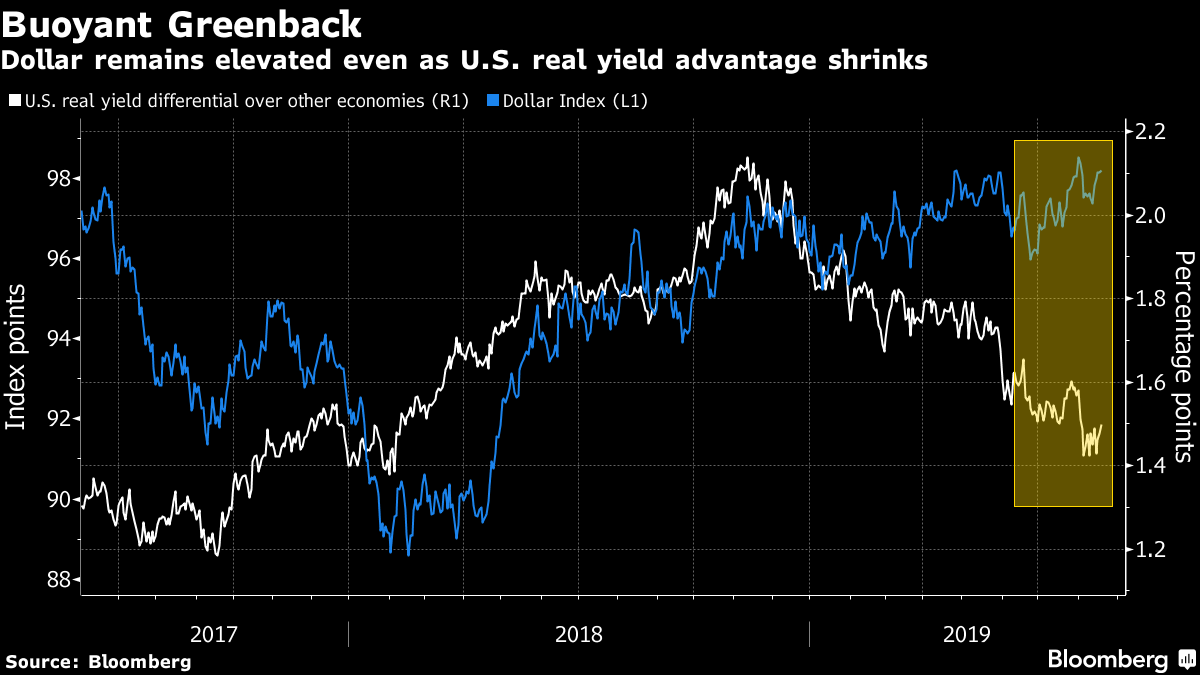 Cormac Mullen is a Cross-Asset reporter and editor for Bloomberg News in Tokyo. Like Bloomberg's Five Things? Subscribe for unlimited access to trusted, data-based journalism in 120 countries around the world and gain expert analysis from exclusive daily newsletters, The Bloomberg Open and The Bloomberg Close. Before it's here, it's on the Bloomberg Terminal. Find out more about how the Terminal delivers information and analysis that financial professionals can't find anywhere else. Learn more. | 


Post a Comment