| Welcome to your morning markets update, delivered every weekday before the European open. Good morning. The trade war has come back to the fore, central bank stimulus is on the tips of tongues and debate continues about the state of the semiconductor market. Here's what's moving markets. Countermeasures While investors busied themselves discussing inverted yields and possible recession, the trade war not-so-quietly came roaring back into focus. China said it was readying countermeasures to the new set of tariffs slapped on their goods by the U.S. and said it wants the U.S. to meet it in the middle in the negotiations, a suggestion President Donald Trump was not jiving with. Those risks are right back on the radar again and in these quiet, low-liquidity markets, the effect on stocks, bonds, currencies and the oil prices could be significant. Recession or Not? Not, of course, that inverted curves don't remain on traders' minds around the world as they flee to safety. The key debate is whether the curve inverting does indeed signal recession or if the bond market has been so distorted by central bank policy that inversion doesn't necessarily mean doom on the horizon. Then there are questions about how one makes money from the $16 trillion of negative-yielding bonds out there and figuring out how troubling the signals are for the corporate bond market. This while watching equity hedge funds ride that bond bull market and pondering the question of whether to buy the dip in stocks. Stimulus The U.S. data which has poured in during the past week supports the view of Federal Reserve Chairman Jerome Powell that the U.S. economy is growing solidly and that inflation will rise, yet economists remain confident that the Fed will cut rates again this year in order to insure against a global slowdown. For the European Central Bank, policy maker Olli Rehn's comments that the ECB should come up with an "impactful and significant" stimulus package caused bond yields to drop on Thursday but markets in Italy, home of the banks that are most sensitive to bond movements, was closed. So look for a delayed reaction on Friday in the Italian banking sector. Chips Semiconductor manufacturer Nvidia Corp. topped sales and profit estimates after U.S. markets closed on Thursday, potentially reading across into a good day for the European chips sector. The numbers suggested that the slump in orders chipmakers have seen may be starting to ease, with a revival seen in demand for graphics chips and data center parts. Possibly taking the sheen off that, however, U.S. chip equipment maker Applied Materials Inc. met analyst estimates but dipped later in the day after it said it was not yet ready to call a bottom in demand for memory chips. Coming Up... Some modest gains in Asian stocks going into the weekend, with shares climbing in China and Hong Kong, Treasury yields steady but Japanese 10-year bond yields slipping to three-year lows. New Zealand 10-year yields also slipped below 1% for the first time. European and U.S. futures are both pointing to a positive start. OPEC's monthly oil report will arrive, following a particularly turbulent time for crude prices, and we'll get trade data for the euro area. What We've Been Reading This is what's caught our eye over the past 24 hours. And finally, here's what Cormac Mullen's interested in this morning The latest Bank of America Merrill Lynch fund manager survey is out and it shows gloomy European investors are battening down the hatches. Growth and profit expectations are at 7-year lows and a record number of participants said they have taken protection for a sharp decline in equities. A net 59% of investors expect the European economy to weaken over the next 12 months -- the highest since December 2011. Still there were a few positives in the detail, if you look past the bearish outlook. While Merrill suggest that it would take nothing but an improvement on the trade front to change European investors defensive mindset, a net 3% of investors say European equities are now undervalued, versus a net 24% who said they were overvalued last month. And the region's fund managers did seem to put some money to work over the last month -- cash levels fell and are now below the global average. The defensive bias is definitely proving a hard nut to crack though -- it seems the cash was used to buy high-quality stocks, which have continued to outperform the broader market. 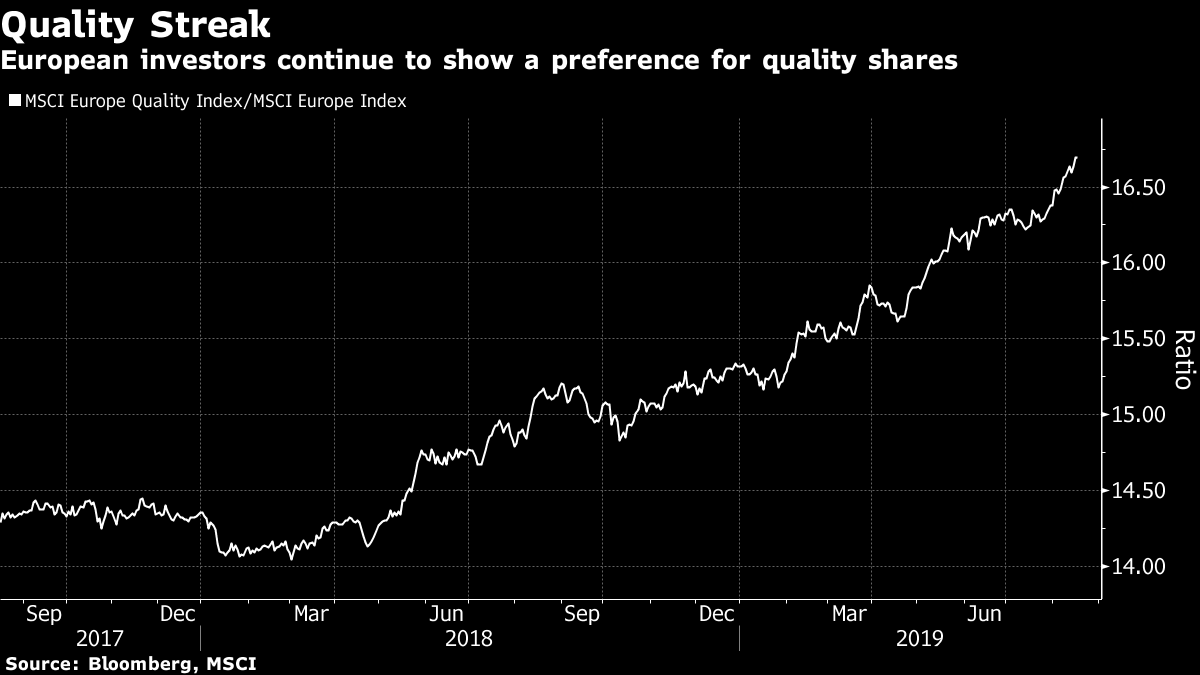 Cormac Mullen is a Cross-Asset reporter and editor for Bloomberg News in Tokyo. Like Bloomberg's Five Things? Subscribe for unlimited access to trusted, data-based journalism in 120 countries around the world and gain expert analysis from exclusive daily newsletters, The Bloomberg Open and The Bloomberg Close. Before it's here, it's on the Bloomberg Terminal. Find out more about how the Terminal delivers information and analysis that financial professionals can't find anywhere else. Learn more. | 


Post a Comment