Volcker rule changes, Boris Johnson's bid to renegotiate Brexit, and today's corporate news is brought to you by the letter A. Easing the rulesWall Street regulators will roll out "Volcker 2.0," an update to the post-crisis rules that restricted banks' ability to bet on markets with their own cash. While the change won't lift the ban on the practice, known as prop-trading, it is expected to simplify the rules limiting banks' investments in private equity and hedge funds, as well as narrowing the types of investments the law is supposed to target. Elsewhere in market-infrastructure developments, the launch of the so-called Loan Prime Rate by the PBOC, with the first reading set at 4.25%, is being seen as a push by policy makers to nudge borrowing costs lower. GambitBritish Prime Minister Boris Johnson made his first public attempt to renegotiate his predecessor's agreement on the U.K.'s withdrawal from the European Union by focusing on the intractable problem of the Irish border. There seems to be little hope for a breakthrough in negotiations as the government plans a publicity blitz aimed at preparing the public for a no-deal exit. Johnson is to meet the leaders of Germany and France in their capitals this week before going to the Group of Seven summit. The pound unwound some recent gains to trade under $1.21 this morning. Apple, AramcoApple Inc. plans to roll out its Apple TV+ movie and TV subscription service by November, with the tech company set to join an increasingly crowded field targeting so-called cable cutters. The original budget to produce content for the service was $1 billion, but that has since expanded, according to reports. Elsewhere in major-companies-trying-new-things, Saudi Aramco has picked Lazard Ltd. and Moelis & Co. to advise on its second attempt at the world's largest IPO. The boutique investment banks have already started preparatory work on the offering, according to people with knowledge of the matter. Markets quietOvernight, the MSCI Asia Pacific Index climbed 0.6% while Japan's Topix index closed 0.8% higher as markets in the region reacted positively to the extension of Huawei-ban exemptions. In Europe, the Stoxx 600 Index rose 0.2% by 5:50 a.m. Eastern Time in fairly subdued trading. S&P 500 futures pointed to a small gain at the open, the 10-year Treasury yield was at 1.562% and gold was back over $1,500 an ounce. Italy, earningsAll European eyes will be on Italy today where it seems increasingly possible that an alliance between the Five Star Movement and the center-left Democratic Party could end Deputy Prime Minister Matteo Salvini's attempts to take over the government. Whatever the outcome, it is unlikely that Italian bonds will be the winners. It is another day of no economic data from the U.S., so attention will be on corporate results from Home Depot Inc. and Toll Brothers Inc. that may give further insight into the strength of the housing market. What we've been readingThis is what's caught our eye over the last 24 hours. And finally, here's what Luke's interested in this morningNot all changes in bond yields are created equal. Generally, a fall in sovereign rates from 2% to 1% will correspond to a bigger increase in the price than a drop from 3% to 2%. That bigger response to shifts in yields as rates fall is a property known as convexity — and twists related to this arcane phenomenon may help explain why global borrowing costs have been so haywire as of late. Back in 2015, a trio of researchers (including Hyun Song Shin, now head of research at the BIS) examined German insurance funds that attempt to match the interest-rate risk embedded in assets with that of their potential payouts for risk-management purposes. They found that in some circumstances where liabilities have a longer maturity profile than the fixed-income assets in their portfolio, bond purchases that push down prices "may generate a feedback loop whereby prices of longer-dated bonds are driven higher, serving to further lower long-term interest rates and eliciting yet additional purchases." In other words, sometimes the demand curve might slope upwards for a substantial chunk of the buying base. That's an exception to the typical rule freshman students are taught in Eco 101: that the quantity demanded of a good tends to decrease as the price increases. A similar so-called negative convexity property also appears in the market for U.S. mortgage debt. These types of odd fixed-income dynamics are useful background for those trying to understand how and why global interest rates tumbled so far, so fast, to plumb depths unimaginable just a few short years ago. 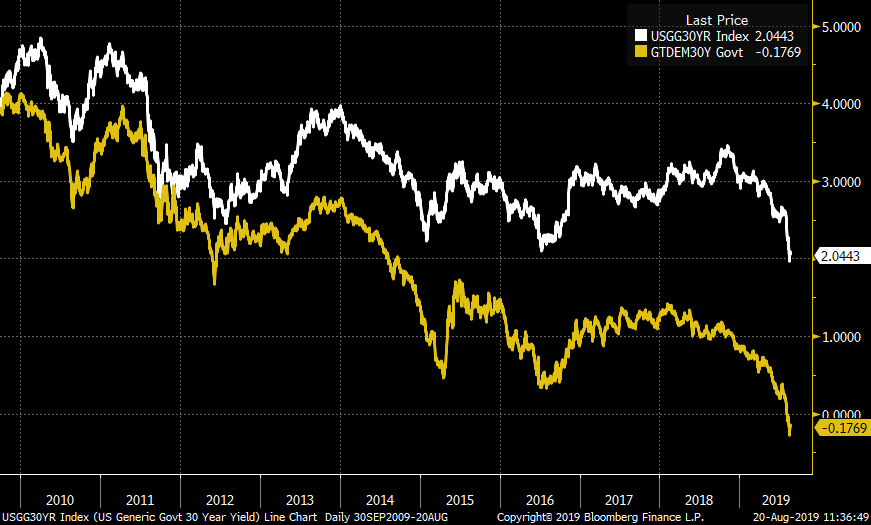 Like Bloomberg's Five Things? Subscribe for unlimited access to trusted, data-based journalism in 120 countries around the world and gain expert analysis from exclusive daily newsletters, The Bloomberg Open and The Bloomberg Close. Before it's here, it's on the Bloomberg Terminal. Find out more about how the Terminal delivers information and analysis that financial professionals can't find anywhere else. Learn more. | 


Post a Comment